
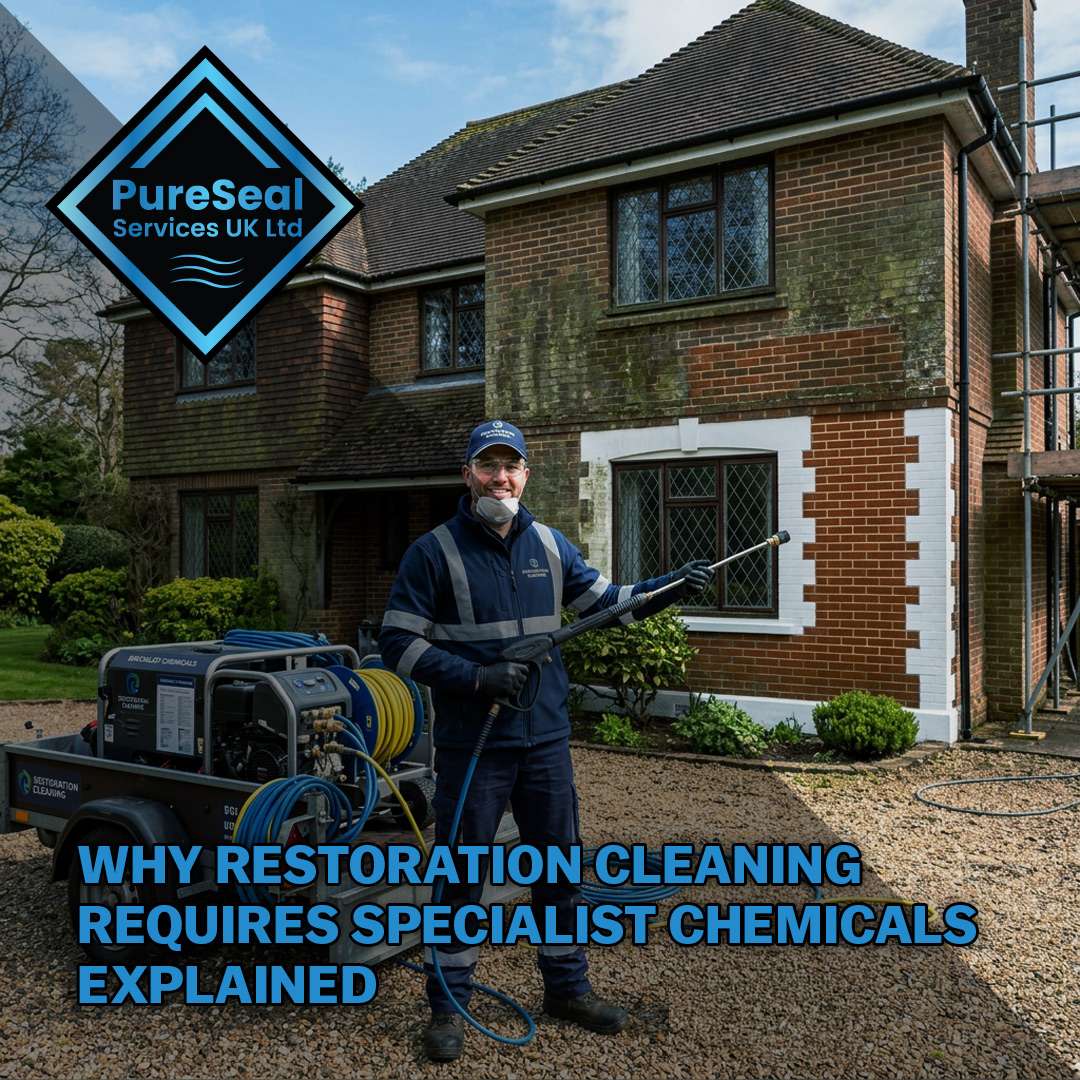
Why Restoration Cleaning Requires Specialist Chemicals Explained
Written by PureSeal Services on . Posted in Pressure Washing, Approved Applicators, Blog
Why Restoration Cleaning Requires Specialist Chemicals Explained
Restoration cleaning goes far beyond making an exterior surface look cleaner. Whether dealing with natural stone, brickwork, concrete, render or paving, the goal is to remove contamination while preserving the integrity of the surface beneath. This requires far more than household detergents or general-purpose cleaning products.
At PureSeal Services, every restoration cleaning project begins with identifying the material, assessing the contamination and selecting specialist chemicals designed specifically for the job. Using the wrong product can permanently damage expensive surfaces, while using the correct treatment allows years of dirt, algae, staining and biological growth to be removed safely and effectively.
What Is Restoration Cleaning?
Restoration cleaning is the process of returning an exterior surface as close as possible to its original condition without causing unnecessary damage.
Unlike routine maintenance cleaning, restoration cleaning often involves removing:
- Heavy algae growth
- Red algae
- Green algae
- Moss
- Lichen
- Black spot
- Oil stains
- Rust stains
- Atmospheric pollution
- Carbon staining
- Organic staining
- General weathering
Each type of contamination responds differently to cleaning products, making chemical selection one of the most important parts of the process.
| Restoration Cleaning | Standard Cleaning |
|---|---|
| Removes deep contamination | Removes surface dirt |
| Uses specialist chemicals | Often uses general detergents |
| Material-specific approach | One method for multiple surfaces |
| Longer treatment times | Faster cleaning |
| Focus on preservation | Focus on appearance |
Why One Chemical Doesn’t Clean Everything
Many people assume there is a single “best” exterior cleaning chemical. In reality, different stains require completely different treatments.
For example:
| Contamination | Typical Treatment |
|---|---|
| Algae | Professional biocide |
| Lichen | Specialist biological treatment |
| Oil | Degreaser |
| Rust | Stone-safe rust remover |
| Carbon staining | Restoration cleaner |
| Cement residue | Carefully selected acidic cleaner (where suitable) |
Using the wrong product may simply fail to clean the surface—or worse, permanently damage it.
Understanding Surface Chemistry
Every building material reacts differently with cleaning chemicals.
Professional contractors assess:
- Surface porosity
- Mineral composition
- Existing sealers
- Previous repairs
- Surface coatings
- Weathering
- Moisture content
Only once these factors have been assessed can the correct cleaning solution be chosen.
Why Household Cleaners Usually Fail
Domestic cleaning products are designed for kitchens and bathrooms, not exterior restoration.
Common problems include:
- Insufficient strength
- Poor penetration
- Incorrect pH
- Excessive foaming
- Residue left behind
- Damage to surrounding plants
Professional restoration products are formulated specifically for construction materials rather than domestic surfaces.
The Importance of pH Balance
One of the biggest factors in restoration cleaning is pH.
Cleaning products generally fall into three categories:
| Product Type | pH Level | Typical Use |
|---|---|---|
| Acidic | Below 7 | Mineral deposits and cement residues |
| Neutral | Around 7 | Delicate materials |
| Alkaline | Above 7 | Organic contamination and grease |
Using an acidic cleaner on limestone, for example, can permanently etch the surface.
Professional contractors understand when each product is appropriate.
Why Biocides Are Essential
Many exterior surfaces become covered in biological growth.
This includes:
- Moss
- Green algae
- Red algae
- Mould
- Fungi
- Lichen
Simply pressure washing these organisms away rarely solves the problem.
Professional biocides kill microscopic spores that remain embedded within the surface, helping reduce regrowth.
This is why specialist restoration cleaning often provides results that last significantly longer than cleaning with water alone.
Treating Natural Stone Safely
Natural stone is particularly vulnerable to unsuitable chemicals.
Some stones contain high levels of calcium carbonate, making them sensitive to acidic products.
Professional contractors carefully identify whether the surface is:
- Limestone
- Sandstone
- Granite
- Marble
- Slate
- Travertine
- Yorkstone
Each requires a tailored chemical approach.
| Stone Type | Chemical Sensitivity |
|---|---|
| Limestone | Very high |
| Marble | Extremely high |
| Sandstone | High |
| Travertine | High |
| Slate | Moderate |
| Granite | Lower |
Why Dwell Time Matters
Professional cleaning isn’t always about stronger chemicals.
Often, allowing the correct product sufficient dwell time produces far better results than increasing concentration.
Benefits include:
- Better penetration
- Reduced pressure washing
- Less surface damage
- Improved stain removal
- Longer-lasting results
Experienced contractors monitor dwell times carefully to maximise effectiveness.
Cleaning Without Excessive Pressure
Specialist chemicals often reduce the amount of pressure required during cleaning.
Rather than relying on force alone, contractors allow chemicals to loosen contamination before gently rinsing the surface.
This approach protects:
- Mortar joints
- Decorative stone
- Brick faces
- Render
- Historic materials
- Concrete finishes
The result is a cleaner surface with significantly less risk of damage.
Why Different Stains Require Different Products
Exterior surfaces often contain multiple types of staining simultaneously.
A patio, for example, may suffer from:
- Green algae
- Black spot
- Rust
- Oil
- Atmospheric dirt
Treating every stain with the same chemical rarely produces satisfactory results.
Professional restoration often involves multiple treatment stages, each targeting a specific contaminant.
The Role of Specialist Degreasers
Oil contamination presents unique challenges because oils penetrate porous materials.
Professional degreasers work by:
- Breaking down hydrocarbons
- Lifting oil from pores
- Emulsifying contamination
- Allowing controlled rinsing
Household washing-up liquid simply cannot achieve the same results.
Removing Rust Safely
Rust removal is another area requiring specialist chemistry.
Incorrect products can:
- Bleach surrounding areas
- Damage stone
- Leave permanent marks
- Increase staining
Stone-safe rust removers dissolve iron contamination without attacking the surrounding material.
Restoring Render
Modern render systems are particularly sensitive to aggressive cleaning chemicals.
Professional contractors consider:
- Manufacturer guidance
- Surface coatings
- Existing paint
- Acrylic finishes
- Silicone render
- Mineral render
Incorrect chemical selection may void warranties or permanently alter the appearance of the render.
Heritage and Listed Buildings
Historic buildings demand an even more cautious approach.
Many older structures contain:
- Lime mortar
- Historic stone
- Decorative carvings
- Original brickwork
Professional restoration chemicals are selected to preserve these important architectural features rather than simply producing rapid cleaning.
Environmental Considerations
Modern restoration cleaning also focuses on environmental responsibility.
Professional contractors plan projects to minimise environmental impact by:
- Using biodegradable products where suitable
- Controlling run-off
- Preventing contamination of drains
- Protecting nearby planting
- Applying chemicals accurately
This careful planning helps deliver excellent results while meeting environmental responsibilities.
| Environmental Measure | Benefit |
|---|---|
| Controlled application | Less chemical waste |
| Targeted treatments | Reduced environmental impact |
| Run-off management | Protects drainage systems |
| Plant protection | Reduces accidental damage |
Why Professional Chemicals Aren’t Available in DIY Shops
Many restoration chemicals used by professionals aren’t designed for general public use.
Reasons include:
- Higher concentrations
- Specialist handling requirements
- Professional training
- Safe storage regulations
- Controlled application methods
Using commercial-grade chemicals without suitable knowledge can create unnecessary risks.
Testing Before Full Cleaning
Every restoration project should begin with testing.
Professional contractors assess:
- Chemical compatibility
- Colour stability
- Cleaning effectiveness
- Surface reaction
- Drying appearance
Testing allows adjustments before larger areas are treated.
Why Restoration Cleaning Costs More
Property owners sometimes compare restoration cleaning prices with basic pressure washing.
However, restoration cleaning includes far more than simply arriving with a pressure washer.
Costs reflect:
- Professional site assessment
- Multiple specialist chemicals
- Surface testing
- Controlled application
- Longer treatment times
- Experienced technicians
- Specialist equipment
- Careful waste management
This attention to detail naturally places specialist restoration cleaning towards the premium end of the market.
Common Mistakes Made Using Incorrect Chemicals
Unfortunately, many surfaces require restoration because unsuitable products were used previously.
Common examples include:
| Mistake | Possible Damage |
|---|---|
| Acid on limestone | Permanent etching |
| Bleach on coloured stone | Fading |
| Strong alkalis on sensitive surfaces | Surface degradation |
| Excessive concentrations | Chemical burns |
| Mixing chemicals | Dangerous reactions |
| Incorrect rinsing | Residue and staining |
Repairing this damage often costs considerably more than professional cleaning would have in the first place.
Long-Term Surface Protection
Specialist chemicals don’t simply clean surfaces—they can also prepare them for future protection.
Once contamination has been removed safely, contractors may recommend treatments that help reduce:
- Future algae growth
- Water penetration
- Organic staining
- Dirt accumulation
- Weathering
These treatments perform best when applied to thoroughly cleaned surfaces.
Why Experience Matters as Much as the Chemical
Even the highest-quality restoration products can produce poor results if used incorrectly.
Professional contractors understand:
- Correct dilution ratios
- Safe application methods
- Weather considerations
- Dwell times
- Neutralisation where required
- Safe rinsing techniques
It’s this combination of specialist chemicals and practical experience that delivers consistent, high-quality restoration cleaning while protecting valuable exterior surfaces.
At PureSeal Services, every restoration project is approached individually. Rather than relying on a one-size-fits-all cleaning solution, we carefully select specialist chemicals based on the surface material, the type of contamination and the desired outcome. This detailed approach helps achieve exceptional results while safeguarding the appearance, durability and value of your property for years to come.
Why Surface Preparation Is So Important
Professional restoration cleaning starts long before any chemicals are applied. Surface preparation allows contractors to remove loose debris and inspect the condition of the material before treatment begins.
Preparation may include:
- Sweeping away leaves and dirt
- Removing loose moss by hand
- Protecting surrounding plants
- Covering delicate fixtures
- Testing drainage routes
- Identifying damaged areas
This preparation helps specialist chemicals work more effectively while reducing unnecessary chemical usage.
| Preparation Stage | Why It Matters |
|---|---|
| Surface inspection | Identifies existing damage |
| Debris removal | Improves chemical contact |
| Plant protection | Prevents accidental overspray |
| Drainage checks | Controls run-off safely |
| Test patches | Confirms suitable treatment |
Tackling Years of Atmospheric Pollution
Many older buildings develop a dark appearance over time due to pollution rather than biological growth.
Common sources include:
- Vehicle emissions
- Industrial pollution
- Smoke deposits
- Airborne dust
- General environmental grime
These stains bond tightly to masonry and often cannot be removed using water alone.
Professional restoration chemicals are designed to break down these stubborn deposits without damaging the underlying material, restoring the building’s natural appearance rather than simply washing the surface.
Why Chemical Strength Isn’t Everything
Many people believe stronger chemicals automatically produce better cleaning results.
In reality, restoration cleaning is about selecting the correct product rather than the strongest one.
Professional contractors often adjust:
- Dilution rates
- Contact time
- Application method
- Ambient temperature
- Number of treatments
A correctly diluted specialist chemical frequently performs better than an overly concentrated solution that risks damaging the surface.
Removing Deep Organic Staining
Some stains remain visible even after algae or moss has been removed.
This happens because organic matter can leave pigmentation within porous surfaces.
Professional restoration treatments target these embedded stains gradually, allowing contractors to improve the appearance without resorting to excessive pressure or abrasive cleaning methods.
Patience is often essential when restoring heavily contaminated surfaces.
Protecting Decorative Features
Many properties contain decorative stonework that requires particularly careful handling.
Examples include:
- Stone window surrounds
- Ornamental columns
- Carved lintels
- Garden statues
- Stone balustrades
- Decorative coping stones
These architectural features often contain intricate detailing that can easily be damaged by aggressive cleaning.
Specialist chemicals help loosen contamination while allowing contractors to clean delicate areas using soft brushes and low-pressure rinsing.
Why Professional Application Equipment Matters
The way chemicals are applied is almost as important as the chemicals themselves.
Professional application systems provide:
- Even coverage
- Accurate dilution
- Reduced waste
- Controlled spray patterns
- Improved penetration
This consistency helps achieve uniform results across large areas while avoiding patchy cleaning.
Cleaning Brickwork Without Damaging Mortar
Brick restoration requires careful consideration of both the bricks and the mortar joints.
Older properties frequently contain lime mortar, which is significantly softer than modern cement mortar.
Incorrect chemical use can weaken these joints, leading to:
- Crumbling mortar
- Water ingress
- Loose bricks
- Expensive repointing work
Professional contractors adjust both the cleaning products and application techniques to protect the entire structure rather than focusing solely on the brick faces.
Restoration Cleaning for Commercial Properties
Commercial buildings often experience heavier contamination than residential properties due to increased footfall and environmental exposure.
Typical restoration projects include:
| Property Type | Common Contamination |
|---|---|
| Retail premises | Chewing gum, pollution, algae |
| Offices | Atmospheric staining |
| Schools | Organic growth and dirt |
| Industrial units | Oil, grease and carbon staining |
| Apartment blocks | Algae, moss and pollution |
Each environment presents unique cleaning challenges that require specialist products selected specifically for the contaminants involved.
Seasonal Factors Affect Chemical Performance
The time of year can have a significant impact on restoration cleaning.
Temperature influences:
- Chemical reaction speed
- Drying times
- Surface absorption
- Biological activity
For example, chemicals may remain active for longer during cooler weather, while extremely hot conditions can cause products to dry before they’ve had sufficient time to work.
Professional contractors adapt their methods according to seasonal conditions rather than using identical procedures throughout the year.
Restoring Rather Than Replacing
Many homeowners assume stained or weathered stone needs replacing when, in reality, professional restoration cleaning can transform its appearance.
Specialist chemical treatments can often revive:
- Stone patios
- Block paving
- Concrete driveways
- Brick walls
- Garden paths
- Decorative masonry
Choosing restoration instead of replacement can preserve original materials while avoiding the disruption associated with major building work.
The Importance of Ongoing Maintenance
Once a surface has been professionally restored, regular maintenance helps preserve the results.
This doesn’t necessarily require further chemical treatments every year.
Simple maintenance includes:
- Brushing away debris
- Keeping drainage channels clear
- Removing weeds promptly
- Monitoring shaded areas for algae
- Scheduling periodic professional inspections
Preventative maintenance reduces the need for intensive restoration work in the future.
Why Cheap Cleaning Quotes Can Be Misleading
Restoration cleaning requires considerable investment in:
- Professional-grade chemicals
- Specialist equipment
- Staff training
- Insurance
- Health and safety compliance
- Environmental protection
As a result, specialist contractors are rarely the cheapest option available.
Extremely low quotations may indicate shortcuts such as:
- Using one chemical for every surface
- Skipping test patches
- Relying on excessive pressure
- Inadequate preparation
- Limited aftercare advice
While lower prices can be attractive initially, the risk of accidental damage may ultimately prove far more expensive than investing in experienced specialists from the outset.
Why Every Restoration Project Is Different
No two restoration cleaning projects are identical.
Even neighbouring properties built using similar materials may require completely different treatment plans because of differences in:
- Sunlight exposure
- Drainage
- Previous cleaning history
- Tree cover
- Surface wear
- Environmental pollution
Professional contractors assess each project individually instead of relying on standardised cleaning packages.
This bespoke approach allows chemicals to be selected based on the actual condition of the surface rather than assumptions.
Investing in Specialist Restoration Cleaning
Exterior surfaces represent a significant investment, and preserving them requires more than powerful equipment. Specialist chemicals play a vital role in safely removing contamination while protecting the materials beneath.
Professional restoration cleaning combines scientific understanding, practical experience and carefully selected products to deliver outstanding results without unnecessary risk. From delicate natural stone and historic brickwork to modern render and concrete, every surface benefits from a tailored approach rather than a one-size-fits-all solution.
At PureSeal Services, we believe restoration is about protecting as well as cleaning. Our premium service reflects the expertise, specialist products and meticulous planning required to restore valuable exterior surfaces safely, helping property owners maintain their investment for many years to come.
Tags: pressure washing, Roof Cleaning, Exterior cleaning, gutter cleaning, window cleaning, Patio cleaning, Driveway cleaning
 Artificial and Sports Surfaces
 Awnings / Canopies / Gazebos
 Block Paving
 Brickwork
 Composite Surfaces
 Decking / Timber
 Granite
 Imprinted Concrete
 Internal Masonry
 Limestone
 Marble
 Metal Cladding
 Polished or Honed Stone
 Porcelain
 Render
 Resin Bond
 Road and Rail Signs
 Roof Tiles / Slates
 Sandstone
 Slate
Slate Solar Panels and Glass
 Stone Sills and Pier Caps
 Tarmac and Asphalt
 Gutters & UPVC
 Acid Damage
 Biofilm
 Bitumen
 Blood
Blood Carbon
 Concrete / Grout / Mortar
 Copper Oxide
 Efflorescence
 Egg
Egg Failed Sealer
 Fire Damage
 Fuel / Oil
 Graffiti
 Grease / Fat / Cooking Oil
 Lawn Fertiliser
 Lead Carbonate
 Lead Oxide
 Paint Splashes
 Rust
Rust Tar & Glue
 Tannin Removers
 Traffic Film Removers
 Trapped Moisture / Sealer Repairs
 Urine Neutralisers