
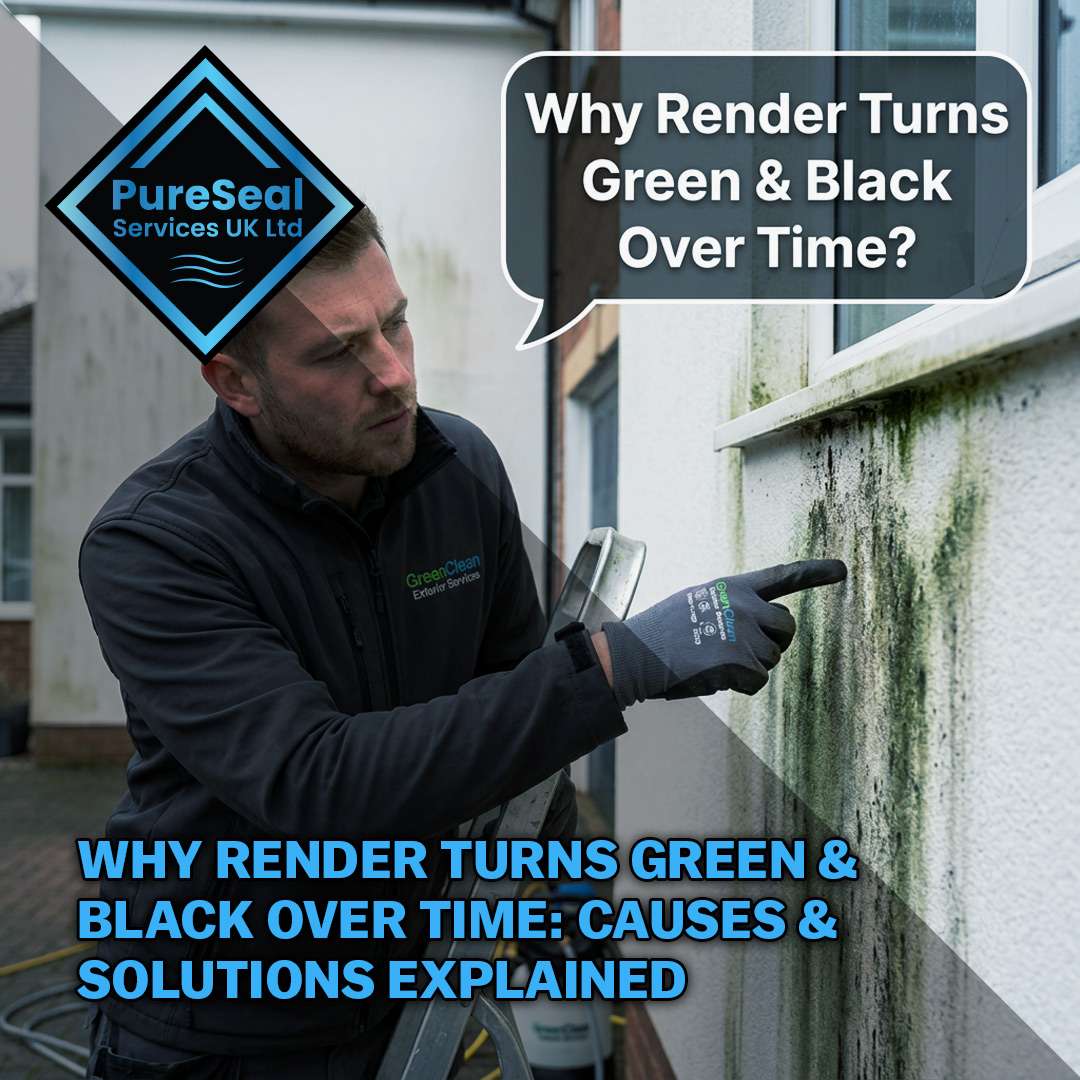
Why Render Turns Green & Black Over Time: Causes & Solutions Explained
Written by PureSeal Services on . Posted in Pressure Washing, Approved Applicators, Blog
Why Render Turns Green & Black Over Time: Causes & Solutions Explained
Modern render gives homes a clean, contemporary appearance and can remain attractive for many years. However, even the highest-quality coloured render will eventually develop green and black staining if left exposed to the British weather. These marks are more than just cosmetic—they are usually signs of biological growth caused by moisture, shade and airborne spores.
Many homeowners assume the render itself is failing, but in most cases the problem lies on the surface rather than within the render. Understanding why render changes colour is the first step towards choosing the correct cleaning method.
At Pure Seal Services, we specialise in professional render cleaning using carefully selected softwashing techniques that remove biological growth while protecting the render finish.
Why Does Render Change Colour?
Render is constantly exposed to:
- Rain
- Wind
- Air pollution
- Dust
- Tree debris
- Organic matter
- Airborne algae spores
Although modern renders are designed to resist water, they still provide microscopic surface texture where contaminants can settle.
Once moisture combines with organic material, biological growth begins to develop.
The Most Common Causes of Render Staining
| Cause | Typical Appearance | Severity |
|---|---|---|
| Green algae | Green streaks and patches | Very common |
| Black mould | Black spotting | Very common |
| Red algae | Pink or red stains | Increasingly common |
| Lichen | White or yellow crusts | Less common |
| Traffic pollution | Grey staining | Urban areas |
| General dirt | Dull appearance | Common |
Each contaminant requires a different cleaning approach.
Why Render Turns Green
Green staining is almost always caused by algae.
Algae spores are naturally present in the atmosphere and settle on virtually every exterior surface.
When they find suitable conditions, they begin growing.
These conditions include:
- Moisture
- Shade
- Mild temperatures
- Limited airflow
- Organic debris
North-facing walls are particularly vulnerable because they remain damp for longer after rainfall.
Conditions That Encourage Green Algae
| Condition | Effect |
|---|---|
| Heavy shade | High risk |
| Trees nearby | High risk |
| Poor airflow | Increased growth |
| Frequent rainfall | Ideal conditions |
| Leaking gutters | Significant increase |
| Dense shrubs | Traps moisture |
The more of these conditions that exist around a property, the faster algae tends to develop.
Why Render Turns Black
Black staining is usually caused by mould rather than dirt.
Black mould thrives in damp environments and often develops after algae has already become established.
Unlike surface dust, mould penetrates tiny pores within the render finish.
This makes it much harder to remove using water alone.
Black staining commonly appears around:
- Window frames
- Roof overhangs
- Gutters
- Downpipes
- Sheltered walls
These areas receive less direct sunlight and remain damp for longer periods.
The Role of Moisture
Moisture is one of the biggest factors influencing render staining.
Sources include:
- Rainwater
- Condensation
- Morning dew
- Overflowing gutters
- Splashback from paving
- Poor drainage
Although coloured render is breathable, constant moisture allows biological organisms to flourish.
Improving drainage and addressing water-related issues can significantly slow future contamination.
Why North-Facing Walls Become Dirty First
Many homeowners notice only one side of their property becoming green.
This is perfectly normal.
North-facing elevations:
- Receive less sunlight
- Dry more slowly
- Stay cooler
- Retain moisture longer
These conditions create the ideal environment for algae and mould growth.
South-facing walls generally remain cleaner for longer because they receive more direct sunlight throughout the day.
Which Elevations Are Most Affected?
| Property Elevation | Risk of Biological Growth |
|---|---|
| North | Very High |
| East | High |
| West | Moderate |
| South | Lower |
This explains why contamination often appears uneven across the property.
How Trees Affect Render
Trees provide many benefits but also increase the likelihood of biological growth.
Trees contribute:
- Shade
- Moisture retention
- Falling leaves
- Airborne spores
- Reduced airflow
Properties surrounded by mature trees often require cleaning more frequently than those in open locations.
Air Pollution Also Plays a Role
Not every stain is biological.
Homes near busy roads often collect:
- Vehicle emissions
- Brake dust
- General pollution
- Industrial particles
These contaminants settle on the render and gradually create a grey or dark appearance.
Pollution also provides additional nutrients for algae and mould.
What About Red Algae?
Red algae has become increasingly common throughout the UK.
Unlike green algae, it produces pink or reddish staining.
It often appears on:
- Modern silicone render
- Monocouche render
- Light-coloured walls
Red algae is particularly stubborn because it penetrates microscopic pores within the render surface.
Professional treatment usually provides the most reliable results.
Different Types of Biological Growth
| Growth | Colour | Difficulty to Remove |
|---|---|---|
| Green algae | Green | Easy to moderate |
| Red algae | Pink or red | Moderate to difficult |
| Black mould | Black | Moderate |
| Lichen | White, yellow or grey | Difficult |
Correct identification helps determine the most effective cleaning treatment.
Can Pressure Washing Remove Green Staining?
Pressure washing may appear to remove staining initially.
However, it often only strips away the visible growth while leaving microscopic spores behind.
Problems associated with pressure washing include:
- Surface damage
- Water penetration
- Patchy cleaning
- Faster regrowth
- Loss of textured finish
Professional softwashing focuses on killing the biological growth rather than simply blasting it away.
Why Softwashing Works Better
Softwashing combines specialist cleaning chemicals with low-pressure application.
The process:
- Kills algae
- Eliminates mould
- Breaks down biological growth
- Reduces future regrowth
This provides longer-lasting results compared with pressure washing alone.
Pressure Washing vs Softwashing
| Feature | Pressure Washing | Softwashing |
|---|---|---|
| Removes algae | Temporary | Excellent |
| Kills spores | No | Yes |
| Suitable for render | Limited | Yes |
| Risk of damage | Higher | Very low |
| Longer-lasting results | Limited | Excellent |
The emphasis is on careful chemical treatment rather than force.
Why DIY Cleaning Often Falls Short
Many off-the-shelf exterior cleaners promise impressive results, but they are often designed for general use rather than specialist render systems.
Common DIY mistakes include:
- Using excessive pressure
- Applying household bleach
- Mixing chemicals
- Scrubbing aggressively
- Cleaning during hot sunshine
- Rinsing too quickly
These mistakes can reduce cleaning effectiveness and, in some cases, damage the render finish.
The Importance of Professional Assessment
Every rendered property is different.
Before beginning any cleaning work, experienced contractors assess:
- Type of render
- Colour
- Age
- Level of contamination
- Existing repairs
- Environmental conditions
This allows the most suitable cleaning method to be selected.
How Weather Affects Render Staining
Britain’s climate creates ideal conditions for biological growth.
Frequent rainfall combined with relatively mild temperatures allows algae to remain active throughout much of the year.
Periods of wet weather encourage rapid growth, while prolonged dry spells may temporarily slow it.
Properties located in valleys, woodland areas or coastal regions often experience even greater moisture exposure.
Can Cleaning Prevent Future Staining?
No cleaning method can permanently prevent algae from returning because spores are naturally present in the air.
However, professional treatments can significantly slow the process.
Long-term maintenance often includes:
- Specialist biocide application
- Removing nearby vegetation where practical
- Repairing leaking gutters
- Improving airflow
- Regular inspections
These measures help keep render looking cleaner for longer.
Signs Your Render Needs Professional Cleaning
Many homeowners wait until staining becomes severe before taking action.
Earlier treatment is usually more effective.
Typical warning signs include:
| Sign | What It Indicates |
|---|---|
| Green streaks | Early algae growth |
| Black spots | Developing mould |
| Pink patches | Red algae |
| Dull appearance | Pollution and dirt |
| Uneven colouring | Biological contamination |
| Persistent damp marks | Moisture retention |
Treating these issues early often requires less intensive cleaning than dealing with years of established contamination.
Why Professional Cleaning Delivers Better Results
Removing green and black staining is about more than improving appearance. The correct treatment protects the render finish, removes biological growth at its source and helps reduce the speed at which contamination returns.
At Pure Seal Services, every render cleaning project starts with a detailed assessment to identify the type of staining, the condition of the render and the most appropriate softwashing treatment. By using professional-grade cleaning solutions and low-pressure application methods, we restore the appearance of coloured render while minimising the risk of damage.
Professional render cleaning is positioned at the premium end of the market because it combines specialist chemicals, safe access equipment and experienced technicians. Although it represents a greater investment than low-cost alternatives, this approach provides longer-lasting results and helps protect the value and appearance of your property.
How Biological Growth Spreads Across Render
One small patch of algae rarely stays isolated for long.
Biological growth spreads through microscopic spores carried by:
- Wind
- Rain splash
- Birds
- Insects
- Falling leaves
- Air movement
Once spores land on damp render, they begin multiplying. This is why a few green spots beneath a window can gradually develop into widespread staining across an entire elevation if left untreated.
Professional cleaning removes the existing contamination while targeting the spores responsible for future growth.
Why Modern Render Can Still Become Dirty
Many homeowners choose silicone render because it is marketed as self-cleaning or low maintenance.
While modern render systems are far more resistant to dirt than traditional cement render, “low maintenance” does not mean “maintenance free”.
Over time, every rendered property will collect:
| Contaminant | Source |
|---|---|
| Dust | Airborne particles |
| Pollen | Trees and plants |
| Pollution | Vehicle emissions |
| Organic debris | Leaves and insects |
| Algae spores | Naturally airborne |
| Mould spores | Moist environments |
Rainwater can wash away some loose dirt, but it cannot remove established biological growth.
The Effect of Gutters and Downpipes
Faulty rainwater goods are one of the most common reasons render becomes stained.
Problems include:
- Overflowing gutters
- Leaking joints
- Blocked downpipes
- Poorly positioned outlets
Constant water running down the render creates ideal conditions for algae and mould.
If these issues are not repaired, staining is likely to return much sooner after cleaning.
Inspecting gutters before arranging professional render cleaning can often improve the longevity of the finished result.
Why Some Homes Stay Cleaner Than Others
You may notice that neighbouring houses with the same render finish can look completely different.
Several factors influence this, including:
- The direction the property faces
- Nearby vegetation
- Roof overhangs
- Local drainage
- General airflow
- How quickly walls dry after rain
A house in full sunlight with good air circulation may remain clean for years longer than an identical property tucked beneath mature trees.
Seasonal Changes in Render Contamination
Biological growth doesn’t develop at the same rate throughout the year.
Each season affects render differently.
| Season | Typical Effect |
|---|---|
| Spring | Algae begins growing rapidly |
| Summer | Growth slows on sunny walls but continues in shaded areas |
| Autumn | Falling leaves increase organic matter |
| Winter | Damp conditions encourage mould and algae |
This is why many homeowners first notice green staining towards the end of winter or during spring.
The Difference Between Dirt and Biological Growth
One common misconception is that all staining is simply dirt.
In reality, most green and black marks are living organisms.
General dirt usually sits on the surface and can often be removed with detergent.
Biological growth behaves differently because it:
- Anchors itself to the render
- Produces spores
- Retains moisture
- Continues spreading over time
This explains why ordinary washing frequently provides only short-term improvements.
Why Colour Choice Makes a Difference
Certain render colours make contamination more noticeable than others.
Lighter colours often highlight:
- Green algae
- Black mould
- Traffic pollution
Darker colours may hide algae for longer but make:
- Dust
- Salt deposits
- Water streaks
more visible.
| Render Colour | Most Common Visible Issue |
|---|---|
| White | Green algae and mould |
| Cream | Red algae and pollution |
| Beige | Organic staining |
| Light grey | Black mould |
| Dark grey | Dust and water marks |
| Charcoal | Salt deposits |
Although all render colours can develop biological growth, lighter finishes usually show contamination much sooner.
Why Harsh Chemicals Can Cause Problems
Choosing the strongest cleaning product is not always the best approach.
Overly aggressive chemicals may:
- Affect surface appearance
- Leave uneven patches
- Damage nearby plants
- Reduce the lifespan of protective finishes
Professional contractors select cleaning products according to the render type and level of contamination rather than applying the same solution to every property.
This tailored approach helps achieve a consistent finish while protecting the render.
The Value of Preventative Maintenance
Allowing algae and mould to build up over many years often makes cleaning more complicated.
Routine inspections and timely professional cleaning offer several benefits:
- Smaller areas require treatment
- Biological growth is easier to remove
- Less intensive chemical application is often needed
- The render maintains its original appearance for longer
- Moisture-related issues can be identified earlier
Preventative maintenance also allows minor defects, such as cracked sealant around windows or leaking gutter joints, to be spotted before they contribute to widespread staining.
Why Experience Matters
Cleaning coloured render successfully requires much more than access to professional chemicals.
Experienced technicians understand how to assess:
- The render system
- The cause of staining
- Environmental conditions
- Appropriate dwell times
- Safe application methods
- Suitable rinsing techniques
Each of these factors influences the final result.
Applying an unsuitable treatment, even with good intentions, can lead to inconsistent cleaning or unnecessary wear to the render finish.
Professional Solutions for Long-Lasting Results
Green and black staining is a natural part of a render’s exposure to the British climate, but it doesn’t have to become a permanent feature of your home. Identifying the underlying cause—whether it’s algae, mould, pollution or excess moisture—is essential before selecting the correct treatment.
At Pure Seal Services, we assess every property individually to determine why staining has developed and which professional softwashing solution is most appropriate. Our approach focuses on removing biological growth safely, preserving the render’s finish and helping to slow future regrowth without relying on aggressive high-pressure cleaning.
As a premium specialist service, professional render cleaning reflects the quality of the products, equipment and expertise involved. While it sits at the higher end of the market compared with basic exterior cleaning, investing in the correct treatment helps protect the appearance, durability and long-term value of coloured render while reducing the risk of unnecessary damage.
Tags: Roof Cleaning, Exterior cleaning, gutter cleaning, window cleaning, Patio cleaning, Driveway cleaning, pressure washing
 Artificial and Sports Surfaces
 Awnings / Canopies / Gazebos
 Block Paving
 Brickwork
 Composite Surfaces
 Decking / Timber
 Granite
 Imprinted Concrete
 Internal Masonry
 Limestone
 Marble
 Metal Cladding
 Polished or Honed Stone
 Porcelain
 Render
 Resin Bond
 Road and Rail Signs
 Roof Tiles / Slates
 Sandstone
 Slate
Slate Solar Panels and Glass
 Stone Sills and Pier Caps
 Tarmac and Asphalt
 Gutters & UPVC
 Acid Damage
 Biofilm
 Bitumen
 Blood
Blood Carbon
 Concrete / Grout / Mortar
 Copper Oxide
 Efflorescence
 Egg
Egg Failed Sealer
 Fire Damage
 Fuel / Oil
 Graffiti
 Grease / Fat / Cooking Oil
 Lawn Fertiliser
 Lead Carbonate
 Lead Oxide
 Paint Splashes
 Rust
Rust Tar & Glue
 Tannin Removers
 Traffic Film Removers
 Trapped Moisture / Sealer Repairs
 Urine Neutralisers