
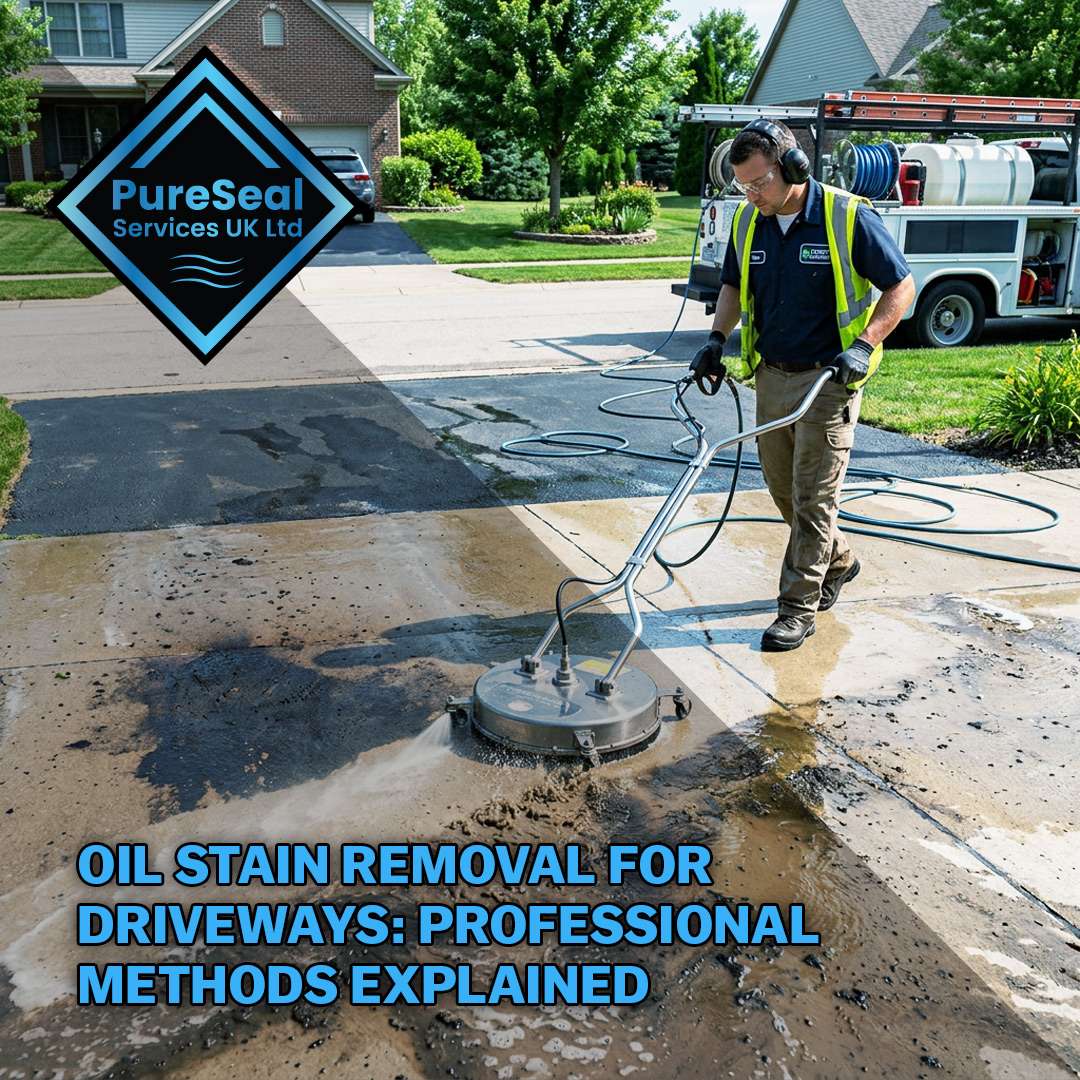
Oil Stain Removal for Driveways: Professional Methods Explained
Oil Stain Removal for Driveways: Professional Methods Explained
Oil stains are one of the most common problems affecting driveways across the UK. Whether caused by a leaking car, motorcycle, van or garden machinery, oil can quickly soak into paving materials and leave unsightly dark patches that are difficult to remove with ordinary cleaning.
Many homeowners try washing the stain away with detergent or a pressure washer, only to discover that the mark remains. That’s because oil behaves very differently from everyday dirt. Instead of sitting on the surface, it penetrates deep into porous materials, making professional treatment the most effective solution.
At Pure Seal Services, every driveway is assessed individually before cleaning begins. Different surfaces require different techniques, and selecting the correct method helps remove as much contamination as possible while protecting the driveway itself.
Why Oil Stains Are So Difficult to Remove
Unlike mud, algae or general traffic grime, oil is designed to resist water.
When oil lands on paving, it quickly begins soaking into microscopic pores within the surface.
As time passes:
- More oil penetrates deeper.
- Dirt sticks to the affected area.
- Rain spreads contamination.
- Sunlight bakes the stain into the surface.
- The patch often becomes darker.
This is why older oil stains are generally much harder to remove than fresh spills.
Common Causes of Driveway Oil Stains
Oil contamination comes from many different sources.
Typical causes include:
- Engine oil leaks
- Gearbox oil
- Hydraulic fluid
- Motorcycle oil
- Power steering fluid
- Diesel spills
- Petrol residue
- Lawn mower maintenance
- Pressure washer servicing
- Garden machinery
Even a small leak over several months can leave significant staining.
Which Driveway Surfaces Are Most Affected?
Some materials absorb oil much faster than others.
| Surface | Oil Absorption |
|---|---|
| Block paving | High |
| Concrete | High |
| Tarmac | Medium |
| Resin-bound surfaces | Low to Medium |
| Porcelain paving | Low |
| Natural sandstone | High |
| Limestone | Medium |
| Granite setts | Low |
Porous materials generally require more specialised cleaning techniques.
Why Pressure Washing Alone Doesn’t Remove Oil
Pressure washing is excellent for removing:
- Surface dirt
- Mud
- Moss
- Green algae
- Red algae
- Lichen
- General grime
However, oil is different.
Because it sits beneath the surface, water pressure alone often removes only the dirt sitting above the stain.
Increasing the pressure rarely solves the problem and may instead:
- Damage pointing.
- Remove jointing sand.
- Etch concrete.
- Damage softer stone.
- Disturb protective coatings.
Professional contractors know when specialist degreasers are needed rather than simply increasing water pressure.
Fresh Oil vs Old Oil Stains
Timing makes a significant difference.
| Age of Stain | Removal Difficulty |
|---|---|
| Less than 24 hours | Low |
| One week | Moderate |
| One month | High |
| Six months | Very High |
| Several years | Extremely High |
Fresh spills can often be treated before they fully penetrate the driveway.
Older contamination usually requires more extensive treatment.
Professional Driveway Assessment
Before cleaning begins, professionals inspect:
- Surface material.
- Severity of staining.
- Previous sealers.
- Existing damage.
- Drainage.
- Multiple contamination types.
- Age of the stain.
This assessment helps determine the safest cleaning method.
Professional Degreasers
Oil removal usually begins with specialist cleaning products.
Professional degreasers are designed to:
- Break down hydrocarbons.
- Lift oil deposits.
- Penetrate porous materials.
- Reduce staining.
- Prepare surfaces for rinsing.
The exact product used depends entirely on the driveway material.
Different surfaces react differently to various cleaning agents.
Why Household Washing-Up Liquid Rarely Works
Many homeowners reach for washing-up liquid first.
Although it can help with fresh spills, it usually struggles with established stains.
Household detergents often:
- Only clean the surface.
- Fail to penetrate deeply.
- Leave residue.
- Require repeated applications.
- Produce inconsistent results.
Professional products are considerably more effective for deeply embedded contamination.
The Professional Oil Removal Process
Every project varies slightly, but most follow a structured process.
| Stage | Purpose |
|---|---|
| Inspection | Assess contamination |
| Surface testing | Confirm product compatibility |
| Preparation | Protect surrounding areas |
| Degreaser application | Break down oil |
| Dwell time | Allow treatment to penetrate |
| Agitation | Lift contamination |
| Rinsing | Remove loosened deposits |
| Inspection | Assess remaining staining |
Sometimes multiple treatments are required for older stains.
Why More Than One Treatment May Be Needed
Oil doesn’t always disappear after one application.
Factors affecting success include:
- Type of oil.
- Age of contamination.
- Surface porosity.
- Weather exposure.
- Previous DIY attempts.
Several carefully controlled treatments often produce better results than one aggressive cleaning attempt.
Oil Removal From Block Paving
Block paving presents unique challenges.
Oil often penetrates:
- Individual blocks.
- Jointing sand.
- Surface texture.
Professional cleaning focuses on removing contamination while preserving:
- Block colour.
- Surface finish.
- Joint stability.
Following cleaning, fresh kiln-dried sand may sometimes be required if pressure washing has disturbed existing joints.
Cleaning Concrete Driveways
Concrete absorbs oil extremely well due to its porous nature.
Professional cleaning involves carefully balancing:
- Chemical strength.
- Contact time.
- Surface protection.
- Thorough rinsing.
Aggressive cleaning methods may damage decorative finishes or exposed aggregate.
Oil Stains on Natural Stone
Natural stone requires additional care.
| Stone Type | Cleaning Considerations |
|---|---|
| Sandstone | Highly absorbent |
| Limestone | Sensitive to some chemicals |
| Granite | Dense and durable |
| Slate | Variable porosity |
| York stone | Often deeply porous |
Professional testing helps avoid unwanted discolouration.
Resin Driveways and Oil
Resin-bound surfaces are generally less porous than block paving or concrete.
However, prolonged exposure to oil can still:
- Leave dark patches.
- Attract dirt.
- Affect appearance.
Cleaning must be carried out carefully to avoid damaging the resin binder.
Why DIY Methods Can Make Things Worse
Popular internet advice often suggests:
- Bleach
- Petrol
- White spirit
- Brake cleaner
- Oven cleaner
- Caustic soda
These products can damage certain driveway materials or create additional staining.
Some may also pose environmental or safety risks if used incorrectly.
Professional contractors select products specifically formulated for exterior cleaning.
The Importance of Treating the Entire Area
Cleaning only the stain sometimes creates a noticeable clean patch.
Professional contractors often recommend cleaning the surrounding driveway as well.
Benefits include:
- Uniform appearance.
- Consistent colour.
- Removal of traffic film.
- Elimination of algae.
- Better overall kerb appeal.
A fully cleaned driveway often looks dramatically better than one with isolated spot treatment.
Identifying the Cause
Removing the stain without fixing the source often leads to repeat problems.
Common causes include:
| Source | Solution |
|---|---|
| Engine leak | Mechanical repair |
| Hydraulic leak | Equipment servicing |
| Motorcycle drip | Maintenance |
| Garden machinery | Routine inspection |
| Oil storage | Proper containment |
Addressing the cause helps protect your driveway long-term.
Commercial Driveway Cleaning
Commercial premises frequently experience oil contamination from:
- Delivery vehicles.
- Forklifts.
- Vans.
- Customer parking.
- Loading bays.
- Fleet vehicles.
Professional cleaning improves appearance while helping maintain a more welcoming environment for staff and visitors.
Weather Conditions Matter
Oil removal is generally more effective during suitable weather.
Ideal conditions often include:
- Dry surfaces.
- Mild temperatures.
- Limited rainfall.
- Minimal wind.
Heavy rain may reduce product effectiveness before treatments have time to penetrate properly.
Planning work around favourable weather conditions contributes to more consistent results.
Safety During Professional Cleaning
Professional contractors take several precautions throughout the cleaning process.
These may include:
- Wearing appropriate PPE.
- Protecting nearby planting.
- Managing runoff.
- Following manufacturer instructions.
- Using suitable dilution rates.
- Controlling access to treated areas.
Careful preparation helps protect both the property and surrounding environment.
Preventing Future Oil Stains
Once your driveway has been professionally cleaned, a few simple habits can help minimise future staining.
| Preventative Measure | Benefit |
|---|---|
| Repair vehicle leaks promptly | Stops fresh contamination |
| Regularly inspect parked vehicles | Detects leaks early |
| Clean spills immediately | Reduces penetration |
| Service garden machinery | Prevents accidental drips |
| Store oils carefully | Avoids accidental spills |
| Schedule routine driveway cleaning | Maintains appearance |
Routine maintenance is usually far easier than removing years of built-up oil contamination.
Why Professional Experience Makes a Difference
Oil stain removal is about much more than applying a stronger cleaning product. It requires understanding how different driveway materials absorb oil, selecting products that are compatible with each surface and using techniques that remove contamination without causing unnecessary damage.
Premium driveway cleaning services focus on achieving the best possible finish while protecting the long-term condition of the surface. By combining specialist degreasers, professional equipment and careful preparation, experienced contractors can often achieve significantly better results than repeated DIY attempts. For homeowners and businesses wanting to restore the appearance of their driveway, Pure Seal Services provides tailored exterior cleaning solutions designed to tackle stubborn oil staining while preserving the quality and appearance of the surrounding surfaces.
Tags: Patio cleaning, Driveway cleaning, pressure washing, Roof Cleaning, Exterior cleaning, gutter cleaning, window cleaning
 Artificial and Sports Surfaces
 Awnings / Canopies / Gazebos
 Block Paving
 Brickwork
 Composite Surfaces
 Decking / Timber
 Granite
 Imprinted Concrete
 Internal Masonry
 Limestone
 Marble
 Metal Cladding
 Polished or Honed Stone
 Porcelain
 Render
 Resin Bond
 Road and Rail Signs
 Roof Tiles / Slates
 Sandstone
 Slate
Slate Solar Panels and Glass
 Stone Sills and Pier Caps
 Tarmac and Asphalt
 Gutters & UPVC
 Acid Damage
 Biofilm
 Bitumen
 Blood
Blood Carbon
 Concrete / Grout / Mortar
 Copper Oxide
 Efflorescence
 Egg
Egg Failed Sealer
 Fire Damage
 Fuel / Oil
 Graffiti
 Grease / Fat / Cooking Oil
 Lawn Fertiliser
 Lead Carbonate
 Lead Oxide
 Paint Splashes
 Rust
Rust Tar & Glue
 Tannin Removers
 Traffic Film Removers
 Trapped Moisture / Sealer Repairs
 Urine Neutralisers