
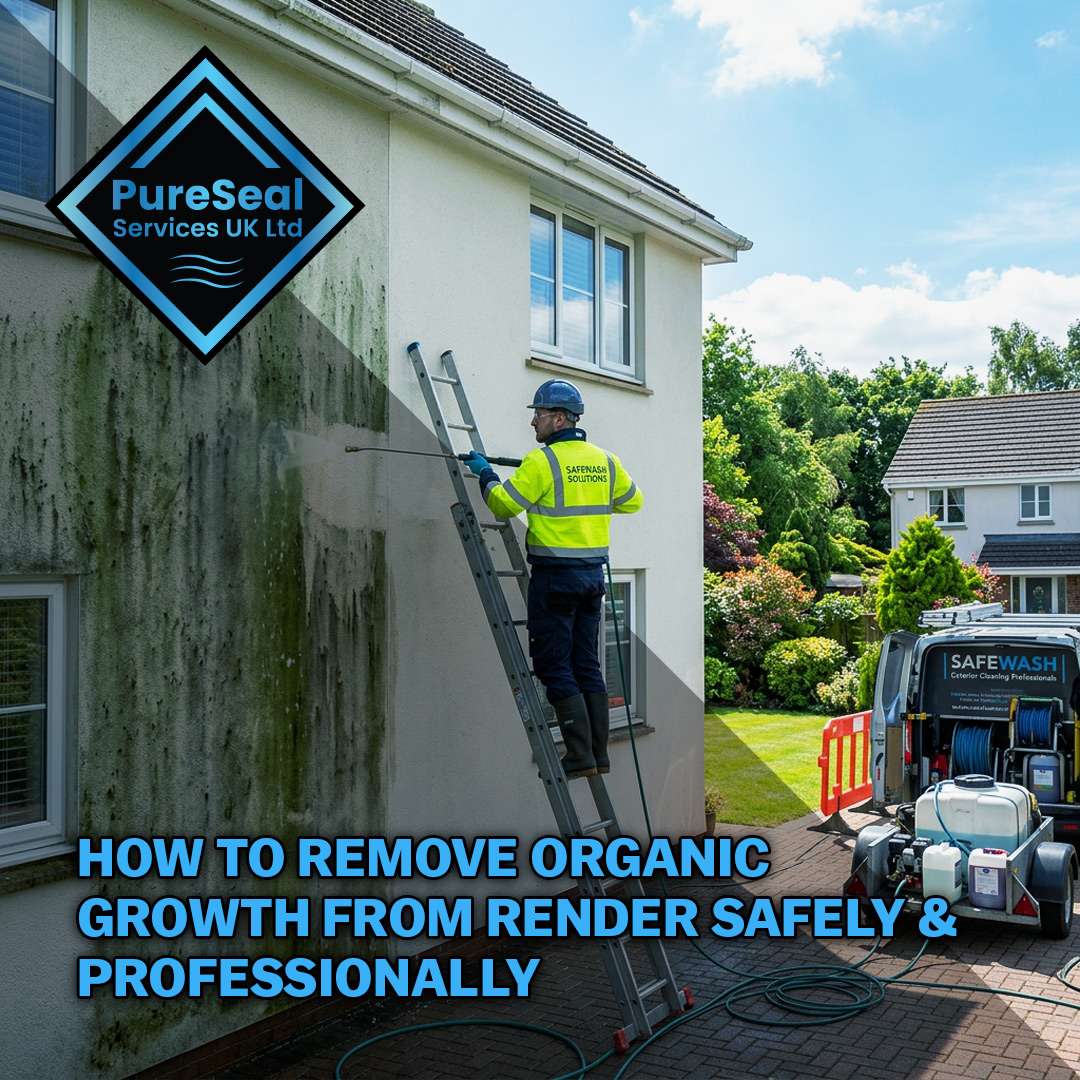
How to Remove Organic Growth From Render Safely & Professionally
Written by PureSeal Services on . Posted in Pressure Washing, Approved Applicators, Blog
How to Remove Organic Growth From Render Safely & Professionally
Render is designed to protect and enhance the appearance of a property, but over time it can become covered in green algae, black mould, red algae, lichen and other forms of organic growth. Left untreated, these contaminants can spoil your property’s kerb appeal and gradually become more difficult to remove.
The good news is that render can often be restored without causing damage, provided the correct cleaning methods are used. At Pure Seal Services, we use professional softwashing techniques that safely remove biological contamination while protecting delicate render finishes.
This guide explains what organic growth is, why it develops, and how professionals remove it safely for long-lasting results.
What Is Organic Growth on Render?
Organic growth refers to living organisms that develop on exterior surfaces where moisture, shade and airborne nutrients are present.
The most common types found on render include:
- Green algae
- Black mould
- Red algae
- Lichen
- Moss (around edges and ledges)
- Fungal spores
- Biofilm
Unlike dirt or dust, these organisms continue growing until they are properly treated.
Why Does Organic Growth Develop?
Render is naturally exposed to changing weather throughout the year.
Certain conditions encourage biological growth, including:
| Cause | Effect on Render |
|---|---|
| Damp conditions | Encourages algae growth |
| North-facing walls | Reduced sunlight keeps surfaces wetter |
| Trees and hedges | Trap moisture and reduce airflow |
| Heavy rainfall | Provides constant moisture |
| Airborne spores | Colonise porous render surfaces |
| Pollution | Creates nutrients for biological growth |
Even newly rendered properties can begin developing algae within only a few years depending on their location.
Types of Organic Growth
Understanding what you’re dealing with helps determine the most suitable treatment.
Green Algae
Green algae is the most common contaminant found on UK render.
It usually appears as:
- Green patches
- Vertical streaks
- Shaded wall discolouration
It spreads quickly in damp environments.
Black Mould
Black mould often develops alongside algae.
It appears as:
- Black spotting
- Dark staining
- Grey-black patches
Without treatment it gradually spreads across larger areas.
Red Algae
Red algae has become increasingly common throughout the UK.
Unlike green algae, it often penetrates much deeper into the render surface.
It commonly appears as:
- Rust-coloured staining
- Pink-red patches
- Orange-red marks
It is often one of the most difficult contaminants to remove without specialist treatment.
Lichen
Lichen is actually a combination of algae and fungi.
It produces:
- White spots
- Grey circles
- Yellow patches
- Crust-like growth
Lichen firmly bonds to render and usually requires professional removal.
Why Pressure Washing Isn’t Always the Answer
Many homeowners assume pressure washing is the quickest solution.
Unfortunately, high-pressure cleaning can create several problems on decorative render.
These include:
- Surface erosion
- Colour fading
- Rough finishes
- Water penetration
- Hairline cracking
- Patchy appearance
Modern render systems are designed to withstand weather—not necessarily aggressive water pressure.
Why Softwashing Is Preferred
Professional softwashing removes contamination differently.
Instead of relying on pressure, specialist cleaning solutions:
- Kill algae
- Destroy mould spores
- Break down organic staining
- Remove biofilm
- Prevent rapid regrowth
Only gentle rinsing is required afterwards.
This protects the render while delivering a deeper clean.
The Professional Render Cleaning Process
Professional contractors follow a structured cleaning process rather than simply spraying chemicals onto the wall.
| Step | Purpose |
|---|---|
| Initial inspection | Assess render condition |
| Identify contamination | Determine algae, mould or lichen |
| Protect surrounding areas | Prevent unnecessary exposure |
| Apply cleaning solution | Begin breaking down growth |
| Allow dwell time | Kill biological contamination |
| Gentle rinse | Remove dead growth |
| Final inspection | Ensure consistent finish |
Every stage contributes to both safety and long-lasting results.
Why Identification Matters
Different contaminants require different treatment approaches.
For example:
| Organic Growth | Typical Difficulty |
|---|---|
| Green algae | Easy |
| Black mould | Moderate |
| Red algae | Difficult |
| Heavy lichen | Difficult |
| Mixed contamination | Moderate to difficult |
Correct identification ensures the appropriate cleaning solution and application time are used.
Can Organic Growth Damage Render?
While algae itself may not immediately damage render, allowing contamination to remain for years can create several issues.
These include:
- Increased moisture retention
- Permanent staining
- Reduced kerb appeal
- Harder future cleaning
- Surface deterioration
Regular maintenance helps prevent these problems from developing.
Why Organic Growth Keeps Returning
One of the biggest frustrations homeowners experience is algae returning only months after cleaning.
This usually happens because:
- Only visible contamination was removed.
- Spores remained alive.
- Moisture conditions were unchanged.
- The wrong cleaning method was used.
Softwashing addresses the biological source of the problem rather than simply removing what can be seen.
The Importance of Low Pressure
Modern render systems often contain decorative textured finishes.
High pressure may:
- Remove texture
- Strip pigments
- Damage protective coatings
- Leave visible cleaning marks
Professional softwashing uses very low pressure throughout the cleaning process, significantly reducing these risks.
Which Render Types Can Be Softwashed?
Most decorative render systems are suitable for professional softwashing.
| Render Type | Suitable for Softwashing |
|---|---|
| Silicone render | ✔ Yes |
| Monocouche render | ✔ Yes |
| Acrylic render | ✔ Yes |
| Mineral render | ✔ Yes |
| Painted render | ✔ Yes |
| Thin coat render | ✔ Yes (following inspection) |
Every property should still be assessed individually before work begins.
Why Timing Matters
Cleaning at the right time of year can improve results.
Ideal conditions include:
- Mild temperatures
- Dry weather
- Limited wind
- No immediate heavy rainfall
Although render can be cleaned throughout much of the year, avoiding extreme weather helps maximise the effectiveness of professional cleaning treatments.
Areas Most Likely to Develop Organic Growth
Certain parts of a property become contaminated faster than others.
Common problem areas include:
- North-facing walls
- Garden-facing elevations
- Areas beneath trees
- Around guttering
- Window reveals
- Below rooflines
- Shaded side walls
These areas often remain damp for longer, allowing algae and mould to flourish.
Is DIY Cleaning Worth the Risk?
Many DIY products promise instant results.
However, homeowners often encounter problems such as:
- Incorrect chemical dilution
- Uneven application
- Patchy cleaning
- Damaged render
- Stubborn regrowth
Domestic pressure washers may also apply far more force than many render systems can safely tolerate.
Professional assessment usually saves both time and expensive repairs.
Typical Costs of Professional Render Cleaning
Prices vary depending on:
- Property size
- Height
- Access
- Severity of contamination
- Render type
Typical professional softwashing prices include:
| Property Type | Typical Cost |
|---|---|
| Small bungalow | £500–£750 |
| Semi-detached property | £700–£1,100 |
| Detached home | £900–£1,800+ |
| Large executive property | £1,800–£3,500+ |
Premium services often command higher prices because they include specialist equipment, experienced technicians, comprehensive insurance and high-quality cleaning solutions that deliver safer, longer-lasting results.
Signs Your Render Needs Cleaning
Many homeowners don’t notice contamination until it has spread significantly.
Watch for:
- Green staining after winter
- Black spots developing
- Pink or red patches
- White lichen circles
- Dark streaks beneath gutters
- Uneven wall colouring
- Damp-looking sections that never seem to dry
Early intervention usually makes professional cleaning quicker and more effective.
Preventing Organic Growth Returning
Although no exterior wall stays perfectly clean forever, several factors can slow regrowth.
These include:
- Keeping gutters clear
- Trimming overhanging trees
- Improving airflow around walls
- Repairing leaking pipework
- Removing excessive vegetation
- Scheduling periodic professional maintenance
Properties located in shaded or damp environments may naturally require cleaning more frequently than those exposed to direct sunlight.
Common Mistakes When Cleaning Render
Professional contractors regularly see damage caused by well-intentioned DIY cleaning.
Some of the most common mistakes include:
| Mistake | Potential Result |
|---|---|
| Using excessive pressure | Surface damage |
| Cleaning too closely | Etching and scarring |
| Using unsuitable chemicals | Colour changes |
| Insufficient dwell time | Poor cleaning performance |
| Skipping inspection | Hidden defects overlooked |
| Uneven application | Patchy appearance |
Avoiding these mistakes helps preserve the appearance and lifespan of the render.
Why Professional Equipment Makes a Difference
Professional render cleaning equipment is designed specifically for delicate exterior surfaces.
Specialist systems provide:
- Controlled chemical application
- Even surface coverage
- Low-pressure rinsing
- Safe access to higher elevations
- Consistent cleaning across the entire property
Combined with the correct cleaning products and experienced operators, this approach delivers reliable, uniform results while minimising the risk of accidental damage.
Choosing the Right Render Cleaning Specialist
Not all exterior cleaning companies specialise in render cleaning. Because decorative render requires a different approach to brickwork, paving or concrete, it’s important to choose a contractor with the appropriate knowledge and equipment.
Before booking, consider asking whether they:
- Carry out a full render inspection before cleaning
- Use low-pressure softwashing methods
- Have experience with your specific render type
- Are fully insured
- Explain the expected results and aftercare
At Pure Seal Services, every render cleaning project begins with a careful assessment to determine the safest and most effective treatment. By using professional softwashing techniques rather than aggressive high-pressure cleaning, organic growth can be removed thoroughly while preserving the finish, colour and long-term condition of your property’s render.
How Organic Growth Affects Different Coloured Renders
Organic growth is often more noticeable on lighter-coloured render, but every colour is susceptible.
Different render colours tend to show contamination in different ways.
| Render Colour | Most Common Visible Contamination |
|---|---|
| White | Green algae, black mould, red algae |
| Cream | Green staining, black spotting |
| Light grey | Dark algae streaks, mould |
| Beige | Green patches, pollution staining |
| Dark grey | Lighter lichen and dusty biofilm |
Although darker colours can hide some staining initially, algae and mould continue growing regardless of the render colour. This means the contamination can become well established before it is obvious from ground level.
Why Organic Growth Spreads So Quickly
Many homeowners are surprised by how quickly a small green patch can spread across an entire wall.
Organic growth reproduces by releasing microscopic spores into the air.
These spores:
- Land on damp render
- Attach themselves to tiny surface pores
- Begin multiplying
- Form larger colonies
- Spread during wet weather
Once established, the growth gradually expands until it covers large sections of the property.
This is why early professional treatment is often simpler than waiting until the render is heavily contaminated.
Does Organic Growth Mean the Render Is Failing?
Not necessarily.
In most cases, algae and mould indicate that moisture is remaining on the surface rather than suggesting the render itself has failed.
However, excessive biological growth can sometimes highlight underlying issues such as:
- Overflowing gutters
- Leaking downpipes
- Poor drainage
- Defective flashing
- Heavy shade preventing drying
A professional inspection can often identify whether the contamination is simply environmental or whether another issue needs addressing.
The Difference Between Dirt and Organic Growth
Many people assume all render staining is simply dirt.
There is an important difference.
Dirt
Usually consists of:
- Dust
- Traffic film
- Air pollution
- Soil particles
This sits mainly on the surface.
Organic Growth
Includes:
- Living algae
- Mould colonies
- Fungi
- Biofilm
- Lichen
These organisms actively grow and multiply.
This is why simply washing them away rarely prevents them returning.
How Professionals Assess a Render Before Cleaning
Before any cleaning begins, an experienced contractor should carefully inspect the property.
This assessment may include:
| Inspection Item | Why It Matters |
|---|---|
| Render type | Determines suitable cleaning method |
| Existing damage | Prevents further deterioration |
| Previous repairs | Identifies vulnerable areas |
| Severity of contamination | Determines treatment strength |
| Access requirements | Ensures safe working |
| Nearby planting | Allows appropriate protection measures |
Skipping this inspection can lead to disappointing results or unnecessary damage.
Why Patience Produces Better Results
Some homeowners expect render to become perfectly white immediately after treatment.
Softwashing often works slightly differently.
The cleaning solution destroys the biological contamination first.
Weathering then gradually removes the dead organic material over the following days or weeks.
This continued improvement is completely normal and often produces a more natural, even finish than aggressive pressure washing.
Does Every Property Need the Same Treatment?
No.
Every building presents different challenges.
Factors affecting treatment include:
- Property age
- Render manufacturer
- Local climate
- Nearby vegetation
- Surface condition
- Amount of organic growth
- Previous cleaning history
Two neighbouring houses may require completely different cleaning approaches despite looking similar.
Professional assessment ensures the treatment matches the property’s individual needs.
Why Access Equipment Matters
Cleaning render safely is about more than choosing the right chemicals.
Working at height requires suitable access equipment and trained operators.
Depending on the property, professionals may use:
- Mobile access towers
- Specialist access platforms
- Cherry pickers
- Scaffold systems where appropriate
Using the correct access equipment allows every section of the render to be cleaned evenly while reducing risks associated with working from ladders.
Can Organic Growth Affect Commercial Buildings?
Absolutely.
Commercial premises often experience even greater levels of contamination due to:
- Higher pollution levels
- Larger shaded elevations
- Greater wall surface area
- Increased exposure to weather
Clean render plays an important role in maintaining a professional appearance for:
- Offices
- Schools
- Retail units
- Apartment blocks
- Care homes
- Hotels
Regular maintenance helps present a positive first impression to visitors, customers and tenants.
Why Experience Makes Such a Difference
Professional render cleaning is far more than simply applying a cleaning solution.
Experienced technicians understand:
- Which products suit different render types
- Appropriate dilution rates
- Correct application methods
- Required dwell times
- Safe rinsing techniques
- How different contaminants respond
This knowledge helps achieve excellent results while protecting delicate finishes.
Seasonal Changes in Organic Growth
Organic contamination develops throughout the year, although some seasons encourage faster growth.
| Season | Typical Activity |
|---|---|
| Spring | Rapid algae growth as temperatures rise |
| Summer | Continued growth in shaded areas |
| Autumn | Increased moisture encourages spread |
| Winter | Damp conditions promote mould and algae development |
Properties surrounded by mature trees often experience higher contamination levels during autumn and winter due to reduced sunlight and increased leaf debris.
The Environmental Benefits of Softwashing
Modern professional softwashing is designed to minimise unnecessary water use.
Compared with prolonged pressure washing, it generally requires:
- Lower water consumption
- Less energy
- More targeted cleaning
- Reduced surface wear
Because the specialist cleaning solution performs most of the work, there is less reliance on high-pressure water to remove contamination.
This helps preserve both the render and the surrounding environment.
How Often Should Render Be Professionally Cleaned?
There is no fixed schedule because every property is different.
Factors influencing cleaning frequency include:
- Nearby woodland
- Coastal exposure
- Weather conditions
- Pollution levels
- Amount of shade
As a general guide:
| Environment | Suggested Inspection Interval |
|---|---|
| Open countryside | Every 3–5 years |
| Residential estate | Every 2–4 years |
| Heavily shaded property | Every 2–3 years |
| Coastal location | Every 2–3 years |
| Beside busy roads | Every 2–4 years |
Regular inspections allow contamination to be treated before it becomes extensive.
Questions Homeowners Frequently Ask
Will cleaning remove every stain?
Most biological staining can be removed successfully. Very old or deeply embedded staining may improve significantly but can sometimes require additional treatment.
Is softwashing safe for coloured render?
Yes. Low-pressure softwashing is widely regarded as the safest professional cleaning method for most coloured render systems because it avoids the aggressive force associated with pressure washing.
Will the render be damaged?
When carried out correctly using suitable products and low-pressure application, professional softwashing is specifically designed to clean without damaging the render surface.
Can algae be prevented completely?
No exterior surface can remain permanently free from algae. Weather, moisture and airborne spores are part of the natural environment. However, professional treatment can dramatically slow regrowth and keep render looking cleaner for much longer.
Why Investing in Professional Cleaning Pays Off
Choosing a specialist company isn’t simply about improving appearance—it’s about protecting your property’s exterior finish for years to come.
Professional softwashing helps:
- Remove organic contamination thoroughly
- Preserve decorative render finishes
- Reduce the likelihood of premature regrowth
- Avoid costly damage caused by excessive pressure
- Maintain the property’s kerb appeal throughout the year
While premium render cleaning services may cost more than basic pressure washing, the additional expertise, specialist equipment, careful preparation and longer-lasting results often provide far better value over the life of the property. For homeowners who want their render cleaned safely and professionally, investing in an experienced specialist such as Pure Seal Services offers peace of mind that the correct methods will be used from the initial inspection through to the completed clean.
Tags: Exterior cleaning, gutter cleaning, window cleaning, Patio cleaning, Driveway cleaning, pressure washing, Roof Cleaning
 Artificial and Sports Surfaces
 Awnings / Canopies / Gazebos
 Block Paving
 Brickwork
 Composite Surfaces
 Decking / Timber
 Granite
 Imprinted Concrete
 Internal Masonry
 Limestone
 Marble
 Metal Cladding
 Polished or Honed Stone
 Porcelain
 Render
 Resin Bond
 Road and Rail Signs
 Roof Tiles / Slates
 Sandstone
 Slate
Slate Solar Panels and Glass
 Stone Sills and Pier Caps
 Tarmac and Asphalt
 Gutters & UPVC
 Acid Damage
 Biofilm
 Bitumen
 Blood
Blood Carbon
 Concrete / Grout / Mortar
 Copper Oxide
 Efflorescence
 Egg
Egg Failed Sealer
 Fire Damage
 Fuel / Oil
 Graffiti
 Grease / Fat / Cooking Oil
 Lawn Fertiliser
 Lead Carbonate
 Lead Oxide
 Paint Splashes
 Rust
Rust Tar & Glue
 Tannin Removers
 Traffic Film Removers
 Trapped Moisture / Sealer Repairs
 Urine Neutralisers