
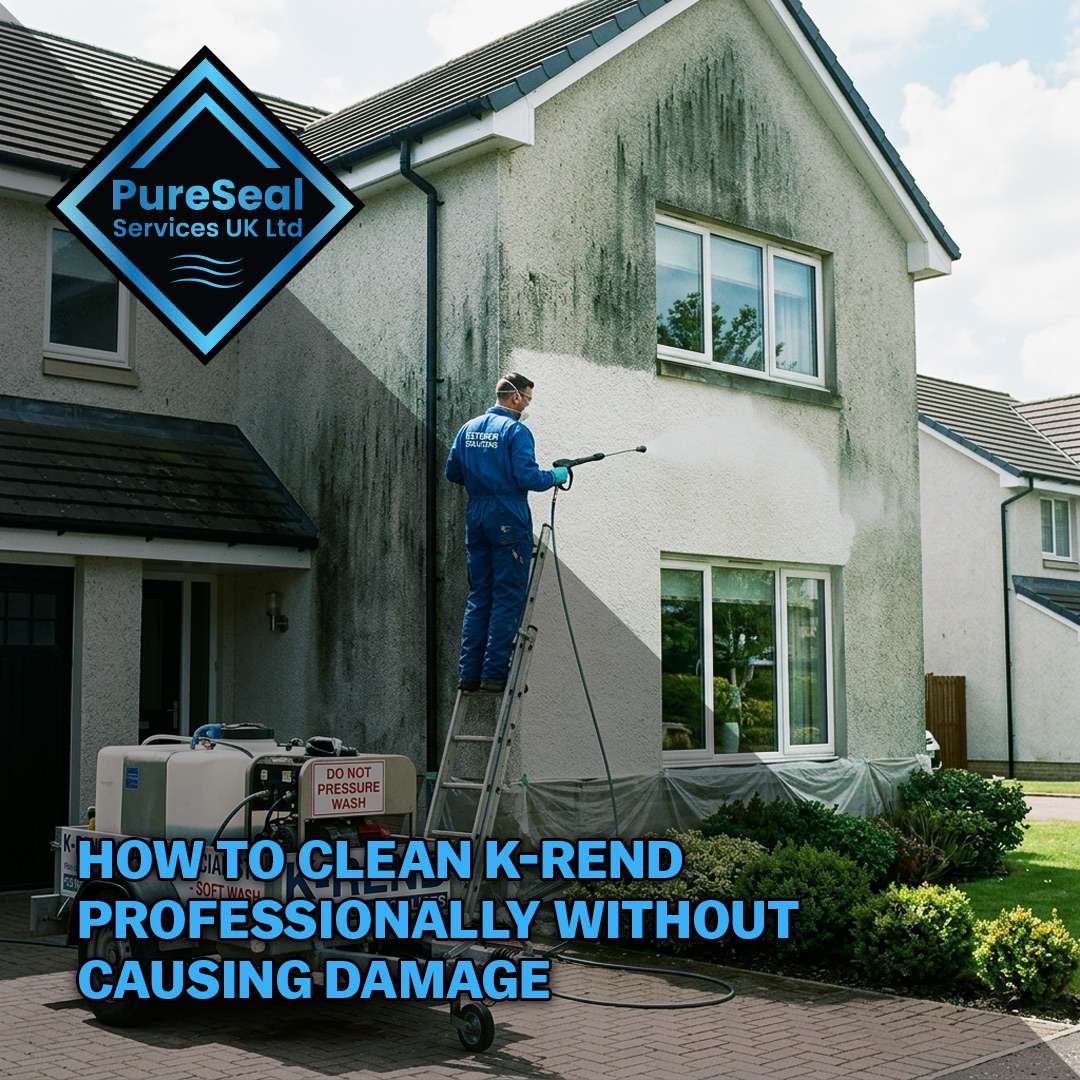
How to Clean K-Rend Professionally Without Causing Damage
Written by PureSeal Services on . Posted in Approved Applicators, Blog, Pressure Washing
How to Clean K-Rend Professionally Without Causing Damage
K-Rend has become one of the UK’s most popular render systems thanks to its attractive appearance, low maintenance requirements and wide range of colours. However, like any external building finish, it is exposed to the elements every day and will eventually develop staining from algae, mould, pollution and general dirt.
Cleaning K-Rend requires far more care than simply pressure washing the surface. Using the wrong equipment or chemicals can permanently damage the textured finish, leaving costly repairs that could have been avoided.
At Pure Seal Services, we specialise in professional render cleaning using methods designed to restore K-Rend safely while protecting its appearance for years to come.
What Is K-Rend?
K-Rend is a silicone-based coloured render system designed to provide an attractive, weather-resistant finish without requiring regular painting.
Its benefits include:
- Long-lasting colour
- Excellent weather resistance
- Breathable finish
- Reduced maintenance
- Modern appearance
- Wide range of colours
Although K-Rend is designed to resist dirt better than traditional renders, it is not completely maintenance-free.
Why Does K-Rend Become Dirty?
Over time, airborne contaminants begin settling onto the surface.
These include:
- Green algae
- Red algae
- Black mould
- Lichen
- Dust
- Traffic pollution
- Organic debris
Properties located near trees, woodland or water often experience contamination more quickly due to increased moisture and airborne spores.
North-facing walls usually become dirty first because they receive less direct sunlight, allowing biological growth to thrive.
Common Causes of K-Rend Staining
| Cause | Appearance | Common Location |
|---|---|---|
| Green algae | Green streaks | Shaded walls |
| Red algae | Pink or red staining | Damp elevations |
| Black mould | Black spotting | Around windows |
| Traffic pollution | Grey film | Roadsides |
| Lichen | White or yellow patches | Older render |
| Organic dirt | Brown staining | Beneath trees |
Why Pressure Washing Can Damage K-Rend
One of the biggest mistakes homeowners make is hiring someone who relies on high-pressure washing.
While pressure washers may produce instant visual improvements, they can also cause irreversible damage.
Potential problems include:
- Removing the protective surface
- Creating patchy colouring
- Opening the textured finish
- Forcing water behind the render
- Increasing future algae growth
- Leaving visible cleaning marks
The textured silicone finish is designed to shed water naturally. Excessive pressure may compromise this protective layer.
Professional render cleaning focuses on chemistry rather than force.
The Professional Softwashing Approach
Softwashing has become the preferred cleaning method for K-Rend throughout the UK.
Instead of relying on pressure, carefully selected cleaning solutions break down biological contamination before it is gently removed.
This approach provides several advantages:
- Minimal surface abrasion
- Reduced risk of damage
- Better long-term results
- Effective algae removal
- Longer-lasting cleanliness
The cleaning solution does the work rather than excessive water pressure.
Comparing Cleaning Methods
| Method | Safe for K-Rend | Removes Algae | Risk of Damage |
|---|---|---|---|
| High-pressure washing | ❌ | Temporary | High |
| Medium-pressure washing | ⚠️ | Moderate | Medium |
| Softwashing | ✅ | Excellent | Very Low |
| Hand scrubbing | ✅ | Good | Low |
| Steam cleaning | Sometimes | Good | Low when correctly controlled |
Step One: Inspect the Render
Every professional clean begins with a detailed inspection.
The technician assesses:
- Type of contamination
- Render condition
- Existing damage
- Hairline cracks
- Previous repairs
- Areas retaining moisture
No two K-Rend properties weather in exactly the same way.
An inspection allows the correct treatment plan to be developed before cleaning begins.
Step Two: Protect Surrounding Areas
Professional preparation is essential.
Nearby areas requiring protection include:
- Plants
- Lawns
- Garden furniture
- External lighting
- Timber features
- Composite doors
- uPVC windows
Protecting the surrounding property is just as important as cleaning the render itself.
Step Three: Apply Specialist Cleaning Chemicals
Professional render cleaning solutions are designed specifically for biological contamination.
Depending on the property, treatment may target:
- Green algae
- Red algae
- Black mould
- Organic staining
The chemicals are carefully diluted according to:
- Temperature
- Humidity
- Surface contamination
- Render type
- Manufacturer guidance
Allowing sufficient dwell time enables the solution to penetrate and destroy algae spores beneath the surface.
Why Dwell Time Matters
Many cleaning failures occur because chemicals are rinsed away too quickly.
Professional cleaners allow enough time for the treatment to:
- Kill algae
- Break down mould
- Loosen dirt
- Penetrate textured surfaces
This reduces the likelihood of rapid regrowth.
Step Four: Gentle Rinsing
Once the chemical has completed its work, the surface is rinsed carefully.
Unlike traditional pressure washing, rinsing uses controlled water flow designed to remove contamination without damaging the render.
The emphasis remains on preserving the original finish rather than blasting dirt away.
Which Chemicals Are Used?
Different contamination requires different treatments.
Common professional products include:
| Chemical Type | Primary Purpose |
|---|---|
| Professional biocide | Kill algae and mould |
| Softwash solution | Remove organic growth |
| Render detergent | Remove atmospheric dirt |
| Specialist surfactants | Improve coverage |
| Residual biocide | Reduce regrowth |
Household bleach and general-purpose exterior cleaners rarely provide the same long-term performance as professional products.
Removing Green Algae
Green algae is by far the most common issue affecting K-Rend.
It usually appears as:
- Green streaks
- Vertical lines
- Dark green patches
- General discolouration
Professional biocides destroy the algae while helping prevent spores from quickly returning.
Simply washing away the visible growth rarely solves the underlying problem.
Treating Red Algae
Red algae has become increasingly common on newer render systems.
Unlike green algae, it often penetrates deeper into microscopic pores.
Removal frequently requires:
- Specialist chemicals
- Longer dwell times
- Multiple treatments
- Careful monitoring
Patience is essential, as aggressive cleaning may permanently affect the finish.
Dealing With Black Mould
Black mould often develops around:
- Windows
- Downpipes
- Shaded walls
- Roof overhangs
Professional mould treatments attack the biological growth at its source rather than merely removing the visible staining.
Areas That Usually Need Extra Attention
| Area | Reason |
|---|---|
| North-facing walls | Less sunlight |
| Beneath gutters | Moisture retention |
| Around windows | Condensation |
| Under roof edges | Limited drying |
| Behind shrubs | Reduced airflow |
These areas often require slightly longer treatment times.
Can K-Rend Be Steam Cleaned?
Steam cleaning can sometimes be suitable for K-Rend, but only under carefully controlled conditions.
When performed professionally, low-pressure steam may help remove:
- Surface dirt
- Light biological growth
- Atmospheric pollution
However, steam alone does not normally provide long-term protection against algae.
For this reason, it is often combined with professional biocide treatments.
How Often Should K-Rend Be Cleaned?
There is no fixed schedule.
Frequency depends on:
- Property location
- Nearby trees
- Weather exposure
- Amount of shade
- Local pollution
Typical maintenance intervals are:
| Environment | Suggested Inspection |
|---|---|
| Urban | Every 3–4 years |
| Rural | Every 2–3 years |
| Woodland | Every 2 years |
| Coastal | Every 2–3 years |
Regular inspections help identify early staining before heavier contamination develops.
Common DIY Mistakes
Attempting to clean K-Rend without specialist knowledge often leads to disappointing results.
Frequent mistakes include:
- Using excessive pressure
- Applying undiluted chemicals
- Mixing cleaning products
- Scrubbing aggressively
- Cleaning during hot sunshine
- Ignoring manufacturer guidance
Even well-intentioned DIY cleaning can shorten the life of the render.
Why Professional Equipment Matters
Professional render cleaning equipment differs significantly from domestic pressure washers.
Specialist systems offer:
- Precise chemical application
- Controlled water flow
- Adjustable pressure
- Safer access equipment
- Improved coverage
- More consistent results
Using the correct equipment reduces the likelihood of accidental damage while producing a more uniform finish.
Weather Conditions Influence Cleaning Results
Professional contractors carefully monitor weather forecasts before starting work.
Ideal conditions generally include:
- Mild temperatures
- Dry weather
- Light cloud
- Low wind
Very hot weather can cause chemicals to dry too quickly, while heavy rain may dilute treatments before they have finished working.
Planning around suitable weather helps maximise cleaning performance.
Why Long-Term Prevention Is Better Than Frequent Cleaning
Although K-Rend is designed as a low-maintenance finish, allowing heavy contamination to build up makes future cleaning more difficult.
Regular professional maintenance offers several benefits:
- Less stubborn staining
- Reduced biological growth
- Lower risk of permanent discolouration
- Improved appearance
- Better protection of the render finish
Addressing algae and mould early usually requires less intensive treatment than waiting until the render is heavily affected.
Choosing a Professional K-Rend Cleaning Service
Not all exterior cleaning companies have experience working with silicone render systems. K-Rend requires an understanding of both the surface material and the cleaning products used to treat it safely.
At Pure Seal Services, every K-Rend cleaning project begins with a detailed assessment to identify the type of contamination, the condition of the render and the most suitable cleaning method. Rather than relying on high pressure, we use carefully selected softwashing treatments and controlled cleaning techniques designed to restore the render while preserving its textured finish.
Premium K-Rend cleaning is an investment in protecting your property’s exterior. While professional treatments are typically positioned at the higher end of the market due to the specialist chemicals, equipment and expertise involved, they help minimise the risk of damage and deliver results that last significantly longer than many DIY or low-cost cleaning methods.
Understanding Different Types of K-Rend Finishes
Although many people refer to all silicone render as “K-Rend”, there are actually several different finishes available, each with slightly different cleaning requirements.
Some finishes have a smoother texture, while others have a more pronounced grain that can trap dirt and biological growth more easily.
Common finishes include:
| Finish Type | Surface Texture | Cleaning Difficulty |
|---|---|---|
| Fine texture | Smooth | Easy |
| Medium texture | Slight grain | Moderate |
| Scraped finish | Textured | Moderate |
| Rough texture | Coarser finish | Higher |
The texture of the render affects how long dirt remains on the surface and how easily cleaning chemicals can penetrate biological growth.
Why Older K-Rend Can Be More Difficult to Clean
A property that has never been professionally cleaned may have years of algae, mould and pollution built up within the textured finish.
Older contamination often becomes layered.
For example:
- Dust settles first.
- Algae begins growing within the dust.
- Mould develops on top of the algae.
- Air pollution sticks to the biological growth.
- Lichen starts forming over several years.
Removing several layers of contamination requires considerably more care than cleaning recently developed staining.
Professional cleaning is about gradually removing these layers rather than trying to strip everything away in one aggressive treatment.
How Property Location Affects Cleaning Requirements
Where a property is situated has a huge impact on how quickly K-Rend becomes dirty.
For example:
| Property Location | Typical Build-up |
|---|---|
| Rural village | Green algae and moss spores |
| Woodland edge | Heavy algae and lichen |
| Coastal areas | Salt deposits and algae |
| Busy roads | Traffic film and pollution |
| Housing estates | General dirt and biological growth |
Properties surrounded by mature trees often remain damp for longer after rainfall, creating ideal conditions for algae growth.
Similarly, homes close to agricultural land can experience additional dust settling on render throughout the year.
Understanding these environmental factors helps determine the most suitable cleaning programme.
The Importance of Low-Pressure Application
One of the key differences between professional K-Rend cleaning and general exterior cleaning is the pressure used to apply chemicals.
Professional softwashing equipment delivers cleaning solutions at low pressure, allowing the chemicals to coat the render evenly without forcing water into the surface.
This offers several advantages:
- Better chemical coverage
- Reduced splash-back
- Improved dwell time
- Lower risk of damaging the textured finish
- More consistent cleaning results
The aim is to allow the cleaning solution to do the work rather than relying on water pressure.
Preventing Streaking During Cleaning
Uneven streaks are one of the biggest concerns for homeowners.
Professional cleaning techniques minimise streaking by ensuring:
- Even chemical coverage
- Correct dilution ratios
- Appropriate dwell times
- Controlled rinsing
- Cleaning from the correct direction
Inexperienced operators often apply chemicals unevenly, resulting in patchy cleaning that becomes more noticeable as the render dries.
Working methodically across each elevation helps produce a uniform appearance.
Why Biological Growth Returns
Even after a successful clean, no render can remain completely free from algae forever.
Spores are constantly carried through the air and settle naturally on exterior walls.
The speed of regrowth depends on factors such as:
- Shade
- Rainfall
- Nearby vegetation
- Air circulation
- Building orientation
- Local climate
Professional biocide treatments help slow this process by killing microscopic spores that ordinary washing leaves behind.
Identifying Early Signs of Contamination
Spotting contamination early allows it to be treated before it spreads across the entire property.
Early warning signs include:
- Slight green tint beneath window sills
- Small dark patches near guttering
- Pink staining beginning to appear
- Dull-looking render after rain
- Black spotting around sheltered areas
These small patches are often much easier to remove than widespread biological growth that has been developing for several years.
Access Equipment Makes Cleaning Safer
Many K-Rend properties include:
- Three-storey elevations
- Gable ends
- Conservatories
- Extensions
- Sloping gardens
Attempting to reach these areas with ladders alone can be unsafe and may make it difficult to apply chemicals evenly.
Professional contractors use suitable access equipment where required to maintain safe working practices while achieving an even finish across the entire property.
This also allows difficult-to-reach areas beneath rooflines and around chimney stacks to receive the same level of treatment as lower walls.
Why Every Property Needs a Different Cleaning Plan
No two homes experience identical contamination.
Before beginning work, experienced render cleaning specialists consider factors including:
| Assessment Factor | Why It Matters |
|---|---|
| Age of render | Older finishes may require gentler treatment |
| Colour | Certain stains are more visible on lighter colours |
| Previous cleaning | May influence chemical selection |
| Surrounding trees | Increase biological growth |
| Weather exposure | Affects contamination patterns |
| Existing repairs | May require additional care |
This tailored approach helps ensure the safest and most effective cleaning process for each individual property.
Investing in Professional K-Rend Maintenance
K-Rend is designed to provide decades of attractive performance, but maintaining that appearance requires the correct cleaning techniques. Choosing an experienced specialist is about far more than simply making the render look clean on the day—it is about preserving the finish for the future.
At Pure Seal Services, we use carefully selected softwashing systems, professional-grade cleaning products and proven application methods to remove algae, red algae, black mould and general dirt without relying on aggressive pressure. Every project is planned around the specific render type, level of contamination and condition of the property.
Professional K-Rend cleaning is typically priced at the premium end of the market because it involves specialist chemicals, dedicated equipment, safe access solutions and experienced technicians. While the initial investment may be higher than lower-cost alternatives, this approach significantly reduces the risk of unnecessary damage and helps maintain the appearance, durability and value of your coloured render for years to come.
Tags: Patio cleaning, Driveway cleaning, pressure washing, Roof Cleaning, Exterior cleaning, gutter cleaning, window cleaning
 Artificial and Sports Surfaces
 Awnings / Canopies / Gazebos
 Block Paving
 Brickwork
 Composite Surfaces
 Decking / Timber
 Granite
 Imprinted Concrete
 Internal Masonry
 Limestone
 Marble
 Metal Cladding
 Polished or Honed Stone
 Porcelain
 Render
 Resin Bond
 Road and Rail Signs
 Roof Tiles / Slates
 Sandstone
 Slate
Slate Solar Panels and Glass
 Stone Sills and Pier Caps
 Tarmac and Asphalt
 Gutters & UPVC
 Acid Damage
 Biofilm
 Bitumen
 Blood
Blood Carbon
 Concrete / Grout / Mortar
 Copper Oxide
 Efflorescence
 Egg
Egg Failed Sealer
 Fire Damage
 Fuel / Oil
 Graffiti
 Grease / Fat / Cooking Oil
 Lawn Fertiliser
 Lead Carbonate
 Lead Oxide
 Paint Splashes
 Rust
Rust Tar & Glue
 Tannin Removers
 Traffic Film Removers
 Trapped Moisture / Sealer Repairs
 Urine Neutralisers