
Softwashing Render vs Pressure Washing Render: Which Is Best?
Written by PureSeal Services on . Posted in Approved Applicators, Blog, Pressure Washing
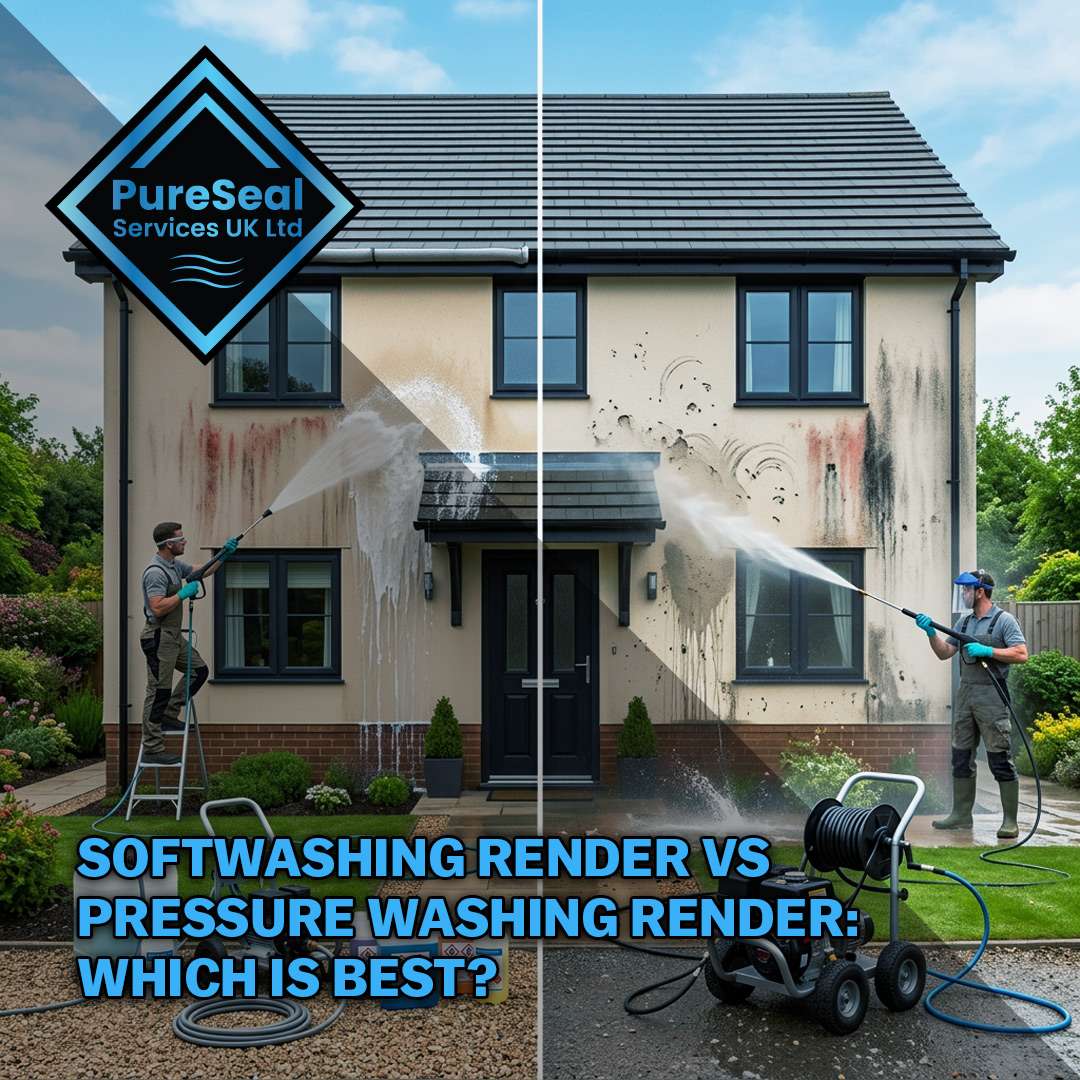
Softwashing Render vs Pressure Washing Render: Which Is Best?
If your property’s render has started turning green, black or stained, you’re probably wondering which cleaning method is the right choice. Two of the most commonly discussed methods are softwashing and pressure washing, but they deliver very different results.
At Pure Seal Services, we specialise in professional exterior cleaning and understand that every render surface requires the correct treatment. Choosing the wrong method can permanently damage modern render systems, while choosing the right one can restore your property’s appearance and keep it cleaner for much longer.
This guide explains how each method works, their advantages and disadvantages, typical costs, and why softwashing has become the preferred choice for most render cleaning projects across the UK.
Why Does Render Become Dirty?
Modern render is designed to be attractive and weather resistant, but it is constantly exposed to the elements.
Over time you may notice:
- Green algae
- Black mould
- Red algae
- Lichen
- Atmospheric pollution
- Road traffic film
- Dust and pollen
- Water staining
These contaminants don’t simply sit on the surface—they often grow within the tiny pores of the render itself.
This is why removing only the visible staining rarely solves the problem.
What Is Softwashing?
Softwashing is a low-pressure cleaning process that combines specialist cleaning solutions with gentle water application.
Instead of blasting dirt away, the cleaning solution breaks down biological growth before it is carefully rinsed from the surface.
The treatment also kills remaining spores that cannot be seen.
Typical softwashing involves:
| Step | Purpose |
|---|---|
| Inspection | Identify render type and contamination |
| Pre-treatment | Apply specialist cleaning solution |
| Dwell time | Allow solution to kill algae and mould |
| Gentle rinse | Remove contamination safely |
| Final inspection | Ensure even cleaning results |
Because very little pressure is used, the render itself remains undamaged.
What Is Pressure Washing?
Pressure washing relies on high-pressure water to physically remove dirt from the render surface.
Typical domestic pressure washers operate between:
- 100–150 bar
- 1,500–3,000 PSI
Commercial machines can be considerably more powerful.
Rather than chemically treating contamination, pressure washing attempts to force it away using water pressure alone.
While this can remove surface dirt quickly, it may not remove the microscopic spores responsible for future regrowth.
Comparing Both Methods
| Feature | Softwashing | Pressure Washing |
|---|---|---|
| Water pressure | Very low | High |
| Removes algae | Yes | Mostly surface only |
| Kills spores | Yes | Usually no |
| Risk of render damage | Very low | High |
| Suitable for coloured render | Yes | Often not recommended |
| Longer-lasting results | Yes | Usually shorter |
| Water usage | Lower | Higher |
| Risk of streaking | Low | Higher |
Why Most Modern Render Manufacturers Recommend Low Pressure
Many modern render systems are designed with decorative finishes that should not be subjected to aggressive pressure washing.
These include:
- Silicone render
- Acrylic render
- Monocouche render
- Thin coat render
- Coloured render systems
High pressure can remove the protective surface layer, leading to:
- Colour fading
- Rough patches
- Water ingress
- Hairline cracking
- Patchy appearance
Softwashing avoids these risks by relying on chemistry rather than force.
How Softwashing Actually Cleans
One common misconception is that the cleaning chemical simply bleaches the surface.
In reality, specialist softwash treatments:
- Break down algae cells
- Destroy mould spores
- Remove bacteria
- Eliminate fungi
- Continue working after application
Even areas that still appear slightly stained immediately after treatment often continue improving over several weeks as weathering removes dead organic matter.
This provides a much deeper clean than pressure washing alone.
Why Pressure Washing Often Gives Short-Term Results
Pressure washing can make render appear clean initially because it removes visible contamination.
However, tiny spores often remain hidden inside the porous render surface.
Once moisture returns, these spores begin growing again.
This frequently leads to:
- Green patches returning
- Black mould reappearing
- Uneven staining
- Faster recolonisation
Many homeowners notice regrowth within months if no biocidal treatment follows the cleaning.
Which Method Is Safer?
Safety is one of the biggest differences.
Softwashing Risks
Very low when carried out professionally:
- Minimal surface abrasion
- Low risk of cracking
- Low water penetration
- Gentle on surrounding landscaping
Pressure Washing Risks
Higher potential for damage:
- Surface erosion
- Blown render
- Water forced behind render
- Damaged sealants
- Chipped edges
- Etching
Older render can be especially vulnerable.
Which Render Types Benefit Most From Softwashing?
Softwashing is ideal for almost every decorative render.
| Render Type | Softwashing Suitable? |
|---|---|
| Silicone render | ✔ Yes |
| Monocouche render | ✔ Yes |
| Acrylic render | ✔ Yes |
| Mineral render | ✔ Yes |
| Painted render | ✔ Yes |
| Lime render | Usually (after assessment) |
Each surface should always be inspected before treatment.
How Long Do Results Last?
Results depend on:
- Property location
- Shade
- Nearby trees
- Moisture levels
- Weather exposure
However, softwashing generally keeps render cleaner for considerably longer because it removes the source of biological growth.
| Cleaning Method | Typical Appearance Retention |
|---|---|
| Pressure washing only | 6–12 months |
| Professional softwashing | 2–5 years (depending on conditions) |
Properties surrounded by woodland or close to rivers may experience faster natural regrowth regardless of cleaning method.
Which Uses More Water?
Softwashing is surprisingly more environmentally efficient regarding water consumption.
Pressure washing relies on continuous high-volume water flow.
Softwashing instead relies on:
- Specialist treatment
- Controlled application
- Gentle rinsing
Less water is generally required because the cleaning solution performs most of the work.
Is Pressure Washing Ever Appropriate?
Pressure washing isn’t always the wrong choice.
It can be useful for:
- Concrete walls
- Brickwork
- Certain paving
- Industrial surfaces
- Heavy masonry
However, decorative residential render is an entirely different material.
Using the same cleaning approach on delicate render often creates unnecessary risks.
Can Softwashing Remove Black Staining?
Yes.
Black staining is usually caused by mould or airborne pollution combined with biological growth.
Professional softwashing breaks down:
- Black mould
- Organic staining
- Atmospheric grime
- Surface contamination
Very old staining may require multiple applications depending on severity.
What About Red Algae?
Red algae has become increasingly common on UK render.
It is particularly difficult because it grows deep within the render pores.
Pressure washing often struggles to remove it permanently.
Softwashing chemically attacks the algae itself rather than simply washing away the visible growth.
This makes it significantly more effective on persistent red staining.
Will Pressure Washing Damage Coloured Render?
Potentially, yes.
Coloured render obtains its appearance from pigments built into the finish.
Excessive pressure may:
- Strip colour
- Create lighter patches
- Produce inconsistent finishes
- Expose aggregate
Repairing damaged coloured render can be expensive and usually requires specialist remedial work.
Which Looks Better Afterwards?
Professional softwashing generally provides a more uniform finish.
Because contamination is killed evenly across the surface, the property develops a consistent appearance rather than the streaking sometimes associated with aggressive pressure washing.
The finish often looks:
- Cleaner
- Brighter
- More natural
- Evenly coloured
Typical Costs
Prices vary depending on:
- Property size
- Access requirements
- Amount of contamination
- Render type
- Height
Indicative UK pricing:
| Property | Typical Professional Softwashing Cost |
|---|---|
| Small bungalow | £500–£750 |
| Semi-detached house | £700–£1,100 |
| Detached house | £900–£1,800+ |
| Large executive property | £1,800–£3,500+ |
Premium companies often charge more because they invest in specialist cleaning systems, experienced technicians, insurance, and high-quality cleaning products rather than competing on the lowest price.
Why Professional Softwashing Delivers Better Value
Although pressure washing may appear cheaper initially, repeated cleaning due to rapid regrowth can increase long-term costs.
Professional softwashing offers greater value by:
- Killing biological growth at its source
- Protecting delicate render finishes
- Reducing the likelihood of repeat cleaning
- Maintaining the property’s kerb appeal for longer
- Minimising the risk of expensive render repairs
For homeowners who want a safe, long-lasting solution rather than a quick cosmetic improvement, investing in a specialist service often proves more economical over time.
If you’re considering having your render professionally cleaned, choosing an experienced contractor using the correct low-pressure methods is one of the best ways to protect your property’s exterior while achieving outstanding results. At Pure Seal Services, every render cleaning project is carefully assessed to ensure the most appropriate treatment is selected for the specific render system, contamination level and condition of the property.
Does the Age of the Render Matter?
Absolutely. The age and condition of the render should always influence the cleaning method selected.
Newer render systems are often coated with factory-applied finishes designed to repel water while allowing the wall to breathe. Although durable, these coatings can still be damaged if subjected to excessive water pressure.
Older render may present different challenges, including:
- Hairline cracks
- Previous repairs
- Weathered surfaces
- Areas where the finish has become more porous
- Historic paint coatings
An experienced contractor will inspect the render before recommending any cleaning process. In many cases, a gentle softwash remains the safest option because it avoids placing unnecessary stress on ageing surfaces.
| Age of Render | Recommended Approach |
|---|---|
| Under 5 years | Gentle softwashing if cleaning is required |
| 5–15 years | Softwashing after inspection |
| 15–30 years | Softwashing with additional care around defects |
| Over 30 years | Full assessment before any cleaning begins |
The Importance of Treating the Cause, Not Just the Symptoms
One of the biggest differences between softwashing and pressure washing is the philosophy behind the cleaning process.
Pressure washing focuses on removing what can be seen.
Softwashing focuses on removing what cannot be seen.
Microscopic algae spores, mould colonies and bacteria are often invisible to the naked eye. Even when the render looks clean after pressure washing, these organisms may still be alive beneath the surface.
Once moisture returns, they simply begin growing again.
Softwashing is designed to interrupt this cycle by destroying biological contamination before it has the opportunity to regenerate.
This preventative approach is one of the main reasons homeowners often experience longer-lasting results.
Why Some Homes Get Dirtier Than Others
Two neighbouring houses can have completely different levels of staining.
Several environmental factors influence how quickly render becomes dirty.
North-facing walls
Walls that receive little direct sunlight remain damp for longer, creating perfect conditions for algae growth.
Trees and hedges
Overhanging vegetation traps moisture while reducing airflow around the property.
Coastal locations
Salt carried inland combines with moisture and airborne debris, accelerating the build-up of surface contamination.
Rural areas
Agricultural dust, spores and organic material settle on render throughout the year.
Busy roads
Traffic pollution gradually forms dark staining, particularly on lighter-coloured render.
These environmental factors help determine how often professional cleaning may be required.
Common Myths About Pressure Washing Render
Many homeowners assume pressure washing is always the quickest and cheapest solution.
Let’s separate fact from fiction.
| Myth | Reality |
|---|---|
| High pressure cleans better | Cleaning chemicals often do more of the work than pressure alone. |
| Pressure washing kills algae | It usually removes visible growth but doesn’t always destroy spores. |
| All render is strong enough | Modern decorative render can be surprisingly delicate. |
| Softwashing uses harsh pressure | Professional softwashing uses very low pressure. |
| Once cleaned, render stays clean forever | All exterior surfaces will eventually become dirty again. |
Understanding these differences helps homeowners make informed decisions rather than simply choosing whichever method appears fastest.
Weather Conditions Can Affect Cleaning
Professional render cleaning isn’t simply carried out regardless of the weather.
Several factors influence the quality of the finished result.
Ideal conditions include:
- Mild temperatures
- Dry weather
- Limited wind
- No immediate heavy rainfall
Heavy rain can reduce the effectiveness of certain cleaning treatments if it occurs before sufficient dwell time has been achieved.
Likewise, extremely hot weather may cause cleaning solutions to dry too quickly, reducing their effectiveness.
Professional contractors monitor weather forecasts carefully before beginning work.
Protecting Surrounding Areas During Softwashing
Another advantage of professional softwashing is the careful preparation carried out before cleaning begins.
This may include:
- Wetting surrounding plants
- Protecting delicate shrubs
- Covering sensitive areas where required
- Managing runoff responsibly
- Pre-inspecting windows and seals
Attention to detail helps ensure the cleaning process is safe for both the property and its surroundings.
Can Softwashing Improve Property Value?
Although cleaning alone won’t increase the structural value of a home, presentation plays a major role in first impressions.
Clean render can make a property appear:
- Better maintained
- More modern
- Brighter
- More attractive from the roadside
Estate agents frequently discuss kerb appeal because buyers often form opinions before entering the property.
Removing years of green and black staining can dramatically transform the appearance of a home without the cost of repainting or replacing the render.
Signs Your Render Needs Professional Cleaning
Many homeowners wait until staining becomes severe before seeking professional help.
Earlier treatment is often easier and more cost-effective.
Watch for:
- Green patches appearing after winter
- Black spots spreading across shaded walls
- Red algae beginning to develop
- Uneven discolouration
- Dark streaks beneath windows
- Moss beginning to grow around joints or ledges
Addressing contamination early generally results in quicker cleaning and a better overall finish.
Why DIY Pressure Washing Can Be Risky
Hiring a pressure washer from a local hire shop may seem like a cost-saving solution.
However, without experience it is easy to cause irreversible damage.
Common DIY mistakes include:
- Holding the lance too close
- Using excessive pressure
- Cleaning at the wrong angle
- Allowing water behind the render
- Damaging expansion joints
- Leaving visible cleaning stripes
Repairs to damaged render often cost considerably more than having it professionally cleaned in the first place.
The Value of Professional Equipment
Professional softwashing equipment differs significantly from domestic cleaning machines.
Specialist systems allow contractors to:
- Apply cleaning solutions evenly
- Control application rates
- Reach difficult areas safely
- Maintain consistent coverage
- Rinse gently without damaging the finish
Combined with experience and product knowledge, this produces more predictable and consistent results than general-purpose pressure washing equipment.
Questions to Ask Before Hiring a Render Cleaning Company
Choosing the right contractor is just as important as choosing the right cleaning method.
Before booking any work, consider asking:
| Question | Why It Matters |
|---|---|
| Do you specialise in render cleaning? | Experience reduces the risk of damage. |
| Do you use softwashing? | Low-pressure methods are generally safer. |
| Will you inspect the render first? | Every property is different. |
| Are you fully insured? | Protects both homeowner and contractor. |
| Do you explain the expected results? | Sets realistic expectations before work begins. |
A reputable company should be happy to discuss its process in detail rather than simply quoting a price.
Investing in Long-Term Render Protection
For many homeowners, the cheapest quote is not necessarily the best value.
Professional softwashing requires specialist equipment, high-quality cleaning solutions, trained technicians and careful preparation. While this often places premium services at the higher end of the price range, it also reduces the likelihood of accidental damage and premature regrowth.
When comparing quotations, it is worth considering what is actually included. A comprehensive render cleaning service should focus on delivering long-lasting results rather than simply making the property look cleaner for a few weeks.
Choosing an experienced specialist such as Pure Seal Services means your render is assessed correctly, treated using appropriate low-pressure techniques and cleaned with the long-term health of the surface in mind, helping to preserve both the appearance and integrity of your property’s exterior.
Tags: Patio cleaning, Driveway cleaning, pressure washing, Roof Cleaning, Exterior cleaning, gutter cleaning, window cleaning
 Artificial and Sports Surfaces
 Awnings / Canopies / Gazebos
 Block Paving
 Brickwork
 Composite Surfaces
 Decking / Timber
 Granite
 Imprinted Concrete
 Internal Masonry
 Limestone
 Marble
 Metal Cladding
 Polished or Honed Stone
 Porcelain
 Render
 Resin Bond
 Road and Rail Signs
 Roof Tiles / Slates
 Sandstone
 Slate
Slate Solar Panels and Glass
 Stone Sills and Pier Caps
 Tarmac and Asphalt
 Gutters & UPVC
 Acid Damage
 Biofilm
 Bitumen
 Blood
Blood Carbon
 Concrete / Grout / Mortar
 Copper Oxide
 Efflorescence
 Egg
Egg Failed Sealer
 Fire Damage
 Fuel / Oil
 Graffiti
 Grease / Fat / Cooking Oil
 Lawn Fertiliser
 Lead Carbonate
 Lead Oxide
 Paint Splashes
 Rust
Rust Tar & Glue
 Tannin Removers
 Traffic Film Removers
 Trapped Moisture / Sealer Repairs
 Urine Neutralisers