
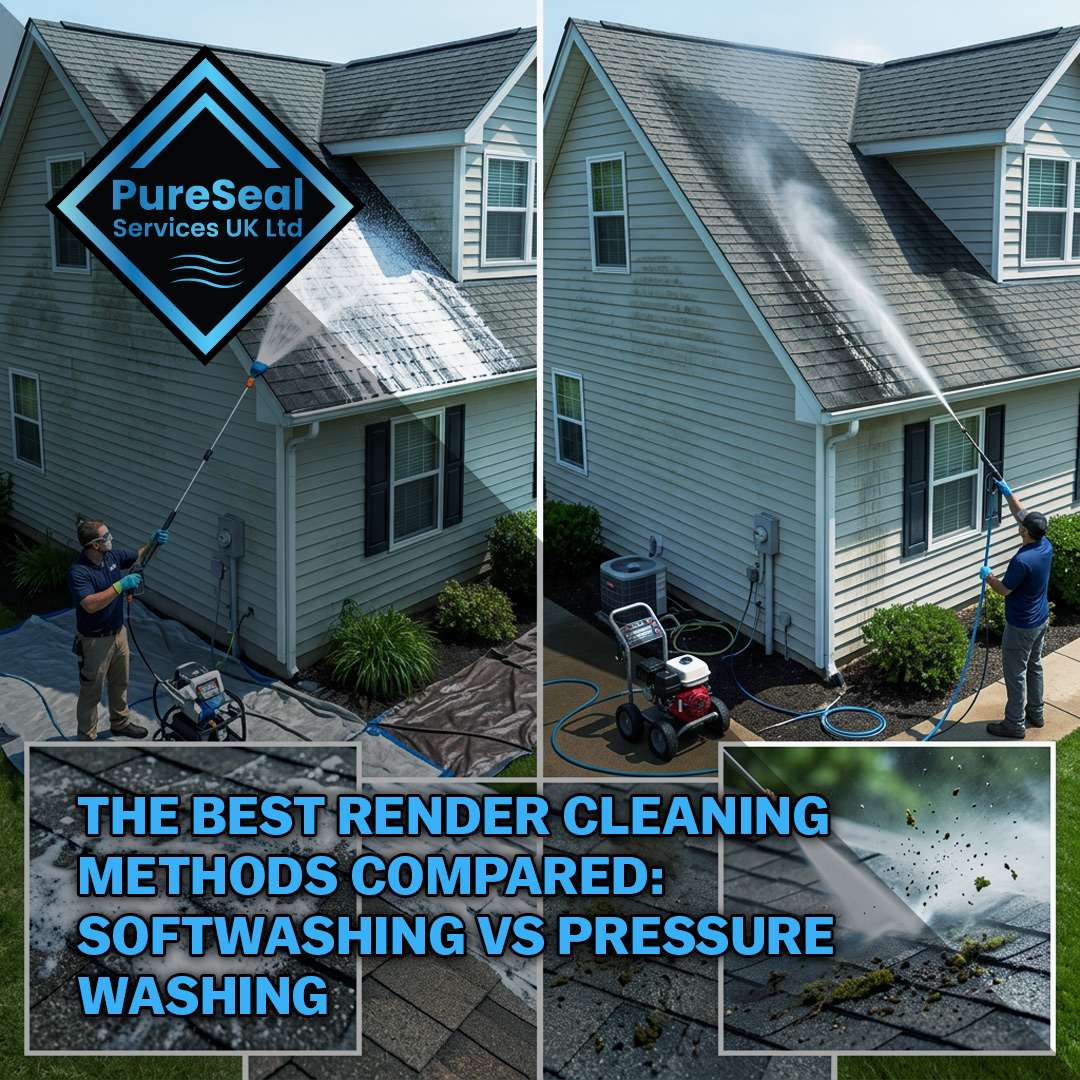
The Best Render Cleaning Methods Compared: Softwashing vs Pressure Washing
Written by PureSeal Services on . Posted in Pressure Washing, Approved Applicators, Blog
The Best Render Cleaning Methods Compared: Softwashing vs Pressure Washing
Render is one of the most popular exterior finishes on modern UK homes, offering a clean appearance and excellent weather resistance. Over time, however, even the highest-quality render will accumulate green algae, red algae, black mould, lichen, pollution and general dirt.
When it comes to restoring the appearance of rendered walls, homeowners are often faced with two common options: softwashing and pressure washing. While both methods can clean exterior surfaces, they work in very different ways and are not equally suitable for all render types.
At Pure Seal Services, we specialise in professional render cleaning using carefully selected methods that prioritise protecting the render while delivering long-lasting results. Understanding the differences between these cleaning techniques will help you choose the safest option for your property.
Why Render Requires Specialist Cleaning
Unlike brick or concrete, render is designed with a decorative finish that should remain intact throughout its lifespan.
Modern render systems include:
- Silicone render
- Acrylic render
- Monocouche render
- Through-coloured render
- Mineral render
Each has different characteristics, but they all share one important requirement: careful cleaning.
Using the wrong method can damage the surface, alter the appearance or reduce the life of the finish.
Common Types of Render Contamination
| Contaminant | Appearance | Typical Cause |
|---|---|---|
| Green algae | Green streaks | Damp conditions |
| Red algae | Pink or red patches | Airborne spores |
| Black mould | Black spotting | Moisture and shade |
| Lichen | White or yellow crusts | Long-term biological growth |
| Pollution | Grey staining | Traffic and industry |
| Organic dirt | Brown staining | Trees and weather |
Different contaminants require different cleaning approaches.
What Is Softwashing?
Softwashing is a specialist cleaning process that relies primarily on professional cleaning solutions rather than high water pressure.
Instead of blasting contamination from the surface, carefully selected chemicals:
- Kill algae
- Destroy mould
- Break down biological growth
- Reduce future regrowth
Once the treatment has done its job, the render is gently rinsed where required.
The cleaning power comes from the chemistry, not force.
What Is Pressure Washing?
Pressure washing relies on powerful jets of water to remove dirt and contamination.
While it can be highly effective on robust surfaces such as concrete, paving and some masonry, render requires much greater care.
Pressure washing physically removes contamination by force rather than treating the underlying biological growth.
This distinction is important when considering long-term results.
Comparing the Two Methods
| Feature | Softwashing | Pressure Washing |
|---|---|---|
| Uses chemicals | Yes | Sometimes |
| Uses high pressure | No | Yes |
| Removes algae | Excellent | Temporary |
| Kills spores | Yes | No |
| Suitable for render | Yes | Limited |
| Risk of damage | Very low | Higher |
How Softwashing Works
Professional softwashing generally follows several stages.
Step 1 – Inspection
The render is inspected to identify:
- Type of render
- Existing damage
- Biological contamination
- Previous repairs
Step 2 – Surface Preparation
Nearby plants, doors, windows and external features are protected before treatment begins.
Step 3 – Chemical Application
Professional cleaning solutions are applied evenly across the render.
These products target:
- Green algae
- Red algae
- Black mould
- Organic staining
Step 4 – Dwell Time
The chemicals are allowed sufficient time to work before rinsing.
Step 5 – Gentle Rinse
The surface is rinsed carefully using controlled water pressure where necessary.
How Pressure Washing Works
Pressure washing uses mechanical force.
Water is delivered through a narrow nozzle at high pressure.
The operator adjusts:
- Pressure
- Spray angle
- Water flow
- Distance from the wall
Although experienced operators can reduce the risk of damage, excessive pressure can still affect delicate render finishes.
Why High Pressure Can Be a Problem
Many render systems have textured surfaces designed to resist weather.
High-pressure water may:
- Remove the surface finish
- Open microscopic pores
- Cause patchy colouring
- Force water behind the render
- Damage repairs
- Increase future contamination
This is why many render manufacturers recommend avoiding excessive pressure.
Potential Risks of Pressure Washing
| Risk | Possible Outcome |
|---|---|
| Surface erosion | Rough finish |
| Colour inconsistency | Patchy appearance |
| Water ingress | Damp issues |
| Damaged joints | Increased maintenance |
| Faster algae return | Shorter cleaning lifespan |
These risks increase when incorrect equipment or inexperienced operators are involved.
Which Method Removes Algae Better?
Algae is a living organism.
Simply washing away the visible growth does not eliminate the spores responsible for future regrowth.
Softwashing:
- Kills algae
- Removes contamination
- Helps prevent rapid regrowth
Pressure washing:
- Removes surface growth
- Leaves spores alive
- Allows faster return
This is one of the biggest reasons professional render specialists often favour softwashing.
Dealing With Red Algae
Red algae has become increasingly common on UK properties.
Unlike green algae, it often penetrates tiny pores within the render.
Professional softwashing treatments allow specialist chemicals time to penetrate the contamination.
Pressure washing alone frequently struggles to remove established red algae and may leave staining behind.
What About Black Mould?
Black mould develops in damp, shaded environments.
Common locations include:
- Around windows
- Under rooflines
- North-facing walls
- Behind shrubs
Because mould grows beneath the surface, chemical treatment is usually more effective than force alone.
Professional softwashing destroys the mould before it is rinsed away.
Comparing Performance
| Cleaning Task | Softwashing | Pressure Washing |
|---|---|---|
| Green algae | ★★★★★ | ★★★☆☆ |
| Red algae | ★★★★★ | ★★☆☆☆ |
| Black mould | ★★★★★ | ★★★☆☆ |
| Traffic pollution | ★★★★☆ | ★★★★☆ |
| General dirt | ★★★★☆ | ★★★★★ |
Both methods have strengths, but softwashing offers superior performance against biological growth.
Which Render Types Benefit Most From Softwashing?
Softwashing is commonly used on:
- Silicone render
- Acrylic render
- K-Rend
- Monocouche render
- Through-coloured render
- Painted render
These finishes benefit from gentle treatment rather than excessive pressure.
Can Pressure Washing Ever Be Suitable?
Pressure washing is not automatically unsuitable.
Very carefully controlled pressure may sometimes be appropriate for:
- Heavy surface dirt
- Certain mineral renders
- Pre-treatment before chemical application
- Limited rinsing
The key is ensuring the pressure remains appropriate for the render type.
Professional contractors understand these limits.
The Importance of Cleaning Chemicals
Professional render cleaning chemicals are designed specifically for biological contamination.
Common treatments include:
- Specialist biocides
- Softwash solutions
- Render detergents
- Surfactants
These products continue working after application by killing algae spores rather than simply removing visible staining.
Weather Also Affects Cleaning Results
Professional render cleaning is heavily influenced by weather conditions.
Ideal conditions generally include:
- Mild temperatures
- Dry weather
- Light cloud
- Low wind
Very hot conditions can reduce chemical dwell time, while heavy rain may dilute treatments before they have finished working.
Planning work around suitable weather helps maximise results.
Which Method Lasts Longer?
One of the biggest differences between the two approaches is longevity.
Because softwashing destroys biological growth, results generally last significantly longer.
Pressure washing may produce impressive immediate results, but algae often begins returning more quickly because the spores remain alive.
Long-Term Comparison
| Factor | Softwashing | Pressure Washing |
|---|---|---|
| Immediate appearance | Excellent | Excellent |
| Long-term cleanliness | Excellent | Moderate |
| Biological control | Excellent | Limited |
| Surface protection | Excellent | Moderate |
| Risk of repeat staining | Lower | Higher |
Why Professional Assessment Is Essential
No two render cleaning projects are identical.
Before selecting a cleaning method, experienced specialists assess:
- Type of render
- Colour
- Age
- Existing damage
- Biological contamination
- Environmental conditions
This allows the safest and most effective process to be chosen for each individual property.
Choosing the Right Professional Service
Render cleaning should never be approached with a one-size-fits-all mindset. The safest and most effective method depends on the render system, the level of contamination and the condition of the surface. While pressure washing has its place on certain robust exterior materials, softwashing is generally the preferred option for modern coloured render because it targets biological growth without relying on aggressive force.
At Pure Seal Services, every render cleaning project begins with a thorough inspection before selecting the most appropriate treatment. By combining specialist softwashing chemicals with controlled application techniques, we remove green algae, red algae, black mould and general staining while helping to preserve the appearance and integrity of the render.
Professional render cleaning sits at the premium end of the market due to the specialist equipment, high-quality cleaning products and experienced technicians involved. Although it represents a greater investment than basic cleaning services, it delivers safer, longer-lasting results and helps protect the appearance and value of your property for years to come.
Understanding Why Softwashing Delivers Longer-Lasting Results
One of the biggest advantages of softwashing is that it treats the cause of staining rather than just the visible symptoms.
Green algae, black mould and red algae are living organisms. Even if they are removed from the surface with high-pressure water, tiny spores often remain embedded within the textured finish of the render.
Professional softwashing chemicals are designed to:
- Kill spores
- Penetrate microscopic pores
- Break down biological growth
- Reduce the speed of regrowth
This is why professionally softwashed render often stays cleaner for considerably longer than render cleaned using pressure alone.
Which Areas of a Property Become Dirty First?
Not every wall becomes contaminated at the same rate.
Certain elevations remain damp for longer, making them more susceptible to algae and mould.
These commonly include:
| Location | Why It Gets Dirty Faster |
|---|---|
| North-facing walls | Minimal direct sunlight |
| Under roof overhangs | Slower drying |
| Beneath leaking gutters | Constant moisture |
| Behind hedges | Restricted airflow |
| Near trees | Shade and airborne spores |
| Close to flower beds | Higher humidity |
These areas usually benefit most from a professional softwashing treatment because biological contamination is often well established before it becomes obvious.
Softwashing Is About Precision, Not Speed
A common misconception is that the fastest cleaning method is automatically the best.
Pressure washing often produces immediate visual results because dirt is physically blasted away.
Softwashing is a more controlled process.
Professional technicians carefully assess:
- The render finish
- Weather conditions
- Type of staining
- Appropriate chemical strength
- Required dwell time
This attention to detail helps produce a more even finish while protecting the render surface.
Why Water Pressure Isn’t the Main Cleaning Force
Many homeowners are surprised to discover that professional render cleaning uses relatively little pressure.
The cleaning process depends primarily on the chemical treatment rather than the force of the water.
Low-pressure application offers several advantages:
- Reduced risk of surface damage
- Even chemical coverage
- Better penetration into textured render
- Lower chance of forcing water behind the render
- Safer treatment of delicate finishes
The rinse stage simply removes contamination that has already been broken down by the cleaning solution.
Comparing Cleaning Costs
Although every property is different, the cleaning method chosen can influence the overall investment.
Softwashing generally involves:
- Specialist chemicals
- Longer application times
- Detailed preparation
- Professional assessment
- Follow-up treatments where required
Pressure washing may appear less expensive initially because it is often quicker to complete.
However, if staining returns sooner or the render becomes damaged, the long-term cost can be considerably higher.
| Method | Initial Investment | Long-Term Value |
|---|---|---|
| Softwashing | Premium | Excellent |
| Pressure washing | Lower initially | Moderate |
For homeowners looking to protect coloured render, investing in a professional softwashing service often provides better long-term value.
Environmental Considerations
Modern render cleaning places significant emphasis on responsible chemical use.
Professional contractors carefully manage:
- Chemical dilution
- Plant protection
- Run-off
- Weather conditions
- Waste management
Using precisely diluted cleaning solutions reduces unnecessary chemical use while still achieving excellent cleaning performance.
Surrounding vegetation is often pre-soaked and protected before treatment begins.
Why DIY Render Cleaning Can Become Expensive
Many homeowners purchase domestic pressure washers hoping to remove algae themselves.
Unfortunately, this often leads to problems such as:
- Uneven cleaning
- Zebra striping
- Surface damage
- Persistent staining
- Faster biological regrowth
Attempting repeated DIY cleaning can also become expensive once equipment, cleaning products and personal time are considered.
Professional treatment aims to resolve the issue correctly the first time.
Render Colour Can Influence Cleaning Results
The colour of the render affects how contamination appears after years of weather exposure.
| Render Colour | Most Noticeable Staining |
|---|---|
| White | Green algae, black mould |
| Cream | Red algae and pollution |
| Beige | Organic staining |
| Light grey | Mould and algae |
| Dark grey | Dust and water marks |
| Charcoal | Mineral deposits |
Professional softwashing systems can be adapted to suit different render colours, helping to achieve an even finish without unnecessarily aggressive cleaning.
When Pressure Washing May Still Be Used
Although softwashing is generally preferred for coloured render, pressure washing still has a place within exterior cleaning.
Experienced contractors may use carefully controlled pressure for:
- Final rinsing after chemical treatment
- Cleaning adjacent paving
- Removing loose surface debris
- Certain robust masonry surfaces
The important distinction is that pressure becomes a supporting tool rather than the primary cleaning method when working on delicate render finishes.
Maintaining Your Render After Professional Cleaning
Once the render has been professionally cleaned, a few simple maintenance measures can help it remain cleaner for longer.
These include:
- Keeping gutters clear
- Trimming back overhanging trees
- Improving airflow around walls
- Removing climbing plants
- Addressing leaks promptly
- Arranging periodic inspections
These small preventative measures reduce the moisture that encourages algae and mould to develop.
Why Experience Makes the Biggest Difference
The equipment alone does not determine the quality of a render cleaning service.
Successful cleaning depends on understanding:
- Different render systems
- Biological contamination
- Safe chemical selection
- Correct application methods
- Appropriate dwell times
- Environmental conditions
Every property presents slightly different challenges, which is why experienced assessment is such an important part of the process.
Investing in the Right Cleaning Method
Choosing between softwashing and pressure washing is about more than simply removing visible staining. The right method should also protect the render, minimise the risk of damage and provide results that last.
At Pure Seal Services, we assess every rendered property individually before recommending the most appropriate cleaning solution. Our professional softwashing process is designed to tackle green algae, red algae, black mould and general dirt using carefully selected cleaning products and controlled application techniques that help preserve the appearance of modern render systems.
As a premium specialist service, professional render cleaning reflects the expertise, equipment and products required to achieve high-quality, long-lasting results. While it represents a higher investment than basic pressure washing alone, it provides greater protection for your property’s exterior and helps maintain the clean, modern appearance that coloured render is designed to deliver.
Tags: pressure washing, Roof Cleaning, Exterior cleaning, gutter cleaning, window cleaning, Patio cleaning, Driveway cleaning
 Artificial and Sports Surfaces
 Awnings / Canopies / Gazebos
 Block Paving
 Brickwork
 Composite Surfaces
 Decking / Timber
 Granite
 Imprinted Concrete
 Internal Masonry
 Limestone
 Marble
 Metal Cladding
 Polished or Honed Stone
 Porcelain
 Render
 Resin Bond
 Road and Rail Signs
 Roof Tiles / Slates
 Sandstone
 Slate
Slate Solar Panels and Glass
 Stone Sills and Pier Caps
 Tarmac and Asphalt
 Gutters & UPVC
 Acid Damage
 Biofilm
 Bitumen
 Blood
Blood Carbon
 Concrete / Grout / Mortar
 Copper Oxide
 Efflorescence
 Egg
Egg Failed Sealer
 Fire Damage
 Fuel / Oil
 Graffiti
 Grease / Fat / Cooking Oil
 Lawn Fertiliser
 Lead Carbonate
 Lead Oxide
 Paint Splashes
 Rust
Rust Tar & Glue
 Tannin Removers
 Traffic Film Removers
 Trapped Moisture / Sealer Repairs
 Urine Neutralisers