
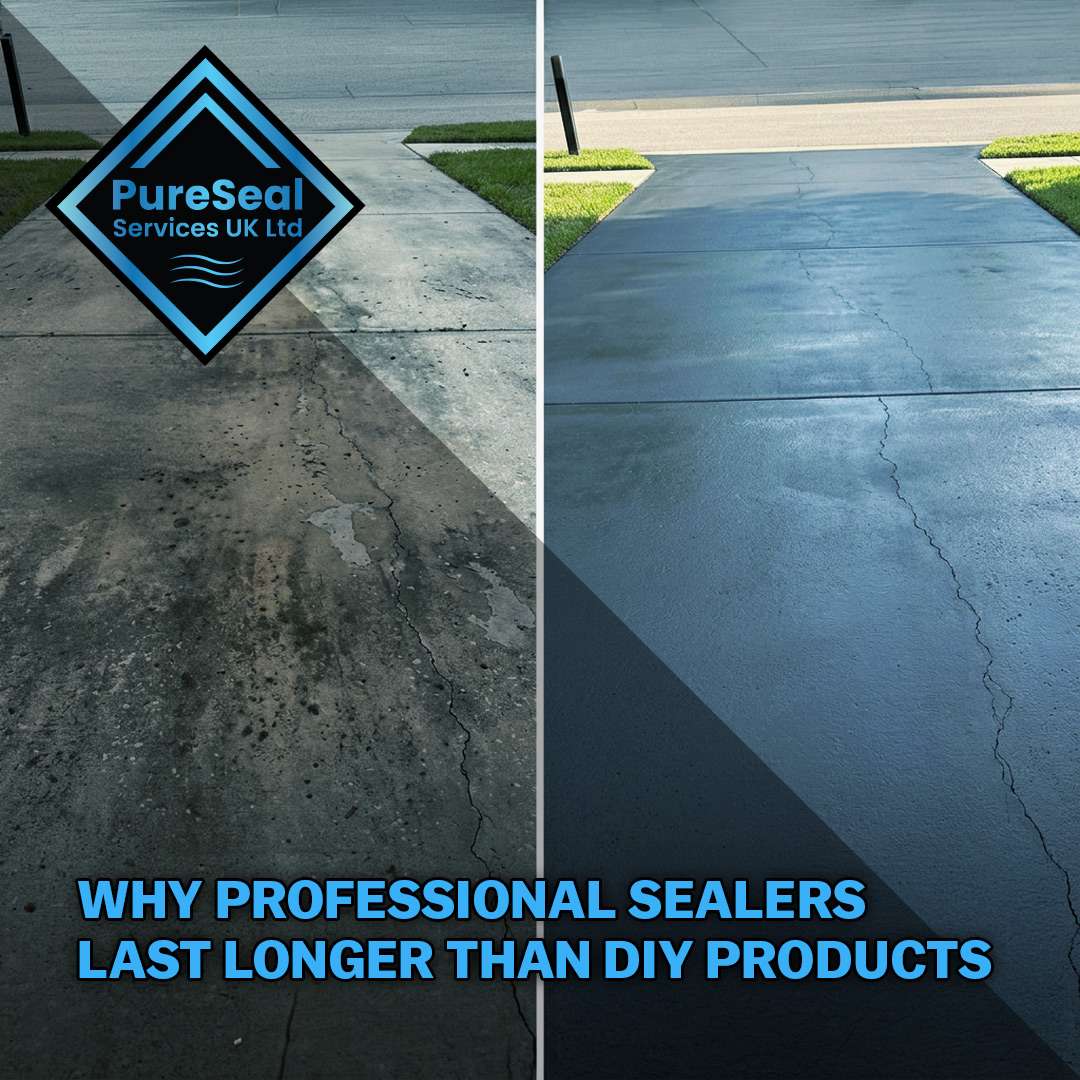
Why Professional Sealers Last Longer Than DIY Products
Why Professional Sealers Last Longer Than DIY Products
Whether you’ve invested in a new block paving driveway, a natural stone patio or an imprinted concrete surface, protecting that investment is essential. Applying a quality sealer helps preserve colour, reduce staining, minimise weed growth and extend the lifespan of the surface.
Many homeowners are tempted by DIY sealers available from builders’ merchants and online retailers because they appear to offer a quick and inexpensive solution. While these products certainly have their place, they rarely deliver the same durability, appearance or long-term value as a professionally applied sealing system.
At Pure Seal Services, we regularly restore and reseal surfaces where DIY products have failed after only a short period. Understanding why professional sealers last significantly longer can help property owners make an informed decision before spending money on products that may require frequent reapplication.
The Difference Between Professional and DIY Sealers
Not all sealers are manufactured to the same standard. The biggest differences lie in the formulation, concentration of active ingredients, application method and preparation required before installation.
| Feature | Professional Sealer | DIY Sealer |
|---|---|---|
| Resin content | High | Often lower |
| UV resistance | Excellent | Variable |
| Wear resistance | High | Moderate |
| Professional preparation | Included | Usually limited |
| Expected lifespan | Several years | Often 1–3 years |
| Application equipment | Specialist equipment | Roller or garden sprayer |
| Coverage consistency | Even and controlled | Can vary significantly |
While the bottle or tin may appear similar, the chemistry inside can be dramatically different.
Higher Quality Resin Technology
The resin is the component that actually forms the protective layer.
Professional sealers generally contain:
- Higher resin concentrations
- Better bonding agents
- Improved flexibility
- Superior chemical resistance
- Better UV stabilisers
These ingredients create a stronger protective barrier capable of coping with Britain’s constantly changing weather.
DIY products often contain lower concentrations of these expensive ingredients in order to meet retail price points.
The result is a thinner protective coating that begins breaking down much sooner.
Proper Surface Preparation Makes All the Difference
One of the biggest reasons professional sealers last longer isn’t actually the sealer itself.
It’s the preparation beforehand.
Professional contractors understand that no sealer will bond correctly to:
- Dirt
- Dust
- Moss spores
- Algae
- Lichen
- Oil contamination
- Previous failing coatings
The surface must be thoroughly cleaned and fully dried before sealing begins.
Skipping even one of these stages dramatically reduces lifespan.
Why Cleaning Matters
Imagine painting over dust.
The paint sticks to the dust rather than the wall.
The same principle applies with sealers.
Professional preparation allows the resin to bond directly with the paving rather than contaminants sitting on top.
This produces a much stronger bond.
Moisture Control
Many DIY failures occur because surfaces aren’t completely dry.
Even tiny amounts of trapped moisture can cause:
- Whitening
- Blooming
- Cloudiness
- Peeling
- Bubbling
- Premature failure
Professionals use weather forecasting, moisture assessment and experience to determine the ideal application window.
This is difficult for most homeowners to judge accurately.
Better Application Equipment
The application method plays a surprisingly large role in longevity.
Professionals typically use specialist equipment that provides:
- Even coverage
- Controlled application rates
- Consistent thickness
- Proper penetration
- Reduced waste
DIY applications often rely upon:
- Rollers
- Paint brushes
- Garden sprayers
These methods can leave:
- Thick patches
- Thin patches
- Missed areas
- Roller marks
- Uneven protection
Comparison of Application Methods
| Method | Consistency | Longevity |
|---|---|---|
| Professional spray systems | Excellent | Excellent |
| Professional resin application | Excellent | Excellent |
| Roller | Moderate | Moderate |
| Brush | Variable | Variable |
| Garden sprayer | Fair | Fair |
Even coverage means the protective film wears evenly instead of developing weak spots.
Stronger Resistance to UV Light
The British weather isn’t just rain.
Ultraviolet light slowly breaks down many coatings.
Cheap sealers often begin fading after prolonged exposure to sunlight.
Professional products typically contain superior UV inhibitors that help protect:
- Colour enhancement
- Gloss finishes
- Resin flexibility
- Surface protection
This helps maintain appearance for significantly longer.
Better Chemical Resistance
Driveways and patios face daily exposure to:
- Oil
- Fuel
- BBQ grease
- Bird droppings
- Plant pots
- Fertilisers
- Leaf tannins
- Food spills
Professional sealers are designed to withstand these contaminants far better than many retail alternatives.
This reduces staining while making cleaning considerably easier.
Improved Abrasion Resistance
Driveways experience constant wear from:
- Vehicle tyres
- Foot traffic
- Wheelie bins
- Bicycles
- Garden equipment
Each movement slowly wears away the protective coating.
Professional-grade sealers generally create a harder wearing surface capable of resisting abrasion for much longer.
DIY products often begin showing wear in high traffic areas surprisingly quickly.
Typical Lifespan Comparison
| Surface | DIY Product | Professional Sealer |
|---|---|---|
| Block paving driveway | 1–3 years | Several years |
| Natural stone patio | 1–2 years | Several years |
| Imprinted concrete | 1–3 years | Several years |
| Resin pathways | Varies | Longer-lasting protection |
| Concrete paving | 1–2 years | Extended protection |
Actual lifespan depends upon traffic levels, weather exposure and maintenance.
Professional Products Penetrate Better
Many premium sealers don’t simply sit on top of the surface.
They partially penetrate into the pores before curing.
This creates a stronger bond that is less likely to peel or flake.
DIY products frequently create a thinner surface coating without achieving the same level of penetration.
Correct Product Selection
Different paving materials require different sealers.
For example:
- Block paving
- Sandstone
- Limestone
- Granite
- Slate
- Concrete
- Porcelain
- Imprinted concrete
Each surface has unique absorption rates and characteristics.
Applying the wrong product can reduce adhesion or even damage appearance.
Professional installers understand which formulations work best for each material.
Environmental Conditions Matter
Temperature plays an enormous role in successful sealing.
Professional installers monitor:
- Air temperature
- Surface temperature
- Humidity
- Rain forecast
- Overnight temperatures
- Wind speed
Applying sealer outside the recommended conditions often results in reduced lifespan.
DIY users rarely have access to this level of planning.
Better Joint Stabilisation
On block paving, sealing is about more than protecting the blocks themselves.
Professionally applied sealers help stabilise kiln-dried jointing sand.
Benefits include:
- Reduced sand loss
- Less weed growth
- Better structural stability
- Reduced insect activity
If the joints aren’t correctly prepared before sealing, much of this benefit is lost.
Reduced Risk of Application Errors
Many DIY failures come from simple mistakes.
Common examples include:
- Applying too much product
- Applying too little
- Sealing damp paving
- Walking on the surface too soon
- Rain before curing
- Applying multiple coats too quickly
- Using incompatible products
Professional experience significantly reduces these risks.
Common DIY Problems
| Issue | Cause |
|---|---|
| White patches | Moisture trapped underneath |
| Peeling | Poor preparation |
| Sticky finish | Over application |
| Uneven gloss | Roller marks |
| Rapid wear | Thin coating |
| Flaking | Incorrect bonding |
Most of these problems require complete stripping before resealing.
Long-Term Cost Comparison
DIY products often appear cheaper initially.
However, repeated applications can become expensive over time.
Consider an example.
| Option | Initial Cost | Frequency |
|---|---|---|
| DIY sealer | Lower upfront cost | More frequent reapplication |
| Professional sealing | Higher initial investment | Longer intervals between applications |
Although professional sealing represents a larger investment at the outset, the extended lifespan often means fewer maintenance cycles over the years.
For homeowners who value durability, appearance and reduced maintenance, investing in a professional service from Pure Seal Services can prove to be the more economical choice over the life of the surface.
Professional Advice Prevents Costly Mistakes
Every property is different.
Factors influencing the best sealing approach include:
- Surface age
- Previous treatments
- Drainage
- Sun exposure
- Shade
- Tree cover
- Vehicle usage
- Surface condition
A professional assessment helps determine whether sealing is appropriate immediately or whether cleaning, repairs or re-sanding should be completed first.
This tailored approach avoids applying products under unsuitable conditions and helps maximise the lifespan of the finished result.
Maintenance After Professional Sealing
A long-lasting sealer still benefits from sensible maintenance. Fortunately, professionally sealed surfaces are usually easier to care for because dirt and contaminants struggle to bond to the protective coating.
Simple maintenance practices include:
| Maintenance Task | Recommended Frequency |
|---|---|
| Sweep loose debris | Weekly or as needed |
| Remove leaves promptly | During autumn |
| Clean spills | As soon as possible |
| Wash surface | Periodically using suitable methods |
| Inspect joints | Annually |
Keeping the surface clean helps preserve both its appearance and the integrity of the protective coating. It also reduces the likelihood of moss, algae and weeds becoming established, allowing the sealer to perform as intended for longer.
Appearance Retention Over Time
One of the most noticeable differences between professional and DIY sealers is how the surface looks after months and years of exposure.
A professionally applied premium sealer is designed to maintain:
- Enhanced colour
- Consistent finish
- Water repellency
- Resistance to fading
- Cleaner appearance between maintenance visits
Lower-cost DIY products can lose their initial appearance relatively quickly, leaving paving looking dull even though a coating remains. As the protective layer degrades, water penetration, staining and biological growth become increasingly likely, meaning the surface may require stripping and resealing much sooner than expected.
Professional sealing combines premium materials, thorough preparation and expert application techniques to achieve a finish that not only looks better on day one but continues protecting the surface for years afterwards.
Tags: Patio cleaning, Driveway cleaning, pressure washing, Roof Cleaning, Exterior cleaning, gutter cleaning, window cleaning
 Artificial and Sports Surfaces
 Awnings / Canopies / Gazebos
 Block Paving
 Brickwork
 Composite Surfaces
 Decking / Timber
 Granite
 Imprinted Concrete
 Internal Masonry
 Limestone
 Marble
 Metal Cladding
 Polished or Honed Stone
 Porcelain
 Render
 Resin Bond
 Road and Rail Signs
 Roof Tiles / Slates
 Sandstone
 Slate
Slate Solar Panels and Glass
 Stone Sills and Pier Caps
 Tarmac and Asphalt
 Gutters & UPVC
 Acid Damage
 Biofilm
 Bitumen
 Blood
Blood Carbon
 Concrete / Grout / Mortar
 Copper Oxide
 Efflorescence
 Egg
Egg Failed Sealer
 Fire Damage
 Fuel / Oil
 Graffiti
 Grease / Fat / Cooking Oil
 Lawn Fertiliser
 Lead Carbonate
 Lead Oxide
 Paint Splashes
 Rust
Rust Tar & Glue
 Tannin Removers
 Traffic Film Removers
 Trapped Moisture / Sealer Repairs
 Urine Neutralisers