
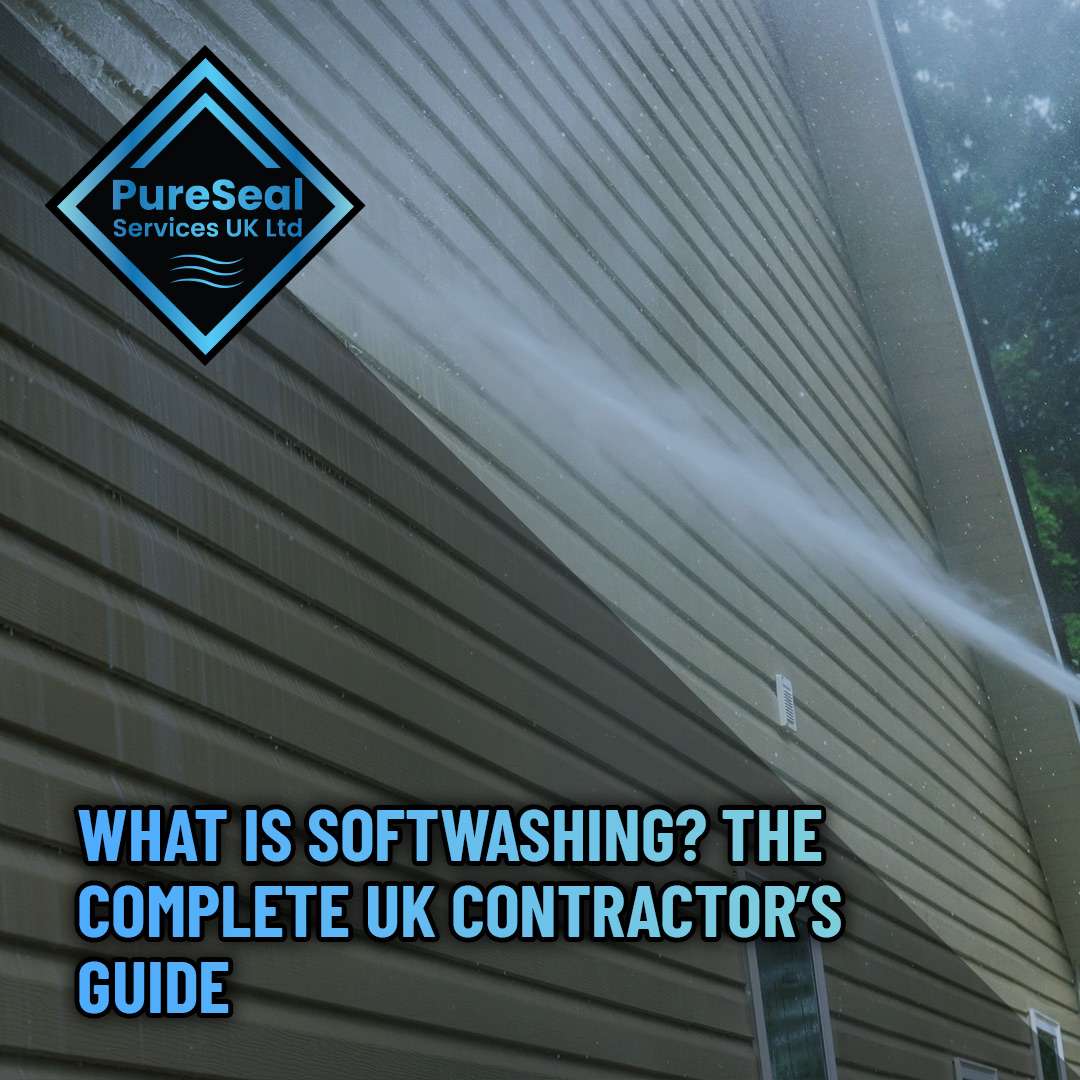
What Is Softwashing? The Complete UK Contractor’s Guide
Written by PureSeal Services on . Posted in Pressure Washing, Approved Applicators, Blog
What Is Softwashing? The Complete UK Contractor’s Guide
If you’ve been researching exterior cleaning methods, you’ve probably come across the term softwashing. While pressure washing has been widely used for decades, softwashing has become the preferred cleaning method for many delicate surfaces across the UK.
For contractors, facilities managers and homeowners alike, understanding what softwashing is—and when it should be used—can help protect buildings while delivering longer-lasting results.
At Pure Seal Services, softwashing forms an important part of many exterior cleaning projects, allowing surfaces to be cleaned thoroughly without unnecessary pressure or damage.
What Is Softwashing?
Softwashing is a low-pressure exterior cleaning method that combines specialist cleaning solutions with gentle water application to remove:
- Algae
- Moss staining
- Lichen
- Mould
- Mildew
- Bacteria
- Atmospheric pollution
- Organic staining
Unlike pressure washing, which relies on force to blast contaminants away, softwashing works by breaking down biological growth at its root, helping surfaces stay cleaner for considerably longer.
This makes it ideal for properties where preserving the surface is just as important as achieving outstanding cleaning results.
How Does Softwashing Work?
A professional softwashing process generally follows several stages.
| Stage | Purpose |
|---|---|
| Inspection | Assess the surface condition and identify contamination |
| Preparation | Protect surrounding plants and sensitive areas |
| Application | Apply specialist cleaning solution evenly |
| Dwell Time | Allow chemicals to break down biological growth |
| Gentle Rinse | Low-pressure rinse where required |
| Final Inspection | Ensure consistent cleaning across all areas |
Rather than simply washing away visible dirt, the cleaning solution continues working after application, killing spores that would otherwise quickly regrow.
Why Has Softwashing Become So Popular?
Across the UK, buildings are increasingly affected by damp conditions, pollution and organic growth.
Green algae, black mould and lichen thrive on many external surfaces, particularly those facing north or shaded by trees.
Softwashing provides an effective solution because it:
- Cleans more deeply
- Produces longer-lasting results
- Uses very low pressure
- Reduces surface damage
- Helps delay regrowth
Many contractors now prefer softwashing over pressure washing for delicate materials.
Pressure Washing vs Softwashing
| Feature | Softwashing | Pressure Washing |
|---|---|---|
| Water Pressure | Very low | High |
| Removes Organic Growth | ✔ Yes | Partially |
| Kills Spores | ✔ Yes | No |
| Surface Damage Risk | Very low | Higher |
| Suitable for Delicate Surfaces | ✔ Yes | Often unsuitable |
| Longer Lasting Results | ✔ Yes | Usually shorter |
Both systems have their place, but choosing the correct method depends entirely on the surface being cleaned.
Which Surfaces Can Be Softwashed?
Professional contractors use softwashing on a wide variety of exterior surfaces.
Render
Modern coloured render is one of the most common applications.
Softwashing removes:
- Green algae
- Red algae
- Black mould
- Organic staining
without damaging the delicate textured finish.
Brickwork
Many brick buildings suffer from algae and pollution staining.
Softwashing can restore the appearance of brick while avoiding excessive pressure that may damage mortar joints.
Stone
Natural stone often requires gentle cleaning.
High-pressure washing may erode softer stone, whereas softwashing removes contamination while preserving the original finish.
Roofs
Although roof moss often requires physical removal first, softwashing treatments help eliminate:
- Moss spores
- Algae
- Lichen
This significantly slows future regrowth.
Cladding
Commercial buildings frequently use softwashing for:
- Composite cladding
- Powder-coated panels
- Aluminium cladding
- UPVC cladding
Low-pressure cleaning reduces the risk of damaging protective coatings.
Fencing
Timber fencing often develops algae and mould in shaded gardens.
Softwashing can brighten timber while being considerably gentler than aggressive pressure washing.
What Contaminants Does Softwashing Remove?
Professional cleaning chemicals are designed to tackle biological contamination rather than simply surface dirt.
| Contaminant | Removed? |
|---|---|
| Green algae | ✔ |
| Red algae | ✔ |
| Black mould | ✔ |
| Lichen | ✔ |
| Moss staining | ✔ |
| Mildew | ✔ |
| Organic staining | ✔ |
| Air pollution | ✔ |
| Surface dirt | ✔ |
The result is a cleaner surface that remains attractive for longer.
Is Softwashing Safe?
When carried out by trained professionals using appropriate products, softwashing is extremely safe.
Professional contractors understand:
- Correct chemical dilution
- Appropriate dwell times
- Weather conditions
- Surface compatibility
- Environmental protection
- Safe disposal procedures
Incorrect chemical use can cause damage, making professional application essential.
Why Low Pressure Matters
Many people assume more pressure equals better cleaning.
In reality, excessive pressure can cause significant problems.
Potential risks include:
- Damaged render
- Etched stone
- Loose pointing
- Water ingress
- Paint removal
- Timber splintering
Softwashing avoids these issues by allowing chemistry—not force—to do the work.
Softwashing vs Simply Applying Chemicals
Some people believe softwashing is simply spraying chemicals onto a surface.
Professional softwashing involves much more.
A complete service includes:
- Surface assessment
- Correct product selection
- Measured dilution rates
- Controlled application
- Appropriate contact time
- Safe rinsing
- Quality inspection
Each stage contributes to achieving professional, long-lasting results.
Commercial Softwashing Applications
Softwashing has become increasingly popular across commercial sectors.
Typical applications include:
| Property Type | Typical Cleaning |
|---|---|
| Schools | Render, walls, pathways |
| Offices | Cladding, brickwork |
| Retail Parks | Shopfronts, signage |
| Care Homes | External walls |
| Hotels | Facades and entrances |
| Apartment Blocks | Render and communal areas |
| Industrial Units | Cladding and concrete |
The ability to clean large areas with minimal disruption makes softwashing particularly attractive for commercial properties.
Residential Softwashing
Domestic properties also benefit from professional softwashing.
Common projects include:
- House render
- Garden walls
- Roof treatments
- Patios
- Driveways
- Conservatories
- Garages
- Boundary walls
Many homeowners are surprised how much brighter their property looks once biological growth has been removed.
How Long Do Results Last?
One of the biggest advantages of softwashing is longevity.
Because the treatment kills spores rather than merely washing away visible growth, results often last considerably longer than pressure washing alone.
The exact lifespan depends on:
- Tree cover
- Local climate
- Surface type
- Sunlight exposure
- Moisture levels
- Previous contamination
Regular maintenance cleaning helps keep buildings looking their best throughout the year.
Does Softwashing Use Less Water?
Generally, yes.
Since the cleaning relies primarily on specialist solutions rather than large volumes of high-pressure water, overall water consumption is often significantly lower.
This can make softwashing a more efficient cleaning option for many projects.
Is Every Surface Suitable?
No.
Every building should be inspected before cleaning begins.
An experienced contractor will assess:
- Surface condition
- Existing damage
- Previous repairs
- Paint coatings
- Material type
- Contamination levels
Only then can the most appropriate cleaning method be selected.
Typical Softwashing Costs in the UK
Professional softwashing is a specialist service, and pricing reflects the expertise, equipment, insurance and high-quality products required to deliver safe, long-lasting results.
At Pure Seal Services, the focus is on achieving exceptional results rather than competing on price. Premium preparation, specialist treatments and experienced technicians help ensure every project is completed to a high standard.
| Surface | Typical Professional Price |
|---|---|
| House render | £700–£1,600+ |
| Roof treatment | £900–£2,500+ |
| Brick cleaning | £600–£1,800+ |
| Commercial cladding | Quotation required |
| Large commercial buildings | Site survey required |
While lower-cost quotations may be available elsewhere, investing in an experienced contractor can reduce the risk of surface damage, inconsistent cleaning and premature regrowth.
Why Contractors Choose Softwashing
Professional contractors increasingly favour softwashing because it offers numerous advantages over traditional high-pressure cleaning.
Some of the biggest benefits include:
| Benefit | Advantage |
|---|---|
| Low pressure | Protects delicate surfaces |
| Specialist chemistry | Removes biological growth at the source |
| Longer-lasting finish | Slower regrowth between cleans |
| Versatile | Suitable for many exterior materials |
| Professional appearance | Restores buildings without aggressive cleaning |
| Lower water use | More efficient than many pressure washing methods |
As demand grows for safer and more effective exterior cleaning, softwashing has become an essential service for contractors working on both residential and commercial properties.
If you’re looking for professional exterior cleaning carried out using proven softwashing techniques, visit the team at Pure Seal Services to learn more about their specialist services and arrange a tailored quotation for your property.
The Science Behind Softwashing
One of the reasons softwashing has become so effective is that it focuses on treating the cause of staining rather than simply improving the appearance of a surface.
Organic growths such as algae, mould and lichen are living organisms. If only the visible layer is removed, microscopic spores often remain behind, allowing the growth to return relatively quickly.
Professional softwashing treatments are designed to:
- Break down the cellular structure of algae and mould
- Kill spores that are invisible to the naked eye
- Penetrate porous surfaces where organisms can hide
- Leave the surface cleaner for a longer period
This biological approach is what separates softwashing from simply rinsing a surface with water.
Common Signs a Property Would Benefit from Softwashing
Many property owners wait until surfaces look heavily stained before arranging cleaning, but there are several early warning signs that indicate softwashing could be beneficial.
| Sign | What It Could Mean |
|---|---|
| Green patches on render | Algae beginning to colonise the surface |
| Black spotting | Mould or mildew growth |
| White or grey crusty marks | Lichen establishing itself |
| Slippery paving | Organic growth creating a safety hazard |
| Dark streaks | Moisture and biological contamination |
| Uneven colouring | Dirt and pollution build-up |
Addressing these issues early often makes cleaning simpler and helps preserve the property’s appearance.
Why Softwashing Is Ideal for the UK Climate
The UK’s climate creates ideal conditions for biological growth throughout much of the year.
Frequent rainfall, relatively mild temperatures and high humidity allow algae, moss and mould to thrive on many external surfaces. Properties located near woodland, rivers or shaded areas are particularly susceptible.
Common factors that accelerate contamination include:
- North-facing walls
- Overhanging trees
- Poor air circulation
- High humidity
- Nearby vegetation
- Consistently damp conditions
Softwashing is specifically suited to these conditions because it targets the organisms responsible for staining rather than simply removing the symptoms.
Equipment Used in Professional Softwashing
Professional contractors use specialist equipment that differs considerably from a standard domestic pressure washer.
Typical equipment includes:
| Equipment | Purpose |
|---|---|
| Low-pressure pumps | Apply cleaning solutions evenly |
| Chemical-resistant hoses | Safely transfer treatment solutions |
| Precision spray nozzles | Control application rates |
| Measuring equipment | Ensure accurate chemical dilution |
| PPE | Protect technicians during application |
| Water-fed rinsing equipment | Gentle rinsing where required |
Using the correct equipment helps ensure an even application while reducing waste and protecting surrounding areas.
Can Softwashing Improve Kerb Appeal?
Absolutely.
A property’s exterior is the first thing visitors, customers or potential buyers notice.
Professional softwashing can dramatically improve:
- Brightness of render
- Appearance of brickwork
- Overall cleanliness
- Colour consistency
- First impressions
- Property value perception
For landlords, estate agents and commercial property managers, maintaining an attractive exterior can also help attract tenants and customers.
Preventative Maintenance Rather Than Reactive Cleaning
Many building owners only arrange cleaning once staining becomes obvious.
Increasingly, contractors recommend preventative maintenance instead.
Rather than waiting for heavy contamination to develop, periodic softwashing helps prevent biological growth from becoming deeply established.
Benefits of planned maintenance include:
- Less severe staining
- Easier future cleaning
- Longer-lasting exterior finishes
- Reduced maintenance costs over time
- Improved presentation throughout the year
This proactive approach is especially valuable for commercial premises where appearance reflects the business occupying the building.
Environmental Considerations
Responsible softwashing isn’t simply about cleaning effectively—it also involves protecting the surrounding environment.
Professional contractors carefully consider:
- Weather forecasts before treatment
- Nearby ponds or watercourses
- Sensitive planting
- Surface drainage
- Product application rates
- Appropriate rinsing procedures
By following industry best practice, cleaning can be carried out responsibly while minimising environmental impact.
Why Experience Matters
Softwashing may appear straightforward, but achieving consistent, professional results requires knowledge and experience.
Every property presents different challenges, including:
- Varying surface materials
- Different levels of contamination
- Previous repair work
- Painted finishes
- Weather exposure
- Access restrictions
An experienced contractor understands how these factors influence the cleaning process and can adjust the treatment accordingly.
Frequently Asked Questions
Will softwashing damage my render?
When carried out correctly using suitable products and low-pressure equipment, softwashing is specifically designed to clean delicate render safely.
Does softwashing remove red algae as well as green algae?
Yes. Professional softwashing treatments are effective against both green algae and red algae, along with mould, mildew and many other forms of biological contamination.
Is softwashing suitable for listed buildings?
In many situations, yes. Because softwashing relies on low pressure rather than aggressive washing, it is often a more sympathetic cleaning method for older and more delicate buildings. However, every listed property should be individually assessed before work begins.
How often should a property be softwashed?
There is no fixed timetable, as it depends on the property’s location and surrounding environment. Buildings beneath trees or in damp areas may require cleaning more frequently than those in open, sunny locations.
Does rain affect the results?
Professional contractors monitor weather conditions carefully. Applying treatments under appropriate conditions allows the cleaning solution sufficient time to work effectively before significant rainfall.
Choosing a Professional Softwashing Contractor
Not every exterior cleaning company specialises in softwashing, so it’s worth asking a few important questions before appointing a contractor.
| Question | Why It Matters |
|---|---|
| Do you specialise in softwashing? | Demonstrates relevant experience |
| Are your technicians insured? | Provides peace of mind |
| Will you inspect the property first? | Ensures the correct cleaning method is chosen |
| Do you protect surrounding areas? | Reduces the risk of accidental damage |
| Do you use professional-grade products? | Helps deliver longer-lasting results |
Selecting a contractor based on expertise rather than simply the lowest quotation often results in a safer process and a better-quality finish that lasts significantly longer.
Tags: Exterior cleaning, gutter cleaning, window cleaning, Patio cleaning, Driveway cleaning, pressure washing, Roof Cleaning
 Artificial and Sports Surfaces
 Awnings / Canopies / Gazebos
 Block Paving
 Brickwork
 Composite Surfaces
 Decking / Timber
 Granite
 Imprinted Concrete
 Internal Masonry
 Limestone
 Marble
 Metal Cladding
 Polished or Honed Stone
 Porcelain
 Render
 Resin Bond
 Road and Rail Signs
 Roof Tiles / Slates
 Sandstone
 Slate
Slate Solar Panels and Glass
 Stone Sills and Pier Caps
 Tarmac and Asphalt
 Gutters & UPVC
 Acid Damage
 Biofilm
 Bitumen
 Blood
Blood Carbon
 Concrete / Grout / Mortar
 Copper Oxide
 Efflorescence
 Egg
Egg Failed Sealer
 Fire Damage
 Fuel / Oil
 Graffiti
 Grease / Fat / Cooking Oil
 Lawn Fertiliser
 Lead Carbonate
 Lead Oxide
 Paint Splashes
 Rust
Rust Tar & Glue
 Tannin Removers
 Traffic Film Removers
 Trapped Moisture / Sealer Repairs
 Urine Neutralisers