
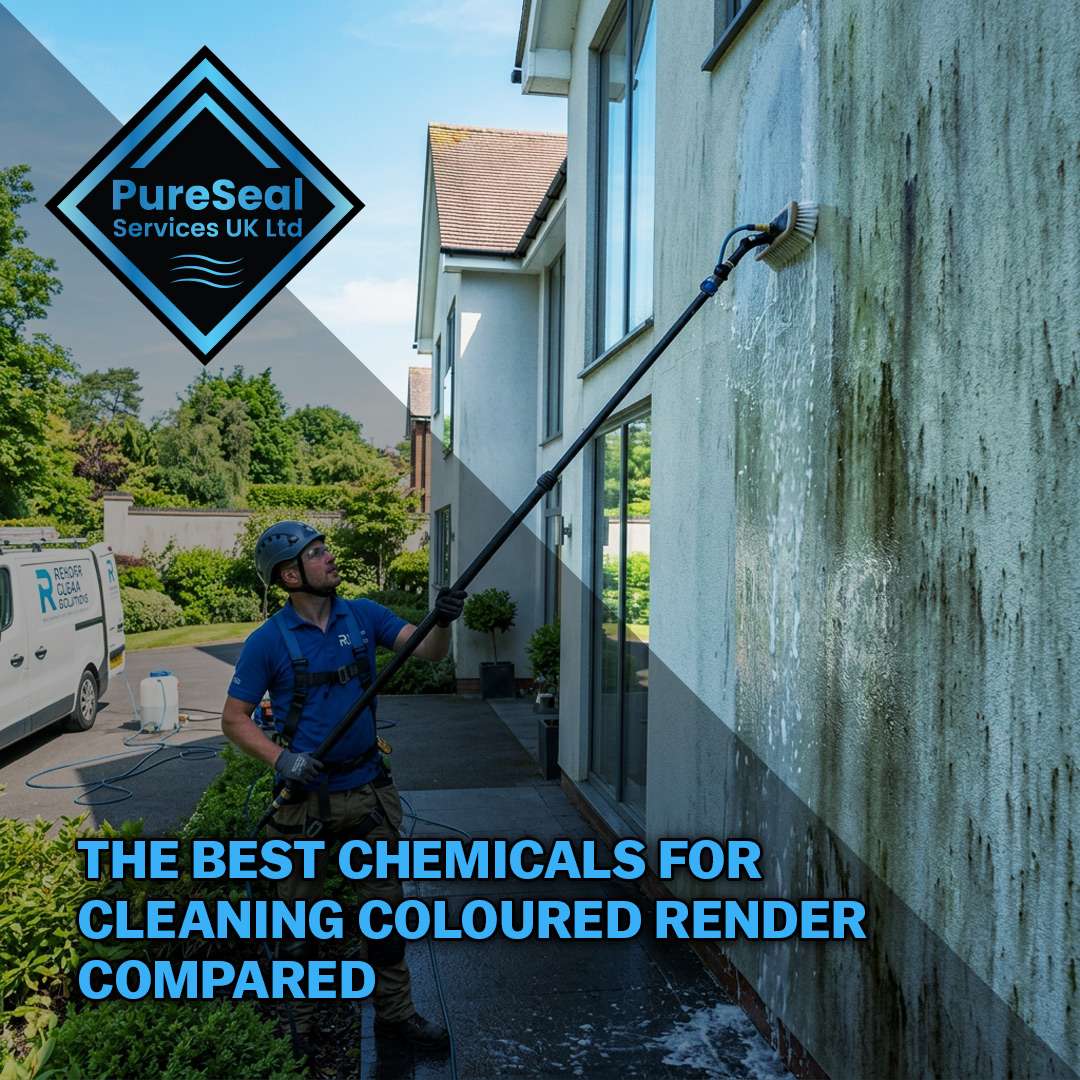
The Best Chemicals for Cleaning Coloured Render Compared
The Best Chemicals for Cleaning Coloured Render Compared
Coloured render is one of the most attractive exterior finishes available for UK properties, offering a modern appearance with long-lasting colour. However, even premium render systems gradually become affected by dirt, atmospheric pollution, green algae, red algae, black mould and lichen. Selecting the correct cleaning chemical is essential for restoring the original appearance without causing damage.
At Pure Seal Services, we carefully assess every property before choosing the most appropriate cleaning solution. Different contaminants require different treatments, and using the wrong chemical can lead to disappointing results or unnecessary risk to the render surface.
This guide compares the most commonly used chemicals for cleaning coloured render, explaining where each performs best and when professional application is recommended.
Why Chemical Selection Matters
Unlike brick or concrete, coloured render is often coated with an integral pigment and may include specialist finishes such as silicone, acrylic or monocouche systems.
These finishes require cleaning methods that:
- Remove biological growth safely
- Preserve the original colour
- Avoid etching or fading
- Continue working after application
- Minimise the chance of future regrowth
Using an unsuitable cleaner may leave staining behind, bleach certain areas or shorten the life of the render.
Common Contaminants Found on Coloured Render
Before selecting a chemical, it’s important to identify exactly what you’re trying to remove.
| Contaminant | Appearance | Typical Cause | Best Treatment |
|---|---|---|---|
| Green algae | Green streaks or patches | Damp conditions | Biocide |
| Red algae | Pink or red staining | Airborne algae spores | Specialist biocide |
| Black mould | Black spotting | Moisture and shade | Softwash treatment |
| Lichen | White, yellow or grey crusts | Long-term biological growth | Biocide followed by gentle removal |
| Traffic pollution | Grey staining | Roads and pollution | Detergent cleaner |
| Organic dirt | Brown staining | Weathering | Low-pressure chemical wash |
Each contaminant responds differently to chemical treatments.
Sodium Hypochlorite
Sodium hypochlorite is probably the best-known render cleaning chemical and forms the basis of many professional softwashing systems.
When diluted correctly and applied safely, it rapidly destroys algae, mould and organic staining.
Advantages
- Very effective on green algae
- Excellent mould removal
- Fast acting
- Suitable for many render types
- Helps brighten surfaces
Limitations
- Requires professional dilution
- Incorrect use can damage surrounding plants
- Needs careful rinsing procedures
- Not suitable for every render finish
Professionals normally combine sodium hypochlorite with surfactants that allow the solution to cling to vertical surfaces for longer.
Best Uses
| Suitable For | Rating |
|---|---|
| Green algae | ★★★★★ |
| Black mould | ★★★★★ |
| Organic staining | ★★★★☆ |
| Red algae | ★★★★☆ |
| Heavy dirt | ★★★☆☆ |
Professional Biocides
Many specialist render cleaning companies use professional-grade biocides designed specifically for exterior surfaces.
Unlike bleach-based products, biocides continue working long after application, killing spores deep within the biological growth.
This makes them ideal for coloured render where long-term protection is important.
Advantages
- Long-lasting protection
- Kills algae spores
- Reduces regrowth
- Lower risk of colour change
- Suitable for delicate render systems
Rather than simply cleaning visible contamination, biocides attack the root cause.
Typical Applications
Professional biocides are commonly used for:
- Silicone render
- Acrylic render
- Monocouche render
- K Rend
- Weber render
- Parex render
- Through-coloured render
Benzalkonium Chloride Solutions
Benzalkonium chloride is another common ingredient used in exterior cleaning chemicals.
It belongs to a group of disinfectants known as quaternary ammonium compounds.
These chemicals:
- Kill algae
- Destroy mould
- Prevent bacterial growth
- Leave residual protection
They work more slowly than bleach-based products but often provide excellent long-term results.
Comparison Table
| Feature | Sodium Hypochlorite | Biocide | Benzalkonium Chloride |
|---|---|---|---|
| Speed | Very fast | Medium | Slow |
| Long-term protection | Good | Excellent | Excellent |
| Green algae | Excellent | Excellent | Excellent |
| Red algae | Very good | Excellent | Very good |
| Mould | Excellent | Excellent | Very good |
| Colour protection | Very good | Excellent | Excellent |
Specialist Render Detergents
Not every coloured render problem involves algae.
Some buildings simply accumulate:
- Traffic film
- Dust
- Atmospheric pollution
- General grime
In these situations, specialist render detergents can be highly effective.
These products lift dirt without relying on aggressive oxidising chemicals.
Benefits include:
- Safe cleaning
- Reduced risk of streaking
- Excellent for regular maintenance
- Compatible with many render systems
Detergents are often used before applying a biocide.
Acid-Based Cleaners
Acid cleaners are sometimes used within the construction industry but are rarely appropriate for coloured render.
Strong acids may:
- Attack pigments
- Damage the finish
- Leave patchy colouring
- Create permanent marks
Most reputable render cleaning specialists avoid aggressive acids unless dealing with very specific contamination such as cement residue on newly completed work.
For established coloured render, acid cleaning is generally avoided.
Comparison of Cleaning Chemicals
| Chemical | Removes Algae | Removes Dirt | Suitable for Coloured Render | Long-Term Protection |
|---|---|---|---|---|
| Sodium hypochlorite | Excellent | Good | Usually | Medium |
| Professional biocide | Excellent | Fair | Excellent | Excellent |
| Benzalkonium chloride | Excellent | Fair | Excellent | Excellent |
| Render detergent | Poor | Excellent | Excellent | None |
| Acid cleaner | Poor | Excellent | Usually not recommended | None |
Softwashing Chemicals
Softwashing isn’t one single chemical.
Instead, it’s a process combining several products.
A professional softwash system may include:
- Surface cleaner
- Surfactant
- Biocide
- Neutralising rinse where required
This layered approach produces much better results than simply spraying bleach onto a wall.
Professional contractors carefully adjust the chemical mix depending on:
- Type of render
- Age
- Level of contamination
- Weather
- Surrounding vegetation
Choosing Chemicals for Different Render Types
Different manufacturers use different formulations.
One chemical suitable for silicone render may not be ideal for acrylic render.
| Render Type | Preferred Chemical |
|---|---|
| Silicone render | Professional biocide |
| Acrylic render | Biocide or specialist detergent |
| Monocouche render | Softwash system |
| Cement render | Biocide with detergent |
| Painted render | Gentle softwash chemicals |
Understanding the render type is one of the first steps in producing consistent cleaning results.
Dealing With Red Algae
Red algae has become increasingly common across the UK.
Unlike ordinary green algae, it often penetrates microscopic pores within the render.
This makes removal significantly more challenging.
The most successful treatments usually involve:
- Specialist softwash chemicals
- Longer dwell times
- Multiple applications
- Follow-up biocide treatment
Attempting to remove red algae with pressure washing alone rarely solves the problem and may even damage the finish.
Should Bleach Be Used on Coloured Render?
This is one of the most common questions homeowners ask.
The answer depends entirely on:
- The render manufacturer
- The dilution rate
- The application method
- The experience of the operator
Professional sodium hypochlorite solutions, correctly diluted and applied, are very different from pouring household bleach onto exterior walls.
Household products often contain additives that make them unsuitable for exterior render cleaning.
Environmental Considerations
Modern render cleaning places far greater emphasis on environmental responsibility than it did years ago.
Professional contractors now carefully manage:
- Run-off
- Plant protection
- Surface saturation
- Waste water
- Chemical handling
This protects gardens, drainage systems and neighbouring properties while still delivering excellent cleaning results.
Why Dwell Time Is So Important
One of the biggest mistakes in render cleaning is rushing the process.
Many chemicals need sufficient contact time to:
- Penetrate algae
- Kill spores
- Break down organic growth
- Loosen staining
Removing chemicals too quickly often means the biological contamination survives beneath the surface.
Professionals monitor weather conditions carefully, as temperature, sunlight and wind all influence dwell time.
Safety When Using Render Cleaning Chemicals
Professional render cleaning involves far more than selecting a strong chemical.
Safe application requires:
- Correct PPE
- Controlled dilution
- Surface testing
- Plant protection
- Safe access equipment
- Knowledge of render compatibility
These factors help produce consistent results while protecting both the property and its surroundings.
Why Professional Chemical Selection Produces Better Results
Many off-the-shelf products promise instant results but are designed to work across a wide variety of surfaces rather than specifically on coloured render.
Professional services take a far more tailored approach. At Pure Seal Services, every project begins with an assessment of the render type, the level of contamination and the most suitable treatment plan. This allows the correct combination of cleaning chemicals to be selected, helping to restore the render while protecting its finish.
Premium render cleaning is rarely the cheapest option, as specialist chemicals, trained technicians and careful application all contribute to the overall cost. However, investing in a professional service helps reduce the risk of damage, improves cleaning performance and can provide longer-lasting results before further treatment is needed.
For homeowners looking to protect the appearance of coloured render, choosing the right chemical is every bit as important as choosing the right cleaning method. A carefully planned softwashing process, using professional-grade products selected for the specific render system, delivers safer, more consistent and longer-lasting results than relying on general-purpose cleaning products or aggressive washing techniques.
Understanding Chemical Dilution Ratios
One of the most overlooked aspects of render cleaning is chemical dilution. A stronger solution does not automatically produce better results. In many cases, using a chemical that is too concentrated can waste product, increase costs and potentially affect sensitive surfaces or surrounding landscaping.
Professional contractors calculate dilution based on factors including:
- The type of render
- The severity of contamination
- Air temperature
- Humidity
- Time since the render was last cleaned
- Manufacturer recommendations
For example, a lightly stained silicone render may only require a mild biocide treatment, whereas a heavily contaminated north-facing wall with years of algae growth may need a stronger softwash solution followed by a secondary application.
Careful dilution also ensures chemicals remain effective while reducing unnecessary environmental impact.
Weather Conditions Affect Chemical Performance
The weather plays a significant role in how well render cleaning chemicals perform.
Many people assume that a hot, sunny day is ideal for exterior cleaning, but this is often not the case.
Very warm temperatures can cause cleaning solutions to dry too quickly before they have had enough time to break down biological growth.
The best conditions are usually:
| Weather Condition | Effect on Cleaning |
|---|---|
| Mild overcast day | Excellent |
| Cool, dry weather | Very good |
| Light cloud | Excellent |
| Strong sunshine | Can reduce effectiveness |
| Heavy rain | May wash chemicals away |
| High winds | Difficult to control application |
Professional cleaners often plan work around the forecast to maximise the effectiveness of the chosen treatment.
Why Pressure Washing Shouldn’t Replace Chemicals
Some homeowners believe pressure washing alone will restore coloured render.
While pressure washing may remove surface dirt temporarily, it often fails to kill the algae or mould responsible for the staining.
In fact, excessive pressure can create additional problems:
- Damage to the render finish
- Increased water penetration
- Removal of protective coatings
- Premature wear
- More rapid biological regrowth
This is why professional softwashing systems rely on chemicals rather than force.
The chemical does the cleaning, while only minimal water pressure is used where necessary to rinse away dead organic matter.
How Long Do Professional Chemicals Continue Working?
One major advantage of specialist biocides is that they don’t stop working once the visible cleaning has finished.
Residual protection can continue helping to suppress biological growth after treatment.
Factors influencing longevity include:
- Property location
- Amount of surrounding vegetation
- Shade
- Moisture levels
- Local climate
- Air pollution
Properties surrounded by trees or located near woodland generally experience faster algae regrowth than homes in open, sunny locations.
Even so, professional treatments often provide significantly longer-lasting results than simple washing alone.
Common Mistakes When Choosing Cleaning Chemicals
Many DIY products are marketed as “render cleaners” despite being designed for multiple exterior surfaces.
Before selecting any product, consider whether it has been formulated specifically for coloured render.
Some common mistakes include:
| Mistake | Possible Result |
|---|---|
| Using household bleach | Uneven cleaning and poor long-term protection |
| Mixing different chemicals | Dangerous chemical reactions |
| Applying too strong a solution | Surface damage or unnecessary expense |
| Ignoring manufacturer guidance | Reduced render lifespan |
| Cleaning without testing | Unexpected colour changes |
Professional contractors always carry out a small test area where appropriate before treating the entire property.
Why Different Colours of Render Show Dirt Differently
Not all coloured render becomes dirty in the same way.
Lighter colours often show:
- Traffic pollution
- Black mould
- General dirt
Darker renders tend to make these less obvious but may show:
- Salt deposits
- Lichen
- Dust
- Water streaking
Popular render colours each present their own cleaning challenges.
| Render Colour | Most Visible Staining |
|---|---|
| White | Green algae, black mould |
| Cream | Red algae, pollution |
| Grey | Dust, lichen |
| Charcoal | Salt marks, dust |
| Beige | Organic staining |
| Buff | Green algae and weathering |
Selecting the correct chemical ensures these different types of staining can be treated effectively without affecting the original colour.
Protecting Nearby Surfaces During Chemical Cleaning
Professional render cleaning doesn’t focus solely on the wall itself.
Nearby materials must also be protected, including:
- uPVC windows
- Composite doors
- Painted timber
- Aluminium frames
- Garden plants
- Decorative stone
- Metal fixtures
Before applying chemicals, experienced contractors often wet surrounding vegetation and take steps to prevent unnecessary overspray.
This level of preparation helps achieve a cleaner finish while protecting the wider property.
Is More Expensive Chemical Always Better?
Not necessarily.
Some premium products cost considerably more because they offer:
- Better adhesion to vertical surfaces
- Longer dwell times
- Reduced odour
- Improved environmental profile
- Greater residual protection
However, even the highest-quality chemical will underperform if applied incorrectly.
Successful render cleaning depends on combining the right product with the correct application technique, dilution ratio and contact time.
Signs It’s Time to Clean Coloured Render
Many homeowners wait until staining becomes severe before arranging professional cleaning.
In reality, early intervention usually delivers better results and often requires less intensive treatment.
Typical signs include:
- Green streaks developing beneath windows
- Small patches of red algae appearing
- Black spots spreading across shaded walls
- General dull appearance
- Uneven colouring after wet weather
- Increased staining around gutters and downpipes
Addressing these issues promptly can help maintain the render’s appearance and reduce the likelihood of more stubborn contamination becoming established.
Professional Assessment Makes the Difference
Although many render cleaning chemicals appear similar on paper, their performance varies depending on how they are used. The most effective treatment is rarely determined by choosing the strongest product, but by understanding the surface being cleaned and selecting a compatible chemical system.
At Pure Seal Services, every coloured render cleaning project is assessed individually. Factors such as the render manufacturer, age, level of contamination and surrounding environment are all considered before treatment begins. This tailored approach helps achieve an even finish while protecting the integrity of the coloured render.
Premium-grade chemicals, specialist equipment and experienced application naturally place professional render cleaning towards the higher end of the market. While this represents a greater initial investment than DIY alternatives, it is designed to provide safer, more reliable and longer lasting results.
Tags: Patio cleaning, Driveway cleaning, pressure washing, Roof Cleaning, Exterior cleaning, gutter cleaning, window cleaning
 Artificial and Sports Surfaces
 Awnings / Canopies / Gazebos
 Block Paving
 Brickwork
 Composite Surfaces
 Decking / Timber
 Granite
 Imprinted Concrete
 Internal Masonry
 Limestone
 Marble
 Metal Cladding
 Polished or Honed Stone
 Porcelain
 Render
 Resin Bond
 Road and Rail Signs
 Roof Tiles / Slates
 Sandstone
 Slate
Slate Solar Panels and Glass
 Stone Sills and Pier Caps
 Tarmac and Asphalt
 Gutters & UPVC
 Acid Damage
 Biofilm
 Bitumen
 Blood
Blood Carbon
 Concrete / Grout / Mortar
 Copper Oxide
 Efflorescence
 Egg
Egg Failed Sealer
 Fire Damage
 Fuel / Oil
 Graffiti
 Grease / Fat / Cooking Oil
 Lawn Fertiliser
 Lead Carbonate
 Lead Oxide
 Paint Splashes
 Rust
Rust Tar & Glue
 Tannin Removers
 Traffic Film Removers
 Trapped Moisture / Sealer Repairs
 Urine Neutralisers