
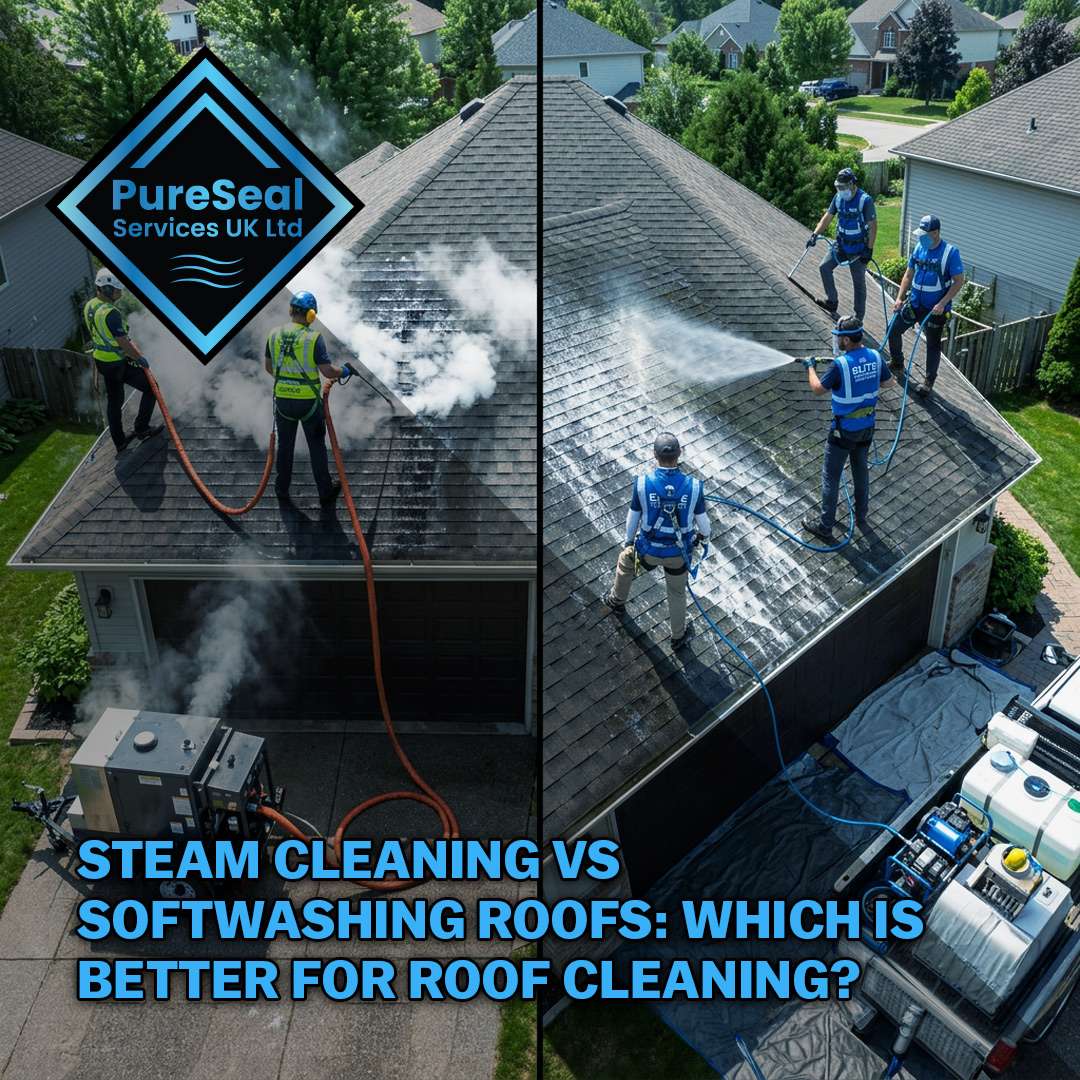
Steam Cleaning vs Softwashing Roofs: Which Is Better for Roof Cleaning?
Steam Cleaning vs Softwashing Roofs: Which Is Better for Roof Cleaning?
Your roof is one of the most important parts of your property, protecting your home from the British weather throughout the year. Over time, however, roofs become covered with moss, algae, lichen and general dirt, affecting not only their appearance but also their long-term condition. When researching roof cleaning methods, two techniques are regularly compared: steam cleaning and softwashing. While both can improve the appearance of a roof, they work in very different ways and achieve different long-term results. If you’re considering professional roof cleaning, understanding the advantages and limitations of each method will help you make an informed decision. At Pure Seal Services, we use proven professional methods designed to deliver outstanding results while protecting your roof for years to come.Understanding Roof Contamination
Before comparing cleaning methods, it’s worth understanding exactly what builds up on a roof. Common contaminants include:- Moss
- Green algae
- Black algae staining
- Lichen
- Air pollution
- Bird droppings
- Organic debris
- Mould spores
| Roof Contaminant | Appearance | Potential Problems |
|---|---|---|
| Moss | Thick green growth | Holds moisture, blocks gutters |
| Algae | Green or black staining | Unsightly appearance, slippery surfaces |
| Lichen | White, orange or grey patches | Extremely stubborn, roots into surfaces |
| Dirt | General grime | Dulls roof appearance |
| Organic debris | Leaves and twigs | Encourages moss growth |
What Is Steam Roof Cleaning?
Steam cleaning uses very hot water delivered at relatively low pressure. Unlike pressure washing, the emphasis is on heat rather than force. Typical steam temperatures range between:- 120°C
- 150°C
- Heated water
- Low pressure
- Specialist equipment
- Experienced operators
Advantages of Steam Cleaning
Steam cleaning offers several benefits.Excellent Visual Results
The high temperature removes dirt extremely effectively, leaving roofs looking noticeably brighter.Lower Pressure Than Pressure Washing
Because pressure is kept relatively low, steam cleaning is safer than traditional pressure washing.Reduced Chemical Usage
Some customers prefer fewer chemicals being used. Steam alone can remove:- Surface dirt
- Some algae
- Some moss
- Light staining
Eco-Friendly Cleaning
Steam primarily relies on heat, making it attractive to environmentally conscious homeowners.Disadvantages of Steam Cleaning
Despite its advantages, steam cleaning has several limitations.Moss Removal Can Be Incomplete
Steam kills moss but often doesn’t physically remove every piece unless additional scraping is carried out.Lichen Often Returns
Lichen anchors deeply into roof tiles. Steam may remove the visible part without fully destroying the microscopic spores.High Labour Costs
Steam cleaning equipment is expensive and the process is slow. This generally makes it one of the more expensive roof cleaning methods.Moisture Still Enters the Roof
Although less aggressive than pressure washing, large quantities of water are still introduced onto the roof.What Is Softwashing?
Softwashing is a completely different cleaning process. Rather than relying on heat, softwashing uses specialist professional cleaning solutions that destroy biological growth at its source. The process usually involves:- Manual moss removal where necessary
- Application of professional cleaning solution
- Killing algae, moss and lichen
- Continued cleaning over the following weeks
- Long-lasting protection against regrowth
How Softwashing Works
Unlike steam cleaning, softwashing targets:- Moss spores
- Algae spores
- Lichen growth
- Organic bacteria
Steam Cleaning vs Softwashing
| Feature | Steam Cleaning | Softwashing |
|---|---|---|
| Uses heat | ✔ | ✘ |
| Uses specialist treatment | Limited | ✔ |
| Kills moss | ✔ | ✔ |
| Kills algae | ✔ | ✔ |
| Targets spores | Limited | ✔ |
| Long-term protection | Moderate | Excellent |
| Immediate appearance | Excellent | Improves over time |
| Suitable for delicate roofs | Often | Yes |
| Risk of regrowth | Higher | Lower |
Which Cleans Moss Better?
Moss is one of the biggest reasons homeowners book roof cleaning. A mature moss colony can:- Retain litres of water
- Lift roof tiles
- Block gutters
- Increase winter frost damage
Which Removes Algae Better?
Algae often causes:- Green staining
- Black streaks
- Slippery surfaces
Which Is Better for Lichen?
Lichen is often misunderstood. Unlike moss, lichen forms an extremely strong bond with roof tiles. Steam may remove surface growth. Softwashing gradually destroys the organism itself. Some established lichen can take several months to disappear completely after treatment, but the important factor is that it has been killed.Appearance Immediately After Cleaning
One area where steam cleaning often performs well is immediate appearance.| Time After Cleaning | Steam Cleaning | Softwashing |
|---|---|---|
| Same day | Excellent | Good |
| Two weeks | Excellent | Better |
| One month | Very good | Excellent |
| Six months | Some regrowth possible | Usually cleaner overall |
Water Usage Comparison
Steam cleaning requires considerable amounts of heated water. Softwashing generally uses significantly less water overall.| Method | Approximate Water Use |
|---|---|
| Steam Cleaning | High |
| Softwashing | Low |
| Pressure Washing | Very High |
- Environmental impact
- Water management
- Reduced runoff
Suitability for Different Roof Types
Different roof coverings respond differently to cleaning.| Roof Type | Steam Cleaning | Softwashing |
|---|---|---|
| Concrete tiles | Suitable | Excellent |
| Clay tiles | Suitable | Excellent |
| Slate | Suitable with care | Excellent |
| Fibre cement | Care required | Excellent |
| Older roofs | Depends on condition | Often preferred |
Which Lasts Longer?
This is arguably the biggest difference. Steam cleaning focuses on cleaning. Softwashing focuses on treatment. If spores remain alive, biological growth naturally returns. Professional softwashing treatments are specifically designed to reduce this regrowth for much longer.Cost Comparison
The overall cost depends on:- Roof size
- Access requirements
- Roof pitch
- Amount of moss
- Property height
- Required equipment
| Cleaning Method | Typical Investment |
|---|---|
| Steam Cleaning | Higher due to specialist equipment and slower working |
| Softwashing | Premium investment with excellent long-term value |
| Manual moss removal with softwash treatment | Premium service offering outstanding longevity |
Environmental Considerations
Both methods can be environmentally responsible when carried out correctly. Steam cleaning relies heavily on energy to heat water. Softwashing uses professional cleaning products in carefully controlled quantities. Modern professional products are specifically designed for exterior cleaning applications and should always be applied by trained professionals.Which Method Is Faster?
| Property Size | Steam Cleaning | Softwashing |
|---|---|---|
| Small detached | Moderate | Fast |
| Large detached | Slow | Moderate |
| Commercial property | Slow | Efficient |
Safety Considerations
Roof cleaning should always be carried out safely. Professional contractors should assess:- Roof condition
- Fragile areas
- Weather
- Access equipment
- Fall protection
- Surrounding property
Which Method Is Better for Older Roofs?
Older roofs require careful assessment before any cleaning begins. Factors include:- Tile condition
- Mortar integrity
- Previous repairs
- Existing damage
- Roof age
Long-Term Maintenance
Whichever cleaning method is chosen, regular maintenance helps maximise the lifespan of your roof. A professional maintenance plan may include:- Periodic roof inspections
- Gutter clearing
- Removal of debris
- Spot treatment of new biological growth
- Reapplication of protective treatments where required
Choosing the Right Professional
Not all roof cleaning services are the same. When comparing companies, consider:| Question | Why It Matters |
|---|---|
| Do they inspect the roof first? | Ensures the correct cleaning method is chosen |
| Do they explain the process? | Helps you understand what to expect |
| Are treatments designed to reduce regrowth? | Provides longer-lasting results |
| Is access equipment appropriate? | Improves safety and protects your property |
| Do they offer premium workmanship? | Better results and greater peace of mind |
Steam Cleaning or Softwashing?
There is no universal answer because every roof is different. Steam cleaning excels at producing impressive immediate cosmetic results using heat and low pressure. Softwashing, however, focuses on eliminating the biological causes of moss, algae and lichen, helping roofs remain cleaner for considerably longer. For homeowners looking for long-term protection as well as improved appearance, softwashing is often the preferred professional solution. At Pure Seal Services, every roof is individually assessed to determine the most appropriate treatment, ensuring a premium service tailored to the condition, age and material of your roof while delivering results designed to last.Does Roof Orientation Affect the Best Cleaning Method?
The direction your roof faces has a significant impact on how quickly biological growth develops.
North-facing roofs in the UK receive less direct sunlight throughout the year, meaning they stay damp for longer after rainfall. These conditions create an ideal environment for moss, algae and lichen to thrive. South-facing roofs, by contrast, benefit from greater sun exposure, which helps surfaces dry more quickly and naturally slows biological growth.
| Roof Orientation | Likely Growth Level | Maintenance Requirements |
|---|---|---|
| North-facing | Very high | More frequent inspections |
| East-facing | Moderate | Regular preventative treatment |
| South-facing | Lower | Periodic maintenance |
| West-facing | Moderate to high | Monitor after wet seasons |
Regardless of orientation, professional assessment remains important because nearby trees, surrounding buildings and local weather conditions can all influence how quickly contamination develops.
The Impact of Trees on Roof Cleaning
Properties surrounded by mature trees often experience much faster moss growth than homes in open areas.
Trees contribute to roof contamination by:
- Dropping leaves and organic debris
- Increasing shade
- Reducing airflow
- Retaining moisture
- Depositing seeds and spores
Even a roof that has recently been cleaned can begin developing moss more quickly if these conditions remain.
Softwashing can be particularly effective in these situations because it targets the biological growth that naturally develops in damp, shaded environments.
Seasonal Differences
The time of year can influence both the cleaning process and the results.
Spring
Spring is a popular time for roof cleaning because winter moss growth has become visible and homeowners are preparing their properties for the warmer months.
Summer
Longer daylight hours and drier weather provide favourable working conditions. Treatments also begin working quickly due to increased temperatures.
Autumn
Removing moss before falling leaves begin accumulating can help reduce blocked gutters and standing water.
Winter
Roof cleaning is still possible in suitable weather conditions, although freezing temperatures, snow or high winds may delay work.
| Season | Suitability for Roof Cleaning |
|---|---|
| Spring | Excellent |
| Summer | Excellent |
| Autumn | Very Good |
| Winter | Weather dependent |
Why Professional Equipment Matters
Whichever cleaning method is selected, the quality of equipment used has a major influence on the final result.
Professional roof cleaning equipment is designed to:
- Apply treatments evenly
- Reach difficult areas safely
- Minimise overspray
- Protect surrounding property
- Deliver consistent coverage across the entire roof
Domestic equipment is rarely suitable for roof cleaning, particularly on larger or steeper properties.
Common Myths About Steam Cleaning and Softwashing
Many misconceptions surround professional roof cleaning.
Myth 1: Steam Cleaning Prevents Moss Forever
Steam cleaning removes visible contamination very effectively, but unless spores are eliminated, moss and algae can gradually return.
Myth 2: Softwashing Only Cleans Stains
Softwashing does far more than improve appearance. It is designed to destroy the organisms responsible for biological growth, helping roofs stay cleaner for longer.
Myth 3: Every Roof Needs the Same Treatment
No two roofs are identical.
Factors such as age, tile type, pitch, previous repairs and contamination levels all influence which cleaning method is most appropriate.
Myth 4: Roof Cleaning Is Only Cosmetic
Although appearance is often the first thing homeowners notice, removing excessive moss and biological growth can also help improve drainage, reduce moisture retention and make routine roof inspections easier.
Questions to Ask Before Booking Roof Cleaning
Before investing in professional roof cleaning, it’s worth asking a few important questions.
| Question | Benefit |
|---|---|
| Which cleaning method is recommended for my roof? | Ensures the treatment suits the roof material |
| Will moss be removed before treatment? | Helps achieve better long-term results |
| How will nearby plants and surfaces be protected? | Reduces the risk of accidental damage |
| Is gutter clearing included? | Prevents moss and debris causing blockages |
| What maintenance is recommended afterwards? | Helps preserve results for longer |
A reputable contractor should be happy to explain the reasoning behind their recommendations rather than offering the same solution for every property.
Investing in Quality Rather Than the Lowest Price
Roof cleaning is not a service where choosing the cheapest quotation necessarily offers the best value.
Lower-priced services may:
- Spend less time preparing the roof
- Use lower-quality treatment products
- Skip important stages of the cleaning process
- Provide little or no aftercare advice
Premium roof cleaning generally involves a more thorough approach, careful planning and high-quality products that are intended to deliver longer-lasting results.
Many homeowners find that paying more initially reduces the likelihood of requiring repeat cleaning in the near future, making it a more economical investment over the lifespan of the roof.
Tags: Patio cleaning, Driveway cleaning, pressure washing, Roof Cleaning, Exterior cleaning, gutter cleaning, window cleaning
 Artificial and Sports Surfaces
 Awnings / Canopies / Gazebos
 Block Paving
 Brickwork
 Composite Surfaces
 Decking / Timber
 Granite
 Imprinted Concrete
 Internal Masonry
 Limestone
 Marble
 Metal Cladding
 Polished or Honed Stone
 Porcelain
 Render
 Resin Bond
 Road and Rail Signs
 Roof Tiles / Slates
 Sandstone
 Slate
Slate Solar Panels and Glass
 Stone Sills and Pier Caps
 Tarmac and Asphalt
 Gutters & UPVC
 Acid Damage
 Biofilm
 Bitumen
 Blood
Blood Carbon
 Concrete / Grout / Mortar
 Copper Oxide
 Efflorescence
 Egg
Egg Failed Sealer
 Fire Damage
 Fuel / Oil
 Graffiti
 Grease / Fat / Cooking Oil
 Lawn Fertiliser
 Lead Carbonate
 Lead Oxide
 Paint Splashes
 Rust
Rust Tar & Glue
 Tannin Removers
 Traffic Film Removers
 Trapped Moisture / Sealer Repairs
 Urine Neutralisers