
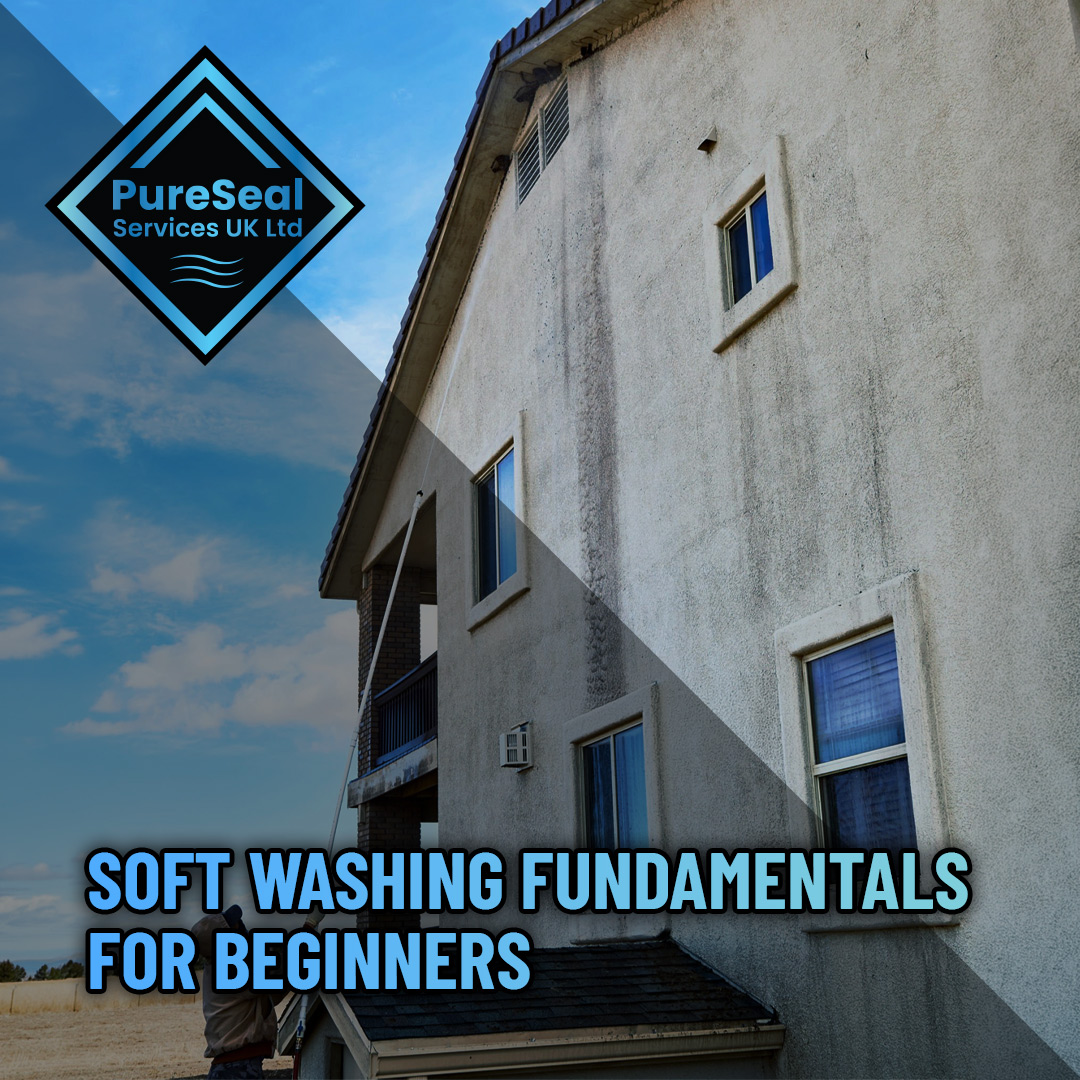
Soft washing fundamentals for beginners
Written by PureSeal Services on . Posted in Pressure Washing, Blog
Soft Washing Fundamentals for Beginners
Soft washing is one of the most effective and safest methods for cleaning exterior surfaces. Unlike high-pressure washing, which relies on force, soft washing uses specialised cleaning solutions and low pressure to remove organic growth, stains, and contaminants. This makes it ideal for delicate surfaces such as roofs, render, cladding, and painted areas.
For beginners, understanding the fundamentals of soft washing is essential before attempting any cleaning work. This guide explains how soft washing works, the equipment required, chemical basics, safety procedures, costs, and best practices to achieve professional results. 🧼
What Is Soft Washing?
Soft washing is a cleaning technique that combines low-pressure water application with specially formulated chemical solutions. The chemicals break down organic matter such as:
-
Algae
-
Moss
-
Lichen
-
Mould
-
Mildew
-
Bacteria
Rather than blasting these contaminants off with pressure, soft washing kills the growth at its root. This results in longer-lasting cleanliness and reduces the risk of damage.
Key Characteristics of Soft Washing
| Feature | Soft Washing | Pressure Washing |
|---|---|---|
| Pressure level | Low pressure (40–150 PSI) | High pressure (1,500–4,000 PSI) |
| Cleaning method | Chemical-based | Force-based |
| Surface safety | Very safe | Can damage delicate surfaces |
| Longevity of results | Long-lasting | Shorter-term |
| Suitable for roofs | Yes | Often unsafe |
Why Soft Washing Is Important
Organic growth is not just unsightly—it can damage surfaces over time. Algae and moss retain moisture, which can cause deterioration, staining, and structural problems.
Soft washing provides several benefits:
-
Extends lifespan of surfaces
-
Improves property appearance
-
Prevents costly repairs
-
Kills organic growth completely
-
Reduces regrowth speed
This makes soft washing especially valuable for roofs, render, and external building surfaces.
Surfaces Suitable for Soft Washing
Soft washing can be used on a wide range of surfaces, including:
-
Roof tiles (clay, concrete, slate)
-
Render (K-render, monocouche, silicone render)
-
UPVC cladding
-
Fascias and soffits
-
Painted surfaces
-
Decking
-
Fencing
-
Brick and stone
Surfaces That Should Always Be Soft Washed
| Surface | Reason |
|---|---|
| Roof tiles | Prevents damage and water ingress |
| Render | Pressure can cause permanent marks |
| Painted wood | Pressure strips paint |
| UPVC | Chemicals remove stains safely |
| Older brickwork | Protects mortar integrity |
How Soft Washing Works
Soft washing involves three main steps:
-
Application of cleaning solution
-
Dwell time to allow chemicals to work
-
Gentle rinsing (optional in some cases)
The cleaning solution penetrates organic growth and breaks it down at a microscopic level. This ensures deeper cleaning than pressure washing alone.
The Cleaning Process Explained
| Step | Description |
|---|---|
| Surface assessment | Identify contamination and surface type |
| Preparation | Protect plants and surrounding areas |
| Chemical mixing | Prepare correct dilution ratios |
| Application | Apply using pump or soft wash system |
| Dwell time | Allow chemicals to break down growth |
| Rinse (if required) | Remove residue safely |
Essential Soft Washing Equipment
You do not need extremely expensive equipment to start soft washing, but quality tools make a significant difference.
Basic Equipment List
| Equipment | Purpose | Estimated Cost |
|---|---|---|
| Soft wash pump | Applies cleaning solution | £150–£600 |
| Hose and reel | Transfers solution | £50–£200 |
| Spray nozzles | Controls application pattern | £10–£40 |
| Chemical-resistant tank | Stores cleaning mix | £50–£300 |
| PPE (gloves, goggles, mask) | Safety protection | £30–£100 |
| Ladder or access equipment | Reach higher areas | £100–£500 |
Total starter setup can range from £390 to £1,740 depending on quality.
Understanding Soft Wash Chemicals
The most commonly used soft washing chemical is sodium hypochlorite, often referred to as bleach. It kills organic growth effectively and works quickly.
Other ingredients may include:
-
Surfactants (help solution stick to surfaces)
-
Biocides (prevent regrowth)
-
Neutralisers (reduce chemical strength after cleaning)
Cleaning products specifically designed for soft washing can be found at https://puresealservices.co.uk/ which supply products suitable for exterior cleaning professionals.
Chemical Dilution Ratios
Correct dilution is critical. Using too strong a mix can damage surfaces, while too weak a mix may be ineffective.
Typical Dilution Guide
| Surface | Sodium Hypochlorite Strength | Water Ratio |
|---|---|---|
| Light algae | 1–2% | 1:5 to 1:10 |
| Moderate algae | 3–4% | 1:3 to 1:5 |
| Heavy moss and lichen | 5–6% | 1:1 to 1:3 |
| Roof tiles | 4–6% | 1:1 to 1:3 |
| Render | 2–4% | 1:3 to 1:6 |
Always test on a small area first.
Importance of Surfactants
Surfactants improve cleaning effectiveness by helping the solution cling to surfaces.
Benefits include:
-
Better penetration into growth
-
Reduced runoff
-
More effective cleaning
-
Reduced chemical usage
Without surfactants, solutions run off too quickly and lose effectiveness.
Dwell Time Explained
Dwell time refers to how long the chemical remains on the surface before rinsing.
Typical dwell times:
| Surface | Dwell Time |
|---|---|
| Render | 10–20 minutes |
| Roof tiles | 20–45 minutes |
| UPVC | 5–15 minutes |
| Brickwork | 15–30 minutes |
Longer dwell times improve effectiveness but must be monitored carefully.
Safety Fundamentals ⚠️
Soft washing involves chemicals that must be handled responsibly.
Personal Protective Equipment (PPE)
Always wear:
-
Chemical-resistant gloves
-
Safety goggles
-
Respirator mask
-
Waterproof clothing
-
Boots
Why PPE Is Essential
| Risk | Protection |
|---|---|
| Chemical burns | Gloves |
| Eye damage | Goggles |
| Chemical inhalation | Respirator |
| Skin irritation | Protective clothing |
Protecting Surrounding Areas
Soft washing chemicals can damage plants and surfaces if precautions are not taken.
Protection methods include:
-
Wetting plants with water before cleaning
-
Covering sensitive areas
-
Rinsing surrounding surfaces after application
-
Controlling runoff
This ensures safety and professional results.
Equipment Operation Basics
Soft washing systems typically operate at low pressure using either:
-
Electric pumps
-
Battery-powered systems
-
Manual pumps
Pressure is usually between 40 and 150 PSI, much lower than pressure washing.
This prevents damage while ensuring proper coverage.
Common Beginner Mistakes
Many beginners make avoidable errors.
Mistake 1: Using Too Much Pressure
Soft washing relies on chemicals, not force.
High pressure can:
-
Damage render
-
Remove paint
-
Crack tiles
Mistake 2: Incorrect Chemical Ratios
Too strong:
-
Surface damage
-
Chemical waste
Too weak:
-
Poor results
-
Faster regrowth
Mistake 3: Not Allowing Enough Dwell Time
Chemicals need time to work effectively.
Cost Breakdown for Beginners
Starting soft washing can be affordable compared to other exterior cleaning methods.
Typical Startup Costs
| Item | Cost |
|---|---|
| Pump system | £200 |
| Tank | £100 |
| Hoses and fittings | £100 |
| PPE | £60 |
| Chemicals | £100 |
| Miscellaneous | £100 |
| Total | £660 |
This makes soft washing accessible for beginners and small businesses.
Running Costs Per Job
Soft washing is cost-effective once equipment is purchased.
Typical chemical cost per job:
| Job Type | Chemical Cost |
|---|---|
| Small wall | £5–£10 |
| Render cleaning | £10–£20 |
| Roof cleaning | £20–£40 |
| Large property | £40–£60 |
This allows strong profit margins if done professionally.
Soft Washing vs Pressure Washing Cost Comparison
| Method | Equipment Cost | Surface Safety | Chemical Cost | Maintenance |
|---|---|---|---|---|
| Soft washing | £500–£1,500 | Very safe | Moderate | Low |
| Pressure washing | £300–£1,000 | Riskier | Low | Moderate |
Soft washing often provides better long-term value.
Understanding Organic Growth
Organic growth thrives in damp, shaded environments.
Common causes include:
-
Poor sunlight exposure
-
High humidity
-
Nearby trees
-
Damp climates
Soft washing removes and prevents these issues.
Weather Conditions and Soft Washing 🌦️
Weather plays a significant role.
Ideal Conditions
| Condition | Suitability |
|---|---|
| Dry weather | Excellent |
| Mild temperatures | Ideal |
| Light cloud cover | Good |
Avoid
-
Heavy rain
-
Strong wind
-
Freezing temperatures
These reduce effectiveness and safety.
Application Techniques
Proper application ensures even coverage.
Best practices include:
-
Spray from bottom to top to prevent streaking
-
Apply evenly
-
Avoid oversaturation
-
Monitor dwell time carefully
Consistency improves results.
Neutralising and Rinsing
Some surfaces require rinsing after cleaning.
Others allow natural weather rinsing.
Neutralisers can be used to stop chemical action and protect surfaces.
Longevity of Soft Washing Results
Soft washing provides long-lasting results.
Typical cleanliness duration:
| Surface | Clean Duration |
|---|---|
| Roof | 3–5 years |
| Render | 2–4 years |
| UPVC | 1–3 years |
This makes it highly effective.
Environmental Considerations 🌱
Responsible chemical use is essential.
Good practices include:
-
Controlled application
-
Avoiding overspray
-
Protecting plants
-
Proper storage
This ensures safe and responsible cleaning.
Beginner Workflow Example
Typical beginner job process:
-
Inspect surface
-
Prepare surrounding areas
-
Mix chemicals correctly
-
Apply solution evenly
-
Allow dwell time
-
Rinse if necessary
-
Inspect results
Following this process ensures professional outcomes.
Storage and Maintenance of Equipment
Proper care extends equipment lifespan.
Maintenance Checklist
| Task | Frequency |
|---|---|
| Flush system with water | After each use |
| Inspect hoses | Weekly |
| Clean nozzles | Weekly |
| Check seals | Monthly |
This prevents failures and ensures reliability.
When to Use Soft Washing Instead of Pressure Washing
Soft washing is always preferred for delicate surfaces.
Use soft washing for:
-
Roof cleaning
-
Render cleaning
-
Painted surfaces
-
Older buildings
Use pressure washing for:
-
Concrete driveways
-
Stone paving
-
Heavy dirt removal
Choosing correctly prevents damage.
Profit Potential for Beginners 💷
Soft washing can be highly profitable.
Example job pricing:
| Job Type | Average Charge | Chemical Cost | Profit |
|---|---|---|---|
| Render cleaning | £300 | £20 | £280 |
| Roof cleaning | £600 | £40 | £560 |
| Wall cleaning | £150 | £10 | £140 |
Low running costs increase earnings potential.
Skills Needed to Master Soft Washing
Soft washing is easy to learn but requires attention to detail.
Important skills include:
-
Chemical knowledge
-
Safety awareness
-
Surface identification
-
Proper application techniques
Practice improves results over time.
Why Soft Washing Is Growing in Popularity
Soft washing is becoming more common due to its safety and effectiveness.
Reasons include:
-
Longer-lasting results
-
Reduced surface damage
-
Professional appearance
-
Increased customer demand
It is now considered the preferred method for many exterior cleaning tasks.
Soft washing provides beginners with a safe, effective, and profitable cleaning method. By understanding the fundamentals, using proper equipment, and following safe procedures, excellent results can be achieved consistently.
Understanding Biocides and Post-Treatment Protection
Biocides are specialised chemicals used after cleaning to prevent organic regrowth. While sodium hypochlorite removes existing algae, moss, and lichen, biocides help keep surfaces cleaner for longer by inhibiting future growth.
Biocide treatments are especially useful for:
-
Roof tiles
-
Render
-
North-facing walls
-
Shaded areas
-
Damp environments
Benefits of Biocide Application
| Benefit | Explanation |
|---|---|
| Prevents regrowth | Stops spores from developing |
| Extends clean appearance | Surfaces stay clean longer |
| Reduces maintenance | Less frequent cleaning required |
| Improves customer satisfaction | Longer-lasting results |
Biocides are typically applied at low pressure and left to work naturally over time without rinsing.
Soft Washing Different Roof Types
Different roofing materials require slightly different soft washing approaches. Understanding the surface helps prevent damage and improves results.
Common Roof Types and Recommended Approach
| Roof Type | Soft Wash Suitability | Notes |
|---|---|---|
| Concrete tiles | Excellent | Very durable |
| Clay tiles | Excellent | Requires careful walking |
| Slate | Excellent | Use lower pressure |
| Metal roofing | Good | Use mild chemical mix |
| Felt roofing | Limited | Use gentle treatment |
Concrete and clay tiles respond very well to soft washing, with results lasting several years.
Understanding Surfactant Ratios and Performance
Surfactants are often overlooked by beginners but play a crucial role in cleaning performance. They reduce surface tension, allowing chemicals to spread evenly and stick longer.
Without surfactants, cleaning solutions run off quickly, reducing effectiveness.
Typical Surfactant Usage Guide
| Chemical Mix Volume | Surfactant Amount |
|---|---|
| 10 litres | 50–100 ml |
| 20 litres | 100–200 ml |
| 50 litres | 250–500 ml |
| 100 litres | 500–1,000 ml |
Using the correct surfactant ratio improves cleaning efficiency and reduces chemical waste.
Identifying Different Types of Organic Staining
Recognising the type of staining helps determine the correct treatment strength.
Common Exterior Stains
| Stain Type | Appearance | Treatment Difficulty |
|---|---|---|
| Green algae | Green film | Easy |
| Black algae | Dark streaks | Moderate |
| Moss | Thick green clumps | Moderate |
| Lichen | White or yellow crust | Difficult |
| Mould | Dark patches | Moderate |
Lichen is the most stubborn and often requires stronger chemical mixes and longer dwell times.
Managing Chemical Strength Safely
Chemical strength should always match the contamination level and surface type. Stronger is not always better.
Using excessive strength can cause:
-
Surface discolouration
-
Material weakening
-
Increased costs
-
Safety hazards
Recommended Strength Guide for Beginners
| Surface | Recommended Strength |
|---|---|
| Render | 2–3% |
| Roof tiles | 4–5% |
| UPVC | 2–3% |
| Brickwork | 3–4% |
Testing a small area first ensures safety and effectiveness.
Preventing Streaking and Uneven Cleaning
Streaking is a common beginner issue and usually results from uneven application or improper technique.
Causes of Streaking
-
Uneven chemical application
-
Allowing chemicals to dry too quickly
-
Incorrect spraying direction
-
Insufficient chemical coverage
Prevention Methods
| Method | Why It Works |
|---|---|
| Apply evenly | Ensures uniform cleaning |
| Work in sections | Maintains control |
| Avoid hot weather | Prevents rapid drying |
| Use surfactants | Improves chemical cling |
Consistent spraying technique ensures professional results.
Understanding Pump Types and Their Differences
Different pumps offer different advantages depending on workload and budget.
Common Pump Types
| Pump Type | Cost | Advantages | Disadvantages |
|---|---|---|---|
| Manual pump | £50–£150 | Cheap, simple | Labour intensive |
| Electric pump | £150–£400 | Reliable, consistent | Requires power |
| Battery pump | £200–£600 | Portable | Limited runtime |
| Petrol pump | £300–£900 | Powerful, fast | More maintenance |
Battery and electric pumps are the most popular choices for beginners.
Building Experience and Improving Results Over Time
Soft washing is a skill that improves with experience. Beginners often see significant improvement within their first few months.
Areas that improve with practice include:
-
Chemical mixing accuracy
-
Application consistency
-
Surface assessment
-
Efficiency
-
Safety awareness
Typical Skill Development Timeline
| Experience Level | Skill Level |
|---|---|
| First 5 jobs | Beginner |
| 10–20 jobs | Improving |
| 20–50 jobs | Competent |
| 50+ jobs | Professional |
As experience grows, efficiency improves and results become more consistent.
Tags: gutter cleaning, window cleaning, Patio cleaning, Driveway cleaning, pressure washing, Roof Cleaning, Exterior cleaning
 Artificial and Sports Surfaces
 Awnings / Canopies / Gazebos
 Block Paving
 Brickwork
 Composite Surfaces
 Decking / Timber
 Granite
 Imprinted Concrete
 Internal Masonry
 Limestone
 Marble
 Metal Cladding
 Polished or Honed Stone
 Porcelain
 Render
 Resin Bond
 Road and Rail Signs
 Roof Tiles / Slates
 Sandstone
 Slate
Slate Solar Panels and Glass
 Stone Sills and Pier Caps
 Tarmac and Asphalt
 Gutters & UPVC
 Acid Damage
 Biofilm
 Bitumen
 Blood
Blood Carbon
 Concrete / Grout / Mortar
 Copper Oxide
 Efflorescence
 Egg
Egg Failed Sealer
 Fire Damage
 Fuel / Oil
 Graffiti
 Grease / Fat / Cooking Oil
 Lawn Fertiliser
 Lead Carbonate
 Lead Oxide
 Paint Splashes
 Rust
Rust Tar & Glue
 Tannin Removers
 Traffic Film Removers
 Trapped Moisture / Sealer Repairs
 Urine Neutralisers