
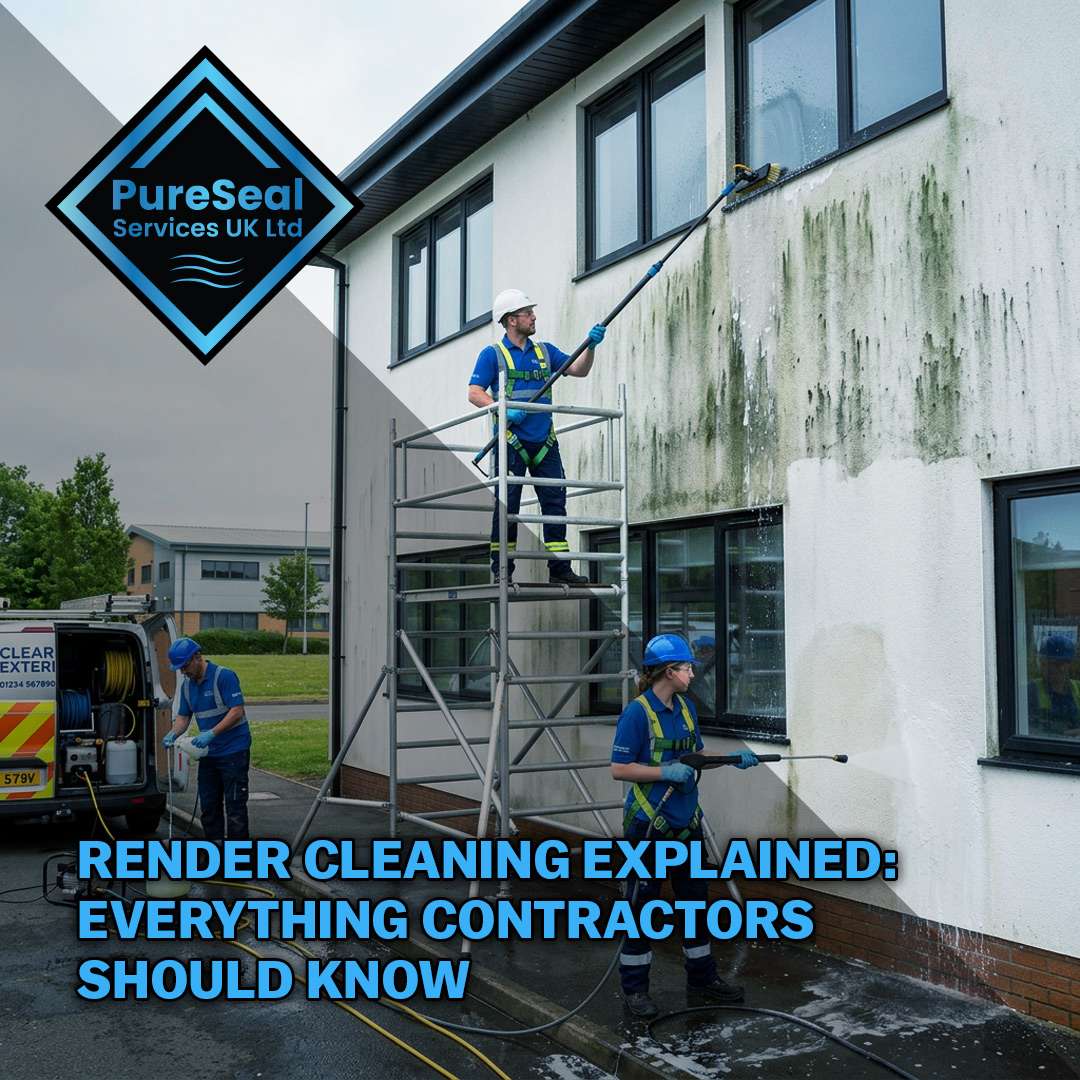
Render Cleaning Explained: Everything Contractors Should Know
Render Cleaning Explained: Everything Contractors Should Know
Render has become one of the most popular exterior finishes on UK homes and commercial buildings. Its modern appearance, wide choice of colours and weather-resistant properties make it an excellent choice for both new-build developments and renovation projects. However, despite its durability, render still requires regular maintenance to keep it looking its best. For contractors, understanding how to clean render correctly is essential. Using the wrong equipment, chemicals or cleaning techniques can permanently damage the surface, leaving costly repairs and dissatisfied customers. At Pure Seal Services, every render cleaning project begins with a full assessment to determine the safest and most effective cleaning method. Premium render cleaning focuses on protecting the surface while delivering long-lasting results rather than simply making the property appear clean for a short period.What Is Render?
Render is a protective coating applied to external walls. It provides weather protection while improving the appearance of buildings. Modern render systems come in a variety of materials, each requiring different cleaning approaches.| Render Type | Characteristics |
|---|---|
| Silicone Render | Highly breathable and water repellent |
| Acrylic Render | Flexible with good weather resistance |
| Mineral Render | Traditional appearance with natural finish |
| Monocouche Render | Through-coloured render requiring specialist cleaning |
| Cement Render | Durable but may become porous over time |
Why Render Gets Dirty
Even premium render systems gradually collect contaminants from the environment. Common causes include:- Air pollution
- Green algae
- Red algae
- Moss
- Lichen
- Traffic emissions
- Dust
- Bird droppings
- Organic staining
- Tree sap
Why Every Render Surface Should Be Assessed First
No two properties are identical. Before cleaning begins, contractors should inspect:- Age of the render
- Existing damage
- Hairline cracks
- Previous repairs
- Biological growth
- Drainage issues
- Nearby vegetation
- Access requirements
| Inspection Item | Reason |
|---|---|
| Cracks | Prevent water penetration during cleaning |
| Loose render | Identify unstable areas |
| Heavy staining | Select suitable treatment |
| Algae growth | Determine cleaning products required |
| Access restrictions | Plan safe working methods |
Understanding Green and Red Algae
One of the most common misconceptions is that all staining on render is the same. Green algae usually develops in damp, shaded conditions and creates green streaks or patches across the surface. Red algae is often far more stubborn and can become deeply embedded into the render, making professional treatment essential. Both forms of contamination should be properly identified before cleaning begins. Removing only the visible staining without treating the underlying biological growth often leads to rapid regrowth.Common Render Cleaning Mistakes
Many render problems are caused by poor cleaning rather than age. Some of the most common mistakes include:- Using excessive pressure
- Applying unsuitable chemicals
- Cleaning without testing products first
- Ignoring damaged render
- Using household bleach incorrectly
- Cleaning during unsuitable weather
- Failing to protect surrounding areas
Why High Pressure Isn’t Always the Answer
Pressure washing is frequently misunderstood. While high pressure may remove dirt quickly, it can also:- Damage protective coatings
- Create surface scarring
- Drive water into cracks
- Remove decorative finishes
- Reduce the render’s lifespan
| Cleaning Method | Suitable For |
|---|---|
| Low-pressure washing | Many render systems after assessment |
| Soft washing | Biological contamination |
| Specialist chemical treatment | Heavy algae and staining |
| Gentle rinsing | Delicate finishes |
The Importance of Correct Cleaning Products
Cleaning chemicals play a major role in achieving long-lasting results. Professional contractors consider:- Surface compatibility
- Biological growth
- Environmental impact
- Drying conditions
- Manufacturer recommendations
Weather Matters More Than Many People Think
Weather conditions affect both safety and cleaning performance. Contractors monitor:- Heavy rainfall
- Strong winds
- Frost
- High temperatures
- Drying times
Safe Access Is Essential
Render cleaning often involves working at height. Professional contractors select access equipment according to:- Property height
- Ground conditions
- Obstacles
- Public safety
- Working duration
- Mobile towers
- Elevated work platforms
- Specialist ladders where appropriate
| Access Method | Typical Use |
|---|---|
| Mobile tower | Medium-height properties |
| Cherry picker | Difficult access locations |
| Roof ladder | Limited situations where appropriate |
| Scaffold | Larger commercial projects |
Protecting Surrounding Areas
Render cleaning affects more than the walls themselves. Professional preparation often includes protecting:- Windows
- Doors
- Driveways
- Patios
- Flower beds
- Garden furniture
- Vehicles
- External lighting
The Role of Biocidal Treatments
Simply washing render clean is rarely enough. Biocidal treatments help eliminate remaining biological growth beneath the visible surface. This provides longer-lasting results by reducing:- Green algae
- Red algae
- Moss
- Lichen
Why Cheap Cleaning Can Become Expensive
Many homeowners naturally compare quotations. However, lower prices often reflect reduced preparation, cheaper equipment or less experienced operatives. Premium contractors typically invest more in:- Staff training
- Specialist equipment
- Professional insurance
- Safe access systems
- Higher-quality cleaning products
- Detailed inspections
| Budget Cleaning | Premium Cleaning |
|---|---|
| Limited inspection | Comprehensive assessment |
| Faster completion | Quality-focused workmanship |
| Basic equipment | Specialist cleaning systems |
| Minimal preparation | Full property protection |
| Short-term appearance | Longer-lasting results |
Common Signs That Render Needs Cleaning
Contractors should educate homeowners about recognising early warning signs. These include:- Green staining
- Red algae patches
- Black streaks
- Uneven colouring
- Moss growth
- Lichen development
- Dirty rainwater marks
Best Practice for Contractors
Professional render cleaning should always follow a structured process. Typical stages include:- Property inspection
- Render identification
- Site preparation
- Protection of surrounding areas
- Selection of suitable cleaning products
- Controlled cleaning
- Application of biocidal treatment where appropriate
- Final rinse if required
- Site clean-up
- Final inspection with the customer
Communicating With Customers
One area that separates experienced contractors from less experienced operators is communication. Customers appreciate understanding:- Why certain methods are recommended
- How long work will take
- What results to expect
- How treatments continue working after cleaning
- How to maintain the render afterwards
Equipment That Professional Contractors Commonly Use
Professional render cleaning requires far more than a domestic pressure washer. Equipment may include:| Equipment | Purpose |
|---|---|
| Low-pressure cleaning systems | Controlled washing of delicate surfaces |
| Chemical application equipment | Even treatment coverage |
| Soft brushes | Gentle agitation where required |
| Water-fed systems | Controlled rinsing |
| Moisture testing equipment | Assess surface conditions |
| PPE | Protect operatives during treatment application |
Delivering Long-Term Value
Professional render cleaning is about preserving the building as much as improving its appearance. A carefully planned cleaning programme can help:- Maintain kerb appeal
- Reduce biological growth
- Protect render finishes
- Identify defects early
- Extend the life of exterior coatings
- Reduce future maintenance requirements
Understanding Different Types of Render Staining
Not all staining develops in the same way, and correctly identifying the cause is an important skill for professional contractors. Misdiagnosing the problem can result in using ineffective cleaning methods or unnecessarily aggressive techniques.
Below are some of the most common types of contamination found on rendered properties.
| Type of Staining | Appearance | Typical Cause |
|---|---|---|
| Green algae | Green patches or streaks | Damp conditions and shaded areas |
| Red algae | Pink or red staining | Persistent moisture and airborne spores |
| Black staining | Dark streaks | Pollution, organic growth or water run-off |
| Lichen | White, grey or yellow patches | Slow-growing fungal organisms |
| Dirt and dust | General discolouration | Traffic pollution and weather exposure |
Correct identification allows contractors to select the safest cleaning solution while achieving the best possible results.
Why Some Properties Become Dirty Faster
Homeowners are often surprised when one rendered property remains clean for years while a neighbouring house quickly develops algae.
Several environmental factors influence how rapidly contamination develops.
These include:
- North-facing walls receiving less sunlight
- Large trees creating permanent shade
- Poor drainage around the property
- Nearby woodland
- Heavy rainfall
- High humidity
- Air pollution from busy roads
Properties affected by several of these factors generally require more frequent maintenance to keep the render looking its best.
Why Contractors Should Never Rush Render Cleaning
Professional render cleaning is rarely a job that should be completed as quickly as possible.
Each stage requires sufficient time to ensure both safety and quality.
For example:
- Cleaning solutions require appropriate dwell time.
- Biological contamination may need repeated treatment.
- Heavily stained areas often require additional attention.
- Surrounding surfaces should be protected before work begins.
- Final inspections help identify any areas requiring further treatment.
Attempting to complete work too quickly often results in inconsistent cleaning and disappointed customers.
The Importance of Customer Expectations
One of the most valuable skills a contractor can develop is managing expectations before work starts.
Customers should understand that:
- Some deep staining may lighten gradually following treatment.
- Severely weathered render cannot always be restored to a brand-new appearance.
- Biological treatments often continue working after the initial visit.
- Results vary depending on the age and condition of the render.
Explaining these points before work begins helps avoid misunderstandings and improves customer satisfaction.
Areas Contractors Often Overlook
Even experienced cleaners can sometimes focus only on the main wall surfaces.
However, a complete render cleaning project should also consider surrounding features.
These may include:
- Window reveals
- Door surrounds
- Garage walls
- Garden walls
- Chimney breasts
- Parapet walls
- Decorative pillars
- Boundary walls finished in matching render
Cleaning these areas creates a more consistent overall finish.
| Area | Why It Matters |
|---|---|
| Window reveals | Often collect heavy algae growth |
| Beneath sills | Frequent water staining |
| North-facing walls | Usually retain more moisture |
| Rear elevations | Often receive less sunlight |
| Garden walls | Easily overlooked but highly visible |
How Regular Maintenance Protects Render
Many homeowners wait until staining becomes severe before arranging professional cleaning.
In reality, lighter contamination is usually easier and safer to remove.
Benefits of regular maintenance include:
- Reduced biological build-up
- Improved kerb appeal
- Less aggressive cleaning requirements
- Earlier identification of defects
- Better long-term appearance
- Lower likelihood of permanent staining
Preventative maintenance is generally more cost-effective than allowing years of contamination to accumulate.
Common Questions Contractors Receive
Professional contractors are frequently asked similar questions by customers considering render cleaning.
| Question | Professional Response |
|---|---|
| Will the render look brand new? | Results depend on age, condition and existing weathering. |
| How long does cleaning take? | Varies depending on property size and contamination levels. |
| Will plants be protected? | Surrounding areas should always be carefully protected where necessary. |
| Is specialist equipment required? | Yes, professional cleaning equipment helps deliver safer, more consistent results. |
| Will algae return? | Over time, biological growth can return, particularly in damp environments, although appropriate treatments help slow regrowth. |
Providing honest answers builds confidence and demonstrates professionalism.
Why Experience Makes Such a Difference
Render cleaning appears straightforward from the ground, but experienced contractors understand how many variables influence the final outcome.
Experience helps with:
- Identifying render systems
- Recognising early signs of deterioration
- Selecting compatible cleaning products
- Adjusting cleaning methods for different surfaces
- Working safely at height
- Managing customer expectations
This knowledge significantly reduces the likelihood of accidental damage while improving the overall quality of the finished work.
Health and Safety Responsibilities
Professional contractors should never overlook their legal and practical responsibilities when working on render cleaning projects.
Good working practices include:
- Carrying out site-specific risk assessments.
- Inspecting access equipment before use.
- Wearing appropriate PPE.
- Restricting public access where necessary.
- Monitoring changing weather conditions.
- Following manufacturer guidance for cleaning products.
A strong commitment to health and safety protects employees, customers and members of the public while helping projects run smoothly.
Why Premium Services Deliver Better Value
Although some customers naturally focus on obtaining the lowest quotation, professional contractors understand that quality render cleaning involves far more than simply washing exterior walls.
Higher-quality services typically include:
- A detailed property inspection before work begins.
- Careful identification of the render system.
- Professional preparation of the surrounding area.
- Specialist cleaning products selected for compatibility.
- Safe access equipment appropriate for the property.
- Thorough post-cleaning inspections.
These additional stages require more time, more training and better equipment, which is why premium render cleaning services are generally priced higher than basic cleaning packages.
Rather than competing to be the cheapest, experienced contractors focus on delivering workmanship that protects the render, maintains the property’s appearance and reduces the likelihood of unnecessary repairs or repeat cleaning. For many homeowners, investing in a professional service provides greater long-term value than choosing a low-cost alternative that may compromise the condition of the render.
Tags: Driveway cleaning, pressure washing, Roof Cleaning, Exterior cleaning, gutter cleaning, window cleaning, Patio cleaning
 Artificial and Sports Surfaces
 Awnings / Canopies / Gazebos
 Block Paving
 Brickwork
 Composite Surfaces
 Decking / Timber
 Granite
 Imprinted Concrete
 Internal Masonry
 Limestone
 Marble
 Metal Cladding
 Polished or Honed Stone
 Porcelain
 Render
 Resin Bond
 Road and Rail Signs
 Roof Tiles / Slates
 Sandstone
 Slate
Slate Solar Panels and Glass
 Stone Sills and Pier Caps
 Tarmac and Asphalt
 Gutters & UPVC
 Acid Damage
 Biofilm
 Bitumen
 Blood
Blood Carbon
 Concrete / Grout / Mortar
 Copper Oxide
 Efflorescence
 Egg
Egg Failed Sealer
 Fire Damage
 Fuel / Oil
 Graffiti
 Grease / Fat / Cooking Oil
 Lawn Fertiliser
 Lead Carbonate
 Lead Oxide
 Paint Splashes
 Rust
Rust Tar & Glue
 Tannin Removers
 Traffic Film Removers
 Trapped Moisture / Sealer Repairs
 Urine Neutralisers