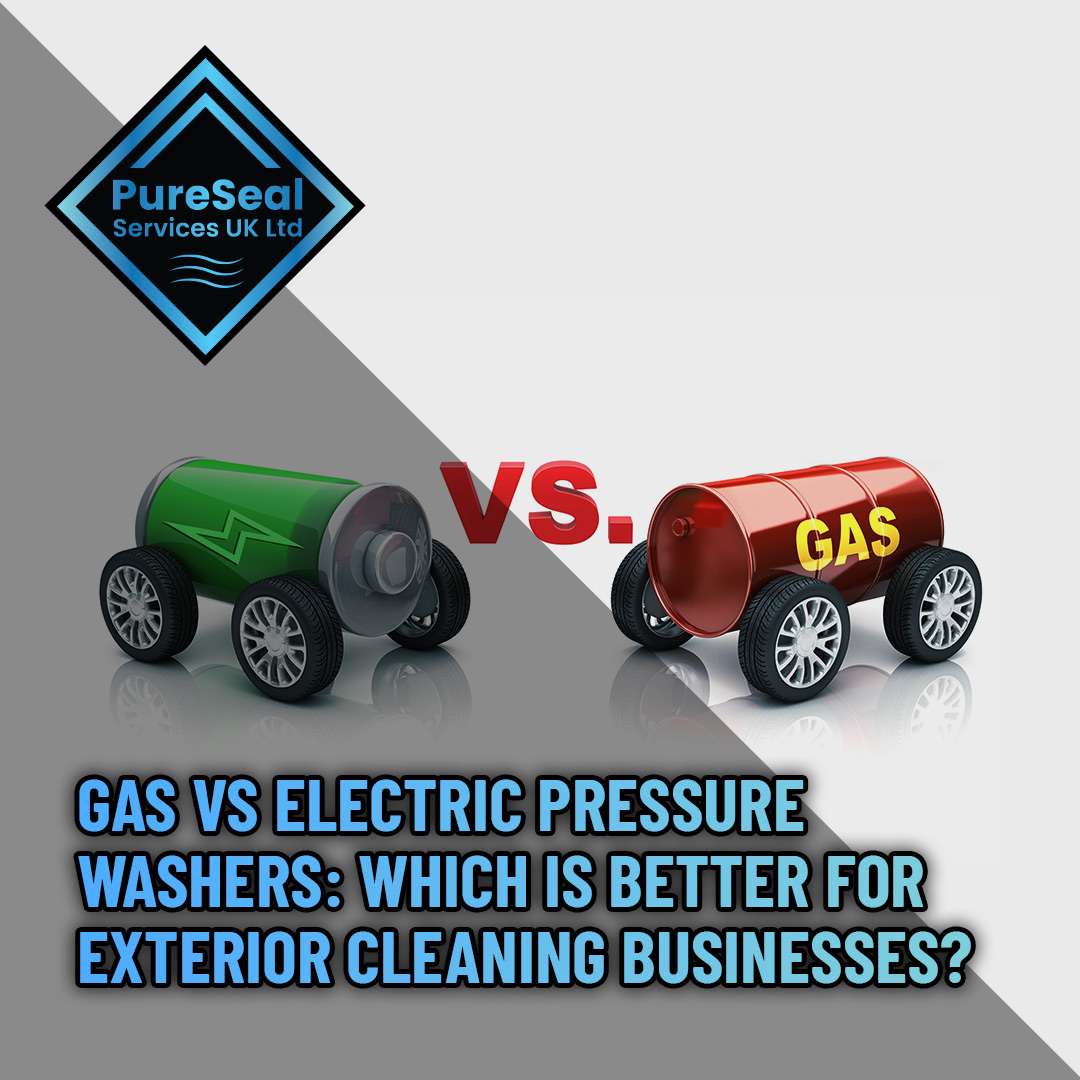
Gas vs Electric Pressure Washers: Which Is Better for Exterior Cleaning Businesses?
Choosing the right pressure washer is one of the most important investments an exterior cleaning business will make. The decision between a gas (petrol) and electric pressure washer affects everything from productivity and operating costs to mobility and the types of jobs you can undertake.
While both options have their place, each has distinct advantages and disadvantages depending on the work you carry out. Understanding these differences helps ensure you invest in equipment that matches your business rather than simply buying the most powerful or least expensive machine available.
At Pure Seal Services, we invest in professional-grade equipment capable of delivering reliable performance across a wide range of exterior cleaning projects. Selecting the right machinery allows us to complete work efficiently while maintaining the high standards our customers expect.
Understanding the Difference
The primary difference between gas and electric pressure washers is the power source.
A gas pressure washer uses a petrol engine to drive the pump, while an electric pressure washer uses an electric motor connected to a mains power supply or, in some cases, a large generator.
Although both machines produce high-pressure water, their performance characteristics vary considerably.
Gas vs Electric at a Glance
Feature
Gas Pressure Washer
Electric Pressure Washer
Power source
Petrol engine
Electric motor
Portability
Excellent
Limited by power supply
Typical pressure
Higher
Moderate to high
Water flow
Higher
Lower to moderate
Noise
Louder
Much quieter
Maintenance
Higher
Lower
Running costs
Fuel required
Lower electricity costs
Commercial suitability
Excellent
Good for selected work
Why Exterior Cleaning Businesses Often Choose Gas
Many professional exterior cleaning contractors favour petrol-powered pressure washers because they provide greater flexibility.
Working on customer properties often means:
No nearby electrical supply
Large outdoor areas
Long driveways
Commercial premises
Rural locations
A petrol-powered machine allows contractors to work almost anywhere without relying on extension leads or generators.
This increased freedom can significantly improve productivity.
Advantages of Gas Pressure Washers
Gas-powered machines offer several important benefits.
Greater Mobility
Without the need for mains electricity, operators can move freely around:
Large homes
Farms
Business parks
Schools
Industrial estates
Construction sites
This makes setup considerably quicker.
Higher Water Flow
Commercial petrol machines generally produce greater litres per minute (LPM).
Higher water flow means:
Faster rinsing
Larger cleaning coverage
Shorter job times
Better debris removal
Improved productivity
Many contractors discover that water flow contributes more to cleaning speed than pressure alone.
More Cleaning Power
Gas machines are often capable of producing higher PSI while maintaining excellent flow rates.
This makes them particularly effective for cleaning:
Concrete yards
Block paving
Commercial forecourts
Industrial buildings
Heavy dirt
Agricultural equipment
Benefits of Electric Pressure Washers
Electric pressure washers also have important advantages.
For certain businesses they may actually be the better option.
Lower Noise Levels
Electric motors operate far more quietly than petrol engines.
This can be beneficial when working:
Early mornings
Residential areas
Schools
Hotels
Offices
Healthcare facilities
Reducing noise may improve customer satisfaction.
Easier Maintenance
Electric motors contain fewer moving parts.
Typical maintenance is limited to:
Checking cables
Cleaning filters
Inspecting hoses
General servicing
Petrol engines require:
Oil changes
Air filters
Spark plugs
Fuel management
Engine servicing
Comparing Maintenance Requirements
Maintenance Item
Gas
Electric
Engine oil
✓
No
Spark plugs
✓
No
Fuel system
✓
No
Air filter
✓
No
Electrical cable checks
No
✓
Pump servicing
✓
✓
Fuel Costs vs Electricity Costs
Running costs differ significantly.
Gas machines require:
Petrol
Engine oil
Regular servicing
Electric machines consume electricity, which generally costs less per hour of operation.
However, electricity is not always available where exterior cleaning takes place.
Contractors may therefore require generators, increasing operating costs.
Which Is More Reliable?
Reliability depends more on maintenance than the power source.
Well-maintained petrol machines can provide many years of dependable service.
Likewise, quality electric machines are extremely reliable when used within their intended operating limits.
Regular servicing remains essential regardless of the machine chosen.
Working Time
Commercial petrol pressure washers can operate for long periods provided fuel is available.
Electric machines may be limited by:
Cable length
Generator capacity
Available power supply
This becomes more noticeable on larger commercial projects.
Environmental Considerations
Electric pressure washers produce no direct exhaust emissions while operating.
Gas-powered machines generate engine emissions.
Businesses increasingly consider environmental impact when selecting equipment.
Factors include:
Fuel consumption
Noise pollution
Carbon emissions
Energy efficiency
Some commercial customers may specifically request lower-emission equipment where practical.
Which Machine Cleans Faster?
Cleaning speed depends on several factors.
These include:
Water flow
Pressure
Operator experience
Surface condition
Chemical use
Accessories
In many cases, petrol-powered machines complete large outdoor projects more quickly because they combine high pressure with higher water flow.
Suitable Jobs for Gas Pressure Washers
Gas pressure washers are particularly suited to:
Cleaning Task
Suitability
Driveway cleaning
Excellent
Commercial paving
Excellent
Industrial cleaning
Excellent
Farm buildings
Excellent
Large patios
Excellent
Heavy moss removal
Excellent
Suitable Jobs for Electric Pressure Washers
Cleaning Task
Suitability
Domestic patios
Good
Vehicle cleaning
Excellent
Indoor cleaning
Excellent
Small courtyards
Good
Residential work
Very Good
Light maintenance cleaning
Excellent
Weight and Transport
Petrol-powered machines are generally heavier because of:
Engine
Fuel tank
Larger pumps
Electric machines are often easier to lift and transport.
However, commercial contractors frequently mount petrol machines permanently inside vans or trailers, reducing the need for manual handling.
Accessories Available
Both machine types support similar accessories including:
Flat surface cleaners
Turbo nozzles
Variable lances
Extension poles
Hose reels
Chemical injectors
Foam systems
Choosing compatible accessories can improve efficiency regardless of power source.
Chemical Compatibility
Professional exterior cleaning rarely depends solely on water pressure.
Pressure washers are commonly paired with specialist cleaning chemicals for:
Algae
Moss
Grease
Oil
Mould
Organic staining
Most commercial machines include chemical injection systems or can be connected to external soft washing equipment.
Using the correct cleaning solution often reduces the pressure required, helping protect delicate surfaces while achieving superior results.
Initial Purchase Costs
Commercial pressure washers vary considerably in price.
Machine Type
Typical Price
Entry-level electric commercial
£700–£1,500
Professional electric
£1,500–£3,000
Entry-level petrol commercial
£1,500–£2,500
Premium petrol commercial
£3,000–£8,000+
Premium equipment generally commands a higher price due to heavier-duty pumps, improved build quality and greater durability.
Long-Term Ownership Costs
When calculating value, businesses should consider more than just purchase price.
Ownership costs may include:
Servicing
Replacement hoses
Pump maintenance
Fuel
Filters
Repairs
Accessories
Higher-quality machines often prove more economical over their working life despite a larger initial investment.
Which Offers Better Productivity?
For contractors cleaning multiple properties every day, productivity is crucial.
Gas-powered machines often provide:
Faster setup
Greater mobility
Higher water flow
Shorter cleaning times
Electric machines may provide:
Easier operation
Lower maintenance
Reduced noise
Lower energy costs
The best choice depends on the types of contracts your business regularly undertakes.
Questions to Ask Before Buying
Before purchasing any commercial pressure washer, ask yourself:
Will I mainly clean domestic or commercial properties?
How often will the machine be used?
Do I regularly work where electricity is unavailable?
Is portability important?
What level of maintenance am I prepared to undertake?
Will I need higher water flow for larger jobs?
Do I expect my business to expand in the future?
Answering these questions honestly can help narrow down the most suitable option.
Investing in Professional Equipment
Exterior cleaning businesses rely heavily on dependable machinery. A pressure washer is not simply another tool—it is one of the most valuable assets in daily operations.
Professional-grade equipment typically offers:
Feature
Business Benefit
Industrial pumps
Longer service life
Higher water flow
Faster job completion
Durable construction
Better reliability
Commercial accessories
Greater versatility
Serviceable components
Lower long-term costs
Premium build quality
Consistent performance
Businesses focused on delivering high-quality workmanship often choose premium equipment rather than the cheapest option available. Although the initial investment is higher, dependable machinery reduces downtime, improves efficiency and supports a consistently professional service.
At Pure Seal Services, we believe investing in commercial-grade equipment is essential for achieving outstanding exterior cleaning results. By combining professional machinery with the correct cleaning techniques and specialist products, we deliver a premium service designed to restore exterior surfaces safely and effectively while maintaining the high standards our customers expect.
Safety Considerations
Whether you choose a gas or electric pressure washer, safe operation should always be a priority. Commercial pressure washers are powerful machines capable of causing injury or damaging property if used incorrectly.
Professional operators should always:
Wear suitable personal protective equipment (PPE)
Inspect hoses and fittings before every job
Check the work area for hazards
Keep members of the public at a safe distance
Use the correct nozzle for the surface
Avoid directing high-pressure water at electrical equipment, windows or fragile materials
Proper training is just as important as choosing the right machine.
Safety Check
Why It’s Important
Inspect hoses
Prevents burst hoses under pressure
Check trigger gun
Ensures safe operation
Test pressure settings
Reduces risk of surface damage
Examine fuel or power cables
Prevents breakdowns and hazards
Wear eye protection
Protects against flying debris
Storage Requirements
Commercial pressure washers represent a significant investment, so storing them correctly helps extend their lifespan.
Gas-powered machines should be stored in a dry, well-ventilated location, with fuel handled safely according to manufacturer recommendations. During colder months, steps should be taken to prevent water remaining inside the pump from freezing.
Electric pressure washers should also be protected from frost and moisture, with electrical cables neatly coiled and checked regularly for damage.
Good storage habits reduce unnecessary wear and help ensure the machine is ready for work when needed.
Seasonal Performance
Weather conditions can influence the performance of both gas and electric pressure washers.
During winter:
Water pipes may freeze
Pumps require protection from frost
Cold temperatures can affect cleaning chemicals
Ice may create additional safety hazards
During summer:
Machines may require more frequent cooling periods during continuous use
Cleaning chemicals may dry more quickly on hot surfaces
Operators should monitor water supplies carefully during extended jobs
Planning work around weather conditions helps maintain consistent cleaning standards throughout the year.
Which Machine Is Better for Growing Businesses?
Many new exterior cleaning businesses begin with one pressure washer before expanding their equipment as demand increases.
When choosing your first commercial machine, think beyond your current workload.
Questions worth considering include:
Will you move into commercial contracts?
Do you plan to clean larger driveways?
Will you eventually employ additional staff?
Could you expand into industrial cleaning?
Will you invest in trailer-mounted systems later?
Purchasing equipment with sufficient capacity for future growth may avoid the need for an expensive replacement only a few years later.
Common Myths About Gas and Electric Pressure Washers
Several misconceptions often influence buying decisions.
“Higher PSI Always Means Better Cleaning”
This is one of the most common myths.
Water flow, cleaning chemicals, nozzle selection and operator experience often have a greater impact than pressure alone.
“Electric Machines Aren’t Suitable for Professional Use”
Modern commercial electric pressure washers can deliver excellent performance, particularly for businesses carrying out regular domestic work or cleaning in noise-sensitive environments.
“Gas Machines Are Too Expensive to Run”
While petrol-powered machines do have higher fuel and maintenance costs, they often complete larger jobs more quickly. Improved productivity may offset these additional running costs.
“Maintenance Isn’t Important”
Regardless of the power source, routine servicing is essential. Neglecting maintenance can lead to reduced performance, unexpected breakdowns and expensive repairs.
Selecting the Right Machine for Your Services
Different exterior cleaning businesses have different priorities. Matching your equipment to the services you provide is far more important than simply choosing the machine with the highest specifications.
Primary Service
Recommended Choice
Residential driveway cleaning
Gas pressure washer
Large commercial paving
Gas pressure washer
Fleet vehicle cleaning
Electric or gas depending on site facilities
Indoor commercial cleaning
Electric pressure washer
Hotel and hospitality maintenance
Electric pressure washer
Mixed domestic and commercial work
Heavy-duty gas pressure washer
Understanding where most of your income comes from can help guide your purchasing decision.
Looking Beyond the Purchase Price
It can be tempting to compare machines purely on their initial cost, but professional contractors understand that value is measured over many years of use.
A premium commercial pressure washer may cost several thousand pounds more than a basic model, yet it can often deliver:
Greater reliability
Lower repair costs
Faster cleaning times
Better operator comfort
Longer service life
Higher resale value
These benefits can make a higher-quality machine the more economical option in the long term.
Businesses that focus on delivering premium exterior cleaning services often choose equipment that reflects the quality of their work rather than aiming for the lowest possible purchase price.
At Pure Seal Services, we believe dependable commercial equipment is an investment in customer satisfaction. Choosing machinery based on reliability, performance and suitability for the work allows us to maintain consistently high standards across every project, whether cleaning domestic driveways or larger commercial properties.

 Artificial and Sports Surfaces
 Awnings / Canopies / Gazebos
 Block Paving
 Brickwork
 Composite Surfaces
 Decking / Timber
 Granite
 Imprinted Concrete
 Internal Masonry
 Limestone
 Marble
 Metal Cladding
 Polished or Honed Stone
 Porcelain
 Render
 Resin Bond
 Road and Rail Signs
 Roof Tiles / Slates
 Sandstone
 Slate
Slate Solar Panels and Glass
 Stone Sills and Pier Caps
 Tarmac and Asphalt
 Gutters & UPVC
 Acid Damage
 Biofilm
 Bitumen
 Blood
Blood Carbon
 Concrete / Grout / Mortar
 Copper Oxide
 Efflorescence
 Egg
Egg Failed Sealer
 Fire Damage
 Fuel / Oil
 Graffiti
 Grease / Fat / Cooking Oil
 Lawn Fertiliser
 Lead Carbonate
 Lead Oxide
 Paint Splashes
 Rust
Rust Tar & Glue
 Tannin Removers
 Traffic Film Removers
 Trapped Moisture / Sealer Repairs
 Urine Neutralisers