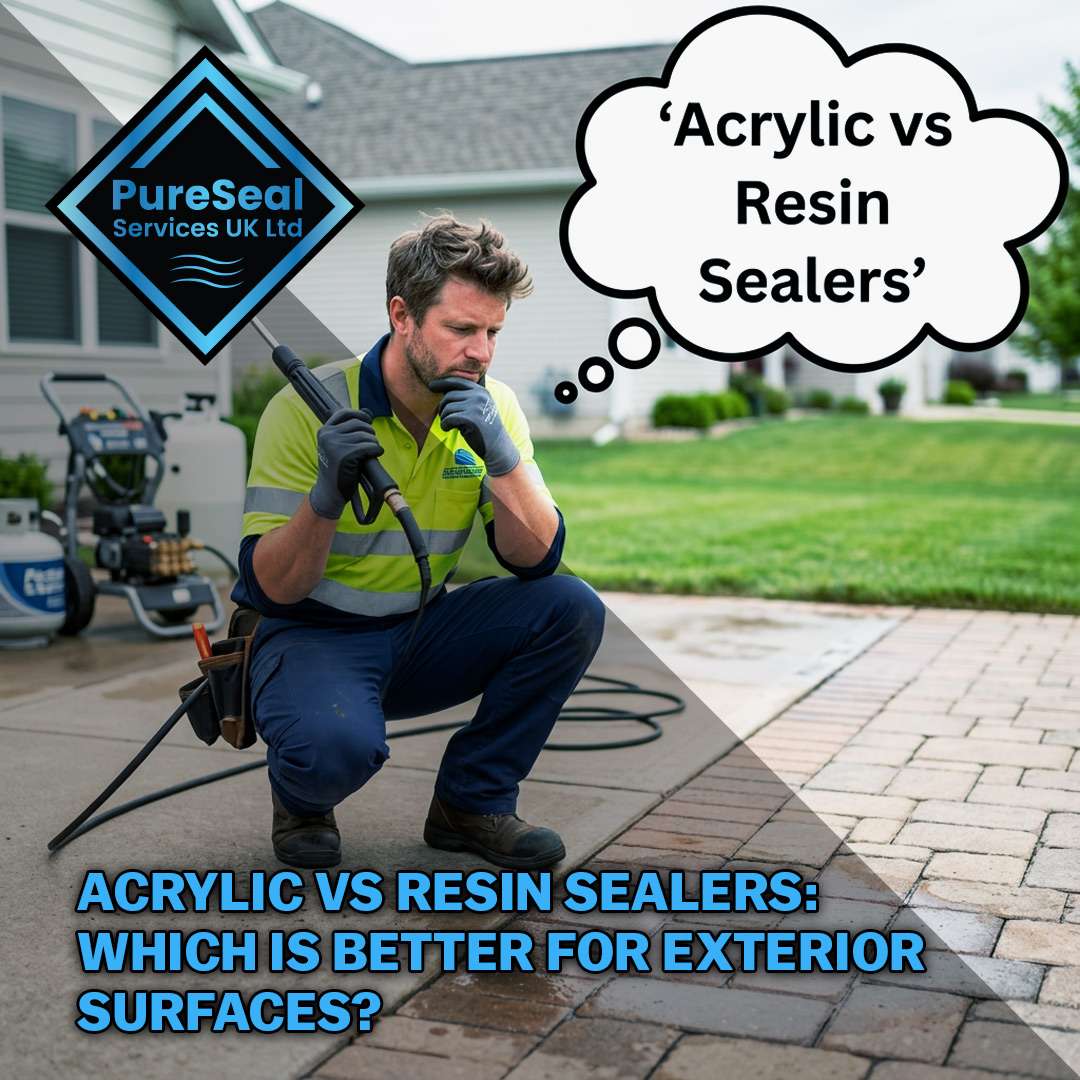
Acrylic vs Resin Sealers: Which Is Better for Exterior Surfaces?
Choosing the right sealer for an exterior surface is just as important as choosing the surface itself. Whether you’re protecting block paving, concrete, natural stone or decorative paving, the correct product can dramatically improve durability, appearance and longevity.
Two of the most common options are acrylic sealers and resin-based sealers. While both provide protection against the British weather, they work in different ways and are suited to different applications.
At Pure Seal Services, we only use premium-grade sealing systems selected for the specific surface being treated. Rather than applying the same product everywhere, we assess every project individually to achieve the best possible long-term results.
This guide compares acrylic and resin sealers, highlighting their advantages, limitations and the situations where each performs best.
Why Exterior Surfaces Need Sealing
Outdoor surfaces face constant exposure to harsh conditions throughout the year.
These include:
Heavy rainfall
UV rays
Frost
Vehicle traffic
Oil spills
Algae and moss
Dirt build-up
Temperature fluctuations
Without protection, porous materials gradually absorb moisture and contaminants, leading to staining, fading and premature wear.
Professional sealing creates a protective barrier that helps preserve both appearance and structural integrity.
Problem
Unsealed Surface
Professionally Sealed Surface
Water absorption
High
Significantly reduced
Colour fading
Gradual
Greatly minimised
Oil staining
Common
Improved resistance
Weed growth
More frequent
Reduced
Cleaning
More difficult
Easier
Surface lifespan
Reduced
Extended
What Is an Acrylic Sealer?
Acrylic sealers are one of the most widely used protective coatings for exterior paving throughout the UK.
They form a thin yet durable protective layer across the surface while allowing the material beneath to retain its appearance.
Modern acrylic formulations offer excellent weather resistance alongside attractive visual enhancement.
Typical applications include:
Block paving
Pattern imprinted concrete
Decorative concrete
Brick paving
Garden paths
Patios
Advantages of Acrylic Sealers
Acrylic sealers remain popular for several reasons.
Excellent Appearance
They can provide:
Natural matt finish
Satin finish
Colour enhancement
Wet-look appearance
This flexibility allows homeowners to choose the finish that best complements their property.
UV Protection
Sunlight gradually fades coloured paving.
Quality acrylic sealers contain UV-resistant properties that help preserve original colours for much longer.
Water Repellency
Reducing water absorption helps minimise:
Frost damage
Surface staining
Organic growth
General weathering
Easier Maintenance
Because dirt remains closer to the surface, routine cleaning often becomes quicker and simpler.
What Are Resin Sealers?
Resin sealers generally refer to coatings that contain stronger resin compounds designed to produce an exceptionally durable protective finish.
Depending on the formulation, these products may provide greater chemical resistance and longer-lasting wear protection than some traditional acrylic products.
They are commonly used on:
Resin-bound surfaces
Commercial paving
Industrial flooring
High-traffic areas
Decorative hard landscaping
Advantages of Resin Sealers
Resin-based systems offer several benefits.
Exceptional Durability
Many resin products are designed to withstand:
Heavy vehicle traffic
Frequent footfall
Abrasion
Weather exposure
Strong Chemical Resistance
These sealers often provide excellent protection against:
Oil
Grease
Fuel
Cleaning chemicals
Longer Maintenance Cycles
In certain applications, resin sealers may require less frequent reapplication than standard coatings.
Acrylic vs Resin at a Glance
Feature
Acrylic Sealer
Resin Sealer
Appearance
Excellent
Excellent
Colour enhancement
Very good
Very good
Durability
Excellent
Outstanding
UV protection
Excellent
Excellent
Oil resistance
Very good
Excellent
Chemical resistance
Good
Outstanding
Ease of maintenance
Excellent
Excellent
Suitable for domestic paving
Yes
Yes
Suitable for heavy commercial use
Limited
Excellent
Which Surfaces Suit Acrylic Sealers?
Acrylic products are ideal for many domestic applications.
These include:
Driveways
Patios
Garden paths
Courtyards
Decorative concrete
Brick paving
Their versatility makes them one of the most commonly specified sealing systems for residential properties.
Which Surfaces Suit Resin Sealers?
Resin sealers are often selected where additional durability is required.
Examples include:
Commercial forecourts
Retail areas
Public walkways
High-use driveways
Resin-bound installations
Where vehicle traffic is particularly heavy, resin systems can offer additional long-term protection.
Appearance Comparison
Many homeowners choose a sealer primarily to improve appearance.
Both systems can achieve attractive results, although there are differences.
Finish
Acrylic
Resin
Natural appearance
Excellent
Excellent
Satin finish
Excellent
Very good
Wet-look finish
Excellent
Excellent
Colour enhancement
Strong
Strong
Gloss finish
Available
Available
The final appearance depends not only on the product but also on the condition of the surface before sealing.
Resistance to Weather
Britain’s weather presents one of the greatest challenges for external surfaces.
Rain, frost and changing temperatures gradually wear down unprotected paving.
Both acrylic and resin sealers help reduce:
Moisture penetration
Surface erosion
Freeze-thaw damage
UV fading
Professional preparation before application plays a major role in determining how well either product performs over time.
Protection Against Stains
Exterior paving is regularly exposed to substances capable of causing permanent staining.
These include:
Engine oil
Diesel
Barbecue grease
Leaf tannins
Bird droppings
Food spills
Sealers create a barrier that slows absorption, giving homeowners much longer to remove spills before permanent marks develop.
Ease of Cleaning
One of the biggest advantages of sealing any external surface is reduced maintenance.
Instead of soaking into porous materials, dirt tends to remain on the protective coating.
Benefits include:
Faster washing
Less scrubbing
Reduced algae attachment
Easier leaf stain removal
Improved overall appearance
This can save considerable time over the life of the surface.
Durability Comparison
Performance Area
Acrylic
Resin
Residential use
Excellent
Excellent
Commercial use
Good
Outstanding
UV stability
Excellent
Excellent
Water resistance
Excellent
Excellent
Abrasion resistance
Very good
Outstanding
Long-term wear
Very good
Excellent
Both products perform exceptionally well when correctly matched to the intended application.
Professional Installation Matters
Even premium products cannot compensate for poor preparation.
Successful sealing normally involves:
Thorough cleaning.
Removal of algae and organic growth.
Drying the surface completely.
Replacing jointing sand where necessary.
Protecting surrounding areas.
Applying the correct amount of product.
Allowing sufficient curing time.
Incorrect application can lead to:
Uneven finish
White blooming
Poor adhesion
Reduced durability
Premature failure
This is why professional installation often produces significantly better long-term results.
Cost vs Value
Homeowners naturally compare prices when considering driveway or patio sealing.
However, the cheapest quotation rarely delivers the best long-term value.
Premium sealing systems generally involve:
Better preparation.
Higher-quality products.
Greater durability.
Longer-lasting protection.
Improved appearance.
Consideration
Budget Sealing
Premium Professional Sealing
Initial cost
Lower
Higher
Product quality
Variable
Premium
Lifespan
Often shorter
Longer
Appearance
Good
Excellent
Long-term value
Moderate
Excellent
At Pure Seal Services, we focus on delivering premium results rather than competing on price alone. Investing in higher-quality products and professional application helps ensure customers receive a finish that continues to protect their exterior surfaces for years to come.
Choosing the Right Sealer
Selecting between acrylic and resin sealers depends on several factors.
These include:
Surface type
Traffic levels
Desired appearance
Existing condition
Exposure to weather
Maintenance expectations
Rather than assuming one product is universally better than the other, it is important to choose the sealing system that best matches the specific installation.
For many residential driveways and patios, modern acrylic sealers offer an excellent combination of protection, appearance and value. For surfaces exposed to exceptionally heavy wear or demanding environments, resin-based systems may provide additional durability.
By assessing every project individually, using premium materials and applying them correctly, homeowners can enjoy long-lasting protection, enhanced kerb appeal and easier maintenance throughout the lifetime of their exterior surfaces.
How UV Exposure Affects Exterior Surfaces
Many homeowners associate weather damage with rain and frost, but ultraviolet (UV) light is equally damaging over time.
Continuous exposure to sunlight can gradually cause:
Colours to fade.
Decorative finishes to lose their richness.
Some materials to become more brittle.
The overall appearance to deteriorate.
Both acrylic and resin sealers provide valuable UV protection, although premium formulations generally offer longer-lasting resistance to fading.
This is particularly important for:
Charcoal block paving
Red block paving
Decorative concrete
Coloured resin-bound surfaces
Pattern imprinted concrete
Maintaining colour not only improves kerb appeal but also helps the surface continue looking newer for longer.
Water Repellency Compared
One of the primary functions of any exterior sealer is preventing excessive water absorption.
When water enters porous materials, it can contribute to:
Frost damage.
Surface erosion.
Organic growth.
Staining.
Efflorescence.
The better a sealer repels moisture, the lower the risk of these problems developing.
Performance
Acrylic Sealer
Resin Sealer
Water repellency
Excellent
Excellent
Rain resistance
Excellent
Excellent
Frost protection
Very good
Excellent
Moisture penetration
Low
Very low
Reducing moisture absorption also makes routine cleaning easier, as dirt is less likely to become embedded within the surface.
Which Sealer Lasts Longer?
There is no universal lifespan because every surface experiences different levels of wear.
Factors influencing longevity include:
Vehicle traffic.
Weather exposure.
Quality of preparation.
Surface porosity.
Product quality.
Maintenance routine.
Generally speaking, professionally applied premium sealers provide considerably longer service than lower-cost alternatives.
Surface Use
Typical Performance
Decorative patio
Long service life
Residential driveway
Excellent longevity
Busy family driveway
Moderate to long service life
Commercial entrance
Depends on traffic levels
Regular inspections and occasional maintenance cleaning can help maximise the life of either sealing system.
The Importance of Breathability
Many people believe the strongest waterproof coating is always the best option.
In reality, exterior surfaces often benefit from a degree of breathability.
A quality breathable sealer allows trapped moisture vapour to escape while still preventing rainwater from penetrating from above.
This balance helps reduce problems such as:
Trapped moisture.
White blooming.
Surface lifting.
Premature coating failure.
Choosing the correct product for the specific material is therefore far more important than simply selecting the thickest coating available.
Environmental Considerations
Modern sealing technology has improved significantly over recent years.
Many premium products now offer:
Lower odour during application.
Reduced environmental impact.
Improved curing performance.
Better long-term durability.
Greater resistance to weathering.
Professional installers also apply products accurately, reducing waste while ensuring the correct coverage rate is achieved across the entire surface.
Can Sealers Prevent Weed Growth?
This is one of the most common questions homeowners ask.
The answer is that no sealer completely eliminates weeds, but it can significantly reduce the conditions that allow them to establish.
Most weeds found in block paving do not grow from underneath the driveway.
Instead, seeds settle into the joints where moisture and organic matter accumulate.
Sealing helps by:
Locking in kiln-dried jointing sand.
Reducing moisture retention.
Making joints less attractive to weed growth.
Making future maintenance easier.
Combined with regular sweeping, sealing can dramatically reduce weed-related maintenance.
Are Sealers Slippery?
When applied correctly, professional exterior sealers should not create an excessively slippery surface.
Modern formulations are designed to maintain good grip while still providing protection.
In fact, by reducing algae and moss growth, a sealed surface may remain safer than an untreated one, particularly during damp autumn and winter months.
Correct application is essential, as excessive product build-up can affect the final finish.
Common Myths About Acrylic and Resin Sealers
There are several misconceptions surrounding exterior sealing.
Myth
Reality
The thickest coating is always best.
Correct product selection is more important than thickness.
Every surface needs the same sealer.
Different materials require different formulations.
Sealers stop all weeds forever.
They reduce conditions for weed growth but cannot prevent airborne seeds.
Sealing hides damaged paving.
It enhances appearance but does not repair structural defects.
DIY products perform the same as professional systems.
Product quality, preparation and application all influence the final result.
Understanding these differences helps homeowners make informed decisions when protecting their property.
Maintaining a Sealed Surface
Although sealing significantly reduces maintenance, it does not eliminate it altogether.
Simple routine care helps maximise the life of the protective coating.
Recommended maintenance includes:
Sweeping away leaves and debris.
Cleaning spills promptly.
Removing standing dirt before it becomes ingrained.
Arranging professional inspections if signs of wear appear.
With sensible maintenance, many sealed surfaces continue looking attractive for years.
Why Surface Preparation Is Worth the Investment
Preparation often represents the most time-consuming part of a professional sealing project, but it is also one of the most important.
Before any premium sealer is applied, the surface should be:
Completely clean.
Free from algae and moss.
Dry throughout.
Structurally sound.
Properly repaired where necessary.
Applying even the highest-quality acrylic or resin sealer over contamination or damp paving can compromise adhesion and reduce longevity.
This is why professional contractors spend considerable time preparing the surface before any coating is applied.
Why Choosing a Premium Service Makes Sense
When comparing quotations, it can be tempting to focus purely on the initial price.
However, the overall value of a sealing project depends on much more than the cost of the product itself.
A premium service typically includes:
A detailed assessment of the surface.
Thorough preparation.
Professional-grade sealers.
Correct application techniques.
Careful attention to curing conditions.
Long-lasting protection.
While this approach generally comes with a higher upfront investment than budget alternatives, it often delivers better durability, enhanced appearance and lower maintenance costs over the years.
At Pure Seal Services, we believe every exterior surface deserves a sealing system tailored to its specific requirements rather than a one-size-fits-all approach. Whether an acrylic or resin-based solution is the most appropriate choice, selecting premium products and applying them professionally helps ensure your driveway, patio or paved area remains protected against the British climate while maintaining its appearance for as long as possible.

 Artificial and Sports Surfaces
 Awnings / Canopies / Gazebos
 Block Paving
 Brickwork
 Composite Surfaces
 Decking / Timber
 Granite
 Imprinted Concrete
 Internal Masonry
 Limestone
 Marble
 Metal Cladding
 Polished or Honed Stone
 Porcelain
 Render
 Resin Bond
 Road and Rail Signs
 Roof Tiles / Slates
 Sandstone
 Slate
Slate Solar Panels and Glass
 Stone Sills and Pier Caps
 Tarmac and Asphalt
 Gutters & UPVC
 Acid Damage
 Biofilm
 Bitumen
 Blood
Blood Carbon
 Concrete / Grout / Mortar
 Copper Oxide
 Efflorescence
 Egg
Egg Failed Sealer
 Fire Damage
 Fuel / Oil
 Graffiti
 Grease / Fat / Cooking Oil
 Lawn Fertiliser
 Lead Carbonate
 Lead Oxide
 Paint Splashes
 Rust
Rust Tar & Glue
 Tannin Removers
 Traffic Film Removers
 Trapped Moisture / Sealer Repairs
 Urine Neutralisers