
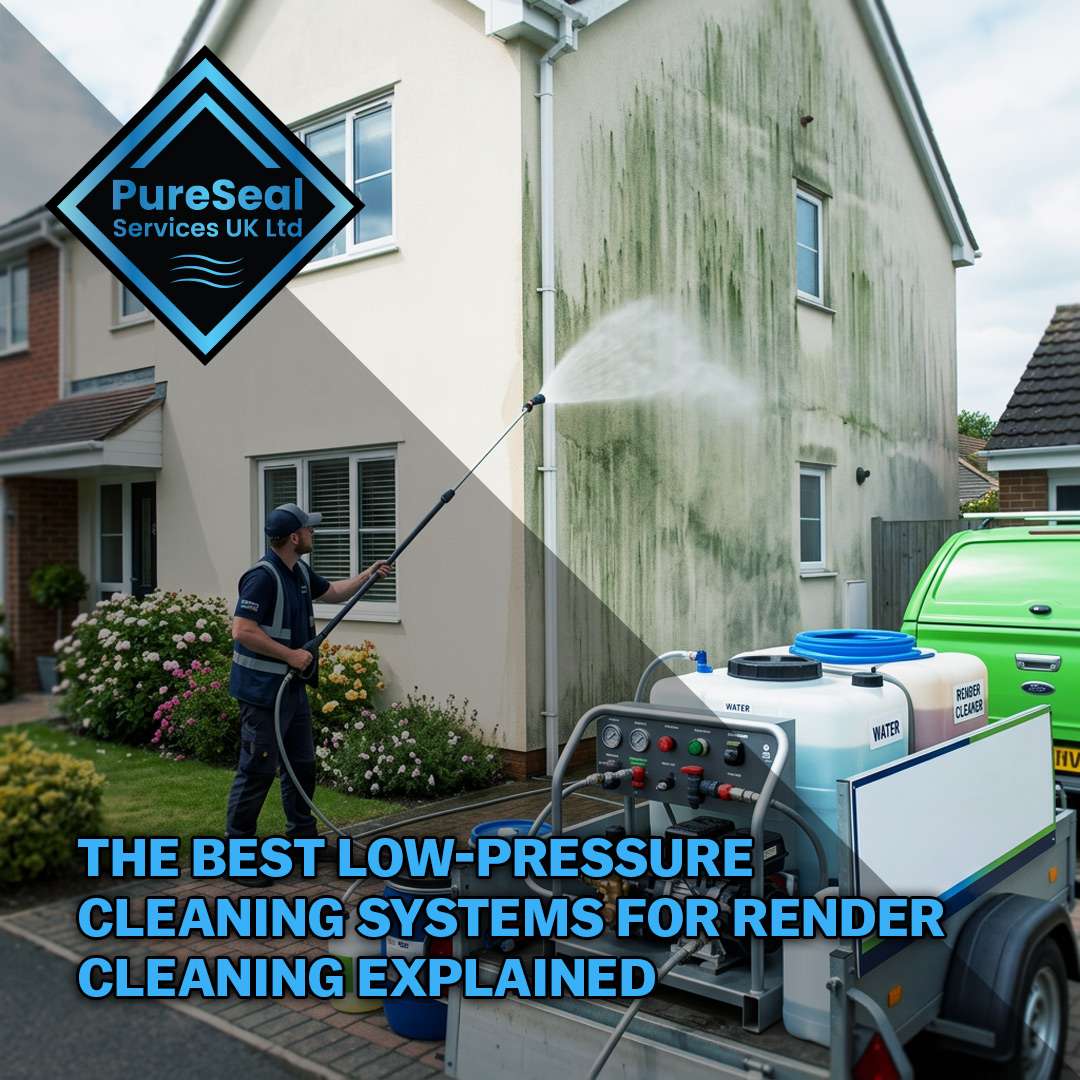
The Best Low-Pressure Cleaning Systems for Render Cleaning Explained
The Best Low-Pressure Cleaning Systems for Render Cleaning Explained
Modern render can completely transform the appearance of a property, but keeping it looking clean requires the correct maintenance. Green algae, black mould, red algae, lichen and atmospheric pollution can all affect render over time, leaving buildings looking tired and neglected.
Choosing the right cleaning system is crucial. While high-pressure cleaning may appear effective at first glance, many render manufacturers recommend low-pressure cleaning methods to reduce the risk of surface damage.
At Pure Seal Services, we use professional low-pressure cleaning systems designed specifically for delicate render finishes. This guide explains how these systems work, why they’re preferred by specialists, and what homeowners should know before arranging professional render cleaning.
What Is Low-Pressure Render Cleaning?
Low-pressure render cleaning is exactly what the name suggests.
Rather than relying on force to blast contamination away, low-pressure systems use carefully controlled application methods alongside specialist cleaning solutions that break down organic growth safely.
The cleaning process focuses on:
- Removing algae
- Killing mould spores
- Eliminating red algae
- Breaking down biofilm
- Protecting the render surface
Very little pressure is required because the cleaning solution performs most of the work.
Why Pressure Matters
Modern render systems are designed to withstand years of weather exposure, but excessive water pressure can still cause damage.
High-pressure cleaning may lead to:
- Surface erosion
- Pigment loss
- Water penetration
- Hairline cracking
- Rough finishes
- Patchy colouring
Low-pressure systems dramatically reduce these risks.
Why Modern Render Needs Specialist Cleaning
Today’s render differs significantly from traditional cement render.
Many properties now feature:
- Silicone render
- Acrylic render
- Monocouche render
- Thin coat render
- Mineral render
These decorative finishes often contain coloured pigments and protective coatings that should be preserved during cleaning.
Aggressive cleaning methods can permanently affect their appearance.
How Low-Pressure Systems Work
Professional low-pressure systems follow a straightforward process.
| Stage | Purpose |
|---|---|
| Inspection | Assess contamination and render condition |
| Preparation | Protect surrounding areas |
| Low-pressure application | Apply specialist cleaning solution evenly |
| Dwell time | Allow treatment to destroy biological growth |
| Gentle rinse | Remove contamination safely |
| Final inspection | Ensure consistent finish |
This method provides a deep clean without unnecessary force.
The Different Types of Low-Pressure Cleaning Systems
Not every low-pressure system operates in exactly the same way.
Professional contractors may use several different application methods depending on the property.
Dedicated Softwash Pumps
Specialist softwash pumps are designed specifically for chemical application.
Advantages include:
- Consistent flow rates
- Accurate chemical delivery
- Even coverage
- Reduced waste
- Low operating pressure
These systems are widely used for residential render cleaning.
Electric Diaphragm Pumps
Electric diaphragm pumps offer excellent control over cleaning solution application.
Benefits include:
- Smooth operation
- Reliable output
- Controlled pressure
- Suitable for delicate render
They are commonly used where precision is particularly important.
Battery-Powered Spray Systems
Battery-powered systems are becoming increasingly popular.
Advantages include:
- Portable operation
- Quiet running
- Flexible access
- Ideal for smaller properties
- Reduced setup time
They allow contractors to work efficiently without sacrificing application quality.
Vehicle-Mounted Softwash Systems
Large professional companies often operate vehicle-mounted cleaning systems.
These provide:
- Higher capacity
- Continuous chemical supply
- Professional hose reels
- Greater efficiency on larger projects
They are particularly useful for commercial buildings and large residential properties.
Comparing Low-Pressure Systems
| Cleaning System | Best For | Pressure Level |
|---|---|---|
| Dedicated softwash pump | Most residential properties | Very low |
| Electric diaphragm pump | Delicate render | Very low |
| Battery spray system | Smaller projects | Very low |
| Vehicle-mounted system | Large properties | Very low |
Despite different equipment, all professional systems share one goal—cleaning safely rather than aggressively.
Why Low Pressure Removes More Than Dirt
One common misunderstanding is that pressure alone cleans render.
In reality, professional low-pressure systems remove:
- Green algae
- Black mould
- Red algae
- Fungal spores
- Biofilm
- Surface bacteria
The cleaning solution destroys these contaminants before they are gently rinsed away.
Why Organic Growth Returns After Pressure Washing
Pressure washing often removes visible contamination while leaving microscopic spores alive.
These spores remain inside the tiny pores of the render.
When damp conditions return, they begin multiplying again.
Professional low-pressure systems are designed to:
- Kill spores
- Break down algae
- Remove mould
- Reduce rapid regrowth
This provides significantly longer-lasting results.
Which Render Types Benefit Most?
Nearly all decorative render systems benefit from low-pressure cleaning.
| Render Type | Suitable for Low-Pressure Cleaning |
|---|---|
| Silicone render | ✔ Yes |
| Monocouche render | ✔ Yes |
| Acrylic render | ✔ Yes |
| Mineral render | ✔ Yes |
| Painted render | ✔ Yes |
| Thin coat render | ✔ Yes |
Professional assessment should always be carried out before cleaning begins.
Water Usage Compared
Many people assume softwashing uses large quantities of water.
In reality, professional low-pressure systems usually consume considerably less water than continuous pressure washing.
| Cleaning Method | Relative Water Usage |
|---|---|
| Pressure washing | High |
| Low-pressure softwashing | Lower |
Less water is required because specialist cleaning solutions perform much of the cleaning process.
Why Consistent Application Matters
An important advantage of professional low-pressure systems is their ability to apply cleaning solutions evenly.
Even coverage helps prevent:
- Patchy cleaning
- Missed contamination
- Uneven colouring
- Streaks
Professional equipment is specifically designed to maintain consistent flow across large wall areas.
Common Areas That Need Low-Pressure Cleaning
Render contamination is rarely evenly distributed.
Areas that commonly require treatment include:
- North-facing walls
- Chimney stacks
- Window reveals
- Beneath gutters
- Garden elevations
- Garage walls
- Boundary walls
These locations often remain damp for longer periods, encouraging biological growth.
Why Access Equipment Is Just As Important
Even the best cleaning system cannot produce good results if technicians cannot safely reach every area.
Professional contractors may use:
- Mobile towers
- Cherry pickers
- Access platforms
- Specialist lifting equipment
Safe access allows cleaning to be completed evenly without relying on dangerous ladder work.
Low-Pressure Cleaning for Commercial Buildings
Large commercial buildings often feature extensive rendered elevations.
Low-pressure cleaning is commonly used on:
- Hotels
- Schools
- Apartment blocks
- Offices
- Healthcare facilities
- Retail premises
The gentle cleaning process helps preserve expensive render systems while maintaining a professional appearance.
Signs Low-Pressure Cleaning Is Needed
Organic growth develops gradually.
Early signs include:
- Green staining
- Black spotting
- Red patches
- White lichen
- Dark streaks
- Uneven colouring
Treating contamination early generally provides quicker and better results.
Typical Professional Costs
Every property differs, so prices vary depending on:
- Height
- Size
- Access
- Render condition
- Contamination level
Typical guide prices include:
| Property | Typical Cost |
|---|---|
| Small bungalow | £500–£750 |
| Semi-detached home | £700–£1,100 |
| Detached house | £900–£1,800+ |
| Large executive property | £1,800–£3,500+ |
Higher-quality services often command premium prices because they use specialist low-pressure equipment, experienced technicians and high-grade cleaning products rather than competing solely on cost.
Questions to Ask Before Choosing a Contractor
Before arranging render cleaning, ask whether the contractor:
| Question | Why It Matters |
|---|---|
| Do you use low-pressure systems? | Protects delicate render |
| Do you specialise in render cleaning? | Experience reduces risk |
| Will the render be inspected first? | Determines suitable treatment |
| Are you fully insured? | Provides reassurance |
| Do you explain aftercare? | Helps maintain results |
A professional company should always be willing to explain its cleaning process in detail.
The Importance of Matching the System to the Property
No single low-pressure cleaning system is suitable for every building. An experienced contractor will choose equipment based on several factors, including the property’s size, the render type, the level of contamination and access requirements.
For example, a small rendered bungalow may be cleaned efficiently using a portable battery-powered system, while a large detached property with multiple elevations may benefit from a vehicle-mounted softwash setup capable of delivering a continuous supply of cleaning solution. Likewise, delicate decorative render may require particularly precise application using an electric diaphragm pump.
Selecting the correct system ensures that the cleaning solution is applied evenly, reaches all affected areas and remains on the surface for the appropriate dwell time before being gently rinsed away.
Why Professional Low-Pressure Cleaning Delivers Better Long-Term Value
The purpose of professional render cleaning is not simply to make a property look cleaner for a few weeks. The objective is to remove biological contamination thoroughly while preserving the finish and extending the time before further cleaning is required.
Premium low-pressure cleaning services often include:
- A detailed pre-clean inspection
- Careful protection of surrounding areas
- Specialist cleaning solutions
- Professional application equipment
- Experienced technicians
- Thorough final quality checks
Although these services are generally positioned at the higher end of the market, they provide greater confidence that the render will be cleaned safely and effectively.
At Pure Seal Services, every render cleaning project is individually assessed to ensure the most appropriate low-pressure cleaning system is selected. By combining specialist equipment with proven softwashing techniques, render can be restored safely while maintaining the colour, texture and long-term integrity of the property’s exterior.
Tags: Exterior cleaning, gutter cleaning, window cleaning, Patio cleaning, Driveway cleaning, pressure washing, Roof Cleaning
 Artificial and Sports Surfaces
 Awnings / Canopies / Gazebos
 Block Paving
 Brickwork
 Composite Surfaces
 Decking / Timber
 Granite
 Imprinted Concrete
 Internal Masonry
 Limestone
 Marble
 Metal Cladding
 Polished or Honed Stone
 Porcelain
 Render
 Resin Bond
 Road and Rail Signs
 Roof Tiles / Slates
 Sandstone
 Slate
Slate Solar Panels and Glass
 Stone Sills and Pier Caps
 Tarmac and Asphalt
 Gutters & UPVC
 Acid Damage
 Biofilm
 Bitumen
 Blood
Blood Carbon
 Concrete / Grout / Mortar
 Copper Oxide
 Efflorescence
 Egg
Egg Failed Sealer
 Fire Damage
 Fuel / Oil
 Graffiti
 Grease / Fat / Cooking Oil
 Lawn Fertiliser
 Lead Carbonate
 Lead Oxide
 Paint Splashes
 Rust
Rust Tar & Glue
 Tannin Removers
 Traffic Film Removers
 Trapped Moisture / Sealer Repairs
 Urine Neutralisers