
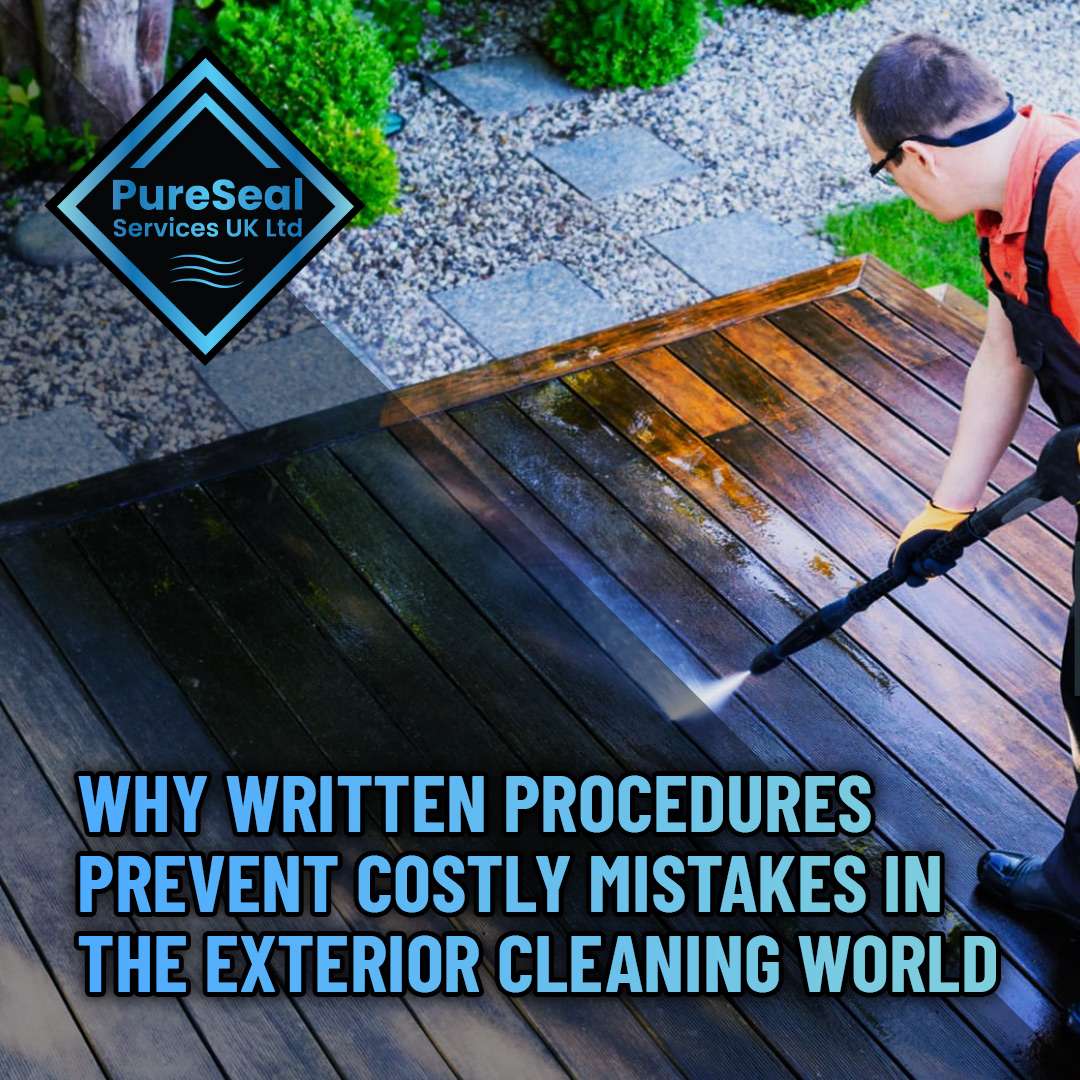
Why Written Procedures Prevent Costly Mistakes in the Exterior Cleaning World
Exterior cleaning looks simple from the outside. Many people assume the work only involves pressure washers, hoses, and basic detergents. In reality, professional exterior cleaning often involves powerful chemical systems, specialist equipment, and careful treatment of delicate surfaces.
Without structured processes, mistakes can happen quickly. A strong chemical mixture may damage render, an incorrect application method could stain roof tiles, or poor rinsing may harm nearby plants.
This is why professional exterior cleaning businesses rely on written procedures. Written procedures provide clear instructions explaining how each task should be completed safely and correctly. These instructions are often called Standard Operating Procedures (SOPs).
A standard operating procedure is essentially a detailed, step-by-step set of instructions designed to ensure that tasks are performed consistently and safely across an organisation.
In the exterior cleaning industry, written procedures protect workers, clients, and businesses from costly errors.
What Written Procedures Mean in Exterior Cleaning
Written procedures describe exactly how a job should be completed.
They typically include instructions covering:
-
chemical selection
-
dilution ratios
-
safety equipment
-
application techniques
-
dwell times
-
rinsing procedures
Instead of relying on memory or guesswork, technicians follow documented steps.
Example Structure of a Cleaning Procedure
| Step | Instruction | Purpose |
|---|---|---|
| Surface inspection | Identify contamination and surface type | Prevent damage |
| Chemical preparation | Mix chemical to defined ratio | Maintain correct strength |
| Safety check | Wear gloves, goggles, and protective clothing | Reduce exposure risk |
| Application | Apply solution evenly across surface | Ensure proper coverage |
| Dwell time | Allow chemical reaction | Break down contamination |
| Final rinse | Remove residue completely | Restore clean surface |
Following this structure reduces the chance of mistakes.
The Cost of Mistakes in Exterior Cleaning
Exterior cleaning involves working on valuable property surfaces.
If a technician uses the wrong chemical or concentration, the consequences can be expensive.
Common Mistakes
| Mistake | Possible Result |
|---|---|
| Chemical too strong | Surface damage |
| Chemical too weak | Poor cleaning results |
| Incorrect mixing | Toxic fumes or reactions |
| Overspray | Plant or property damage |
| Poor rinsing | Residue stains |
Cleaning chemicals can cause burns, respiratory problems, or other hazards if used incorrectly, which is why workers must understand how to use and handle them safely.
Written procedures help prevent these problems before they occur.
Preventing Human Error
Human error is one of the most common causes of operational problems in any industry.
People forget steps, miscalculate chemical mixtures, or apply equipment incorrectly.
Written procedures act as a reference guide that technicians can follow step by step.
How SOPs Reduce Errors
| Factor | Impact |
|---|---|
| Clear instructions | Eliminates confusion |
| Consistent process | Prevents variation |
| Defined chemical ratios | Avoids mixing mistakes |
| Equipment guidelines | Reduces misuse |
When everyone follows the same instructions, errors decrease and service quality remains consistent.
This consistency is essential for professional cleaning businesses.
Protecting Workers and Clients
Exterior cleaning technicians regularly handle chemicals designed to remove mould, algae, grease, and pollution stains.
These chemicals can be hazardous if misused.
Written procedures ensure that workers understand:
-
which chemicals are safe for each surface
-
which protective equipment must be worn
-
how chemicals should be stored and handled
Cleaning chemicals should always be used according to safety guidance and labels, as incorrect use can lead to health risks or accidents.
By following written procedures, companies protect both employees and customers.
Supporting Safety Regulations
In many countries, workplace safety laws require businesses to manage risks associated with chemicals.
For example, UK health and safety regulations require employers to control exposure to hazardous substances used at work.
Written procedures help businesses comply with these regulations.
How Procedures Support Compliance
| Requirement | How Procedures Help |
|---|---|
| Risk assessment | Identify hazards before work |
| Chemical control | Use correct dilution ratios |
| Worker training | Provide clear instructions |
| Incident response | Define emergency actions |
Compliance is easier when procedures are documented and accessible.
Maintaining Consistent Cleaning Quality
Customers expect reliable results.
If two technicians clean the same type of surface using different methods, the outcome may vary significantly.
Written procedures eliminate this inconsistency.
They ensure that:
-
the same chemicals are used
-
dilution ratios remain consistent
-
cleaning techniques remain standardised
Example: Render Cleaning Process
| Stage | Action |
|---|---|
| Inspection | Identify algae contamination |
| Chemical mix | Prepare defined cleaning solution |
| Application | Apply low-pressure spray |
| Dwell time | Allow chemical reaction |
| Rinse | Remove contamination safely |
When every technician follows this process, results remain predictable.
Faster Training for New Staff
Training new technicians is easier when written procedures exist.
Instead of relying on verbal explanations, new employees can follow documented instructions.
Training Advantages
| Benefit | Explanation |
|---|---|
| Faster learning | Clear step-by-step instructions |
| Reduced mistakes | Employees follow proven methods |
| Consistent teaching | All staff learn the same process |
Written procedures also protect businesses when experienced staff leave.
Knowledge remains documented rather than lost.
Reducing Financial Loss
Mistakes in exterior cleaning can quickly become expensive.
For example:
-
replacing damaged render
-
compensating clients for property damage
-
re-cleaning surfaces that were treated incorrectly
Written procedures reduce these risks.
Example Financial Comparison
| Scenario | Estimated Cost |
|---|---|
| Correct chemical application | £120 cleaning job |
| Incorrect chemical mix | £800 repair bill |
| Overspray damage | £500 landscaping repair |
Preventing even one mistake can save more money than the time required to create procedures.
Standardising Chemical Use
Chemical cleaning systems are essential in modern exterior cleaning.
These systems rely on precise dilution ratios and controlled application.
For example:
| Surface | Typical Chemical Ratio |
|---|---|
| Roof tiles | 3–4% solution |
| Render | 1–2% solution |
| Driveways | Variable degreaser mix |
Without written procedures, technicians may mix chemicals incorrectly.
Proper documentation ensures that mixtures remain consistent and safe.
Professional suppliers such as https://puresealservices.co.uk/ provide exterior cleaning chemicals designed for professional use, but the correct results depend on following clear procedures.
Creating Emergency Response Plans
Even with careful preparation, incidents can occur.
Spills, chemical exposure, or equipment failure require immediate action.
Written procedures provide a clear response plan.
Example Emergency Response Procedure
| Situation | Action |
|---|---|
| Chemical spill | Isolate area and dilute with water |
| Skin exposure | Wash with clean water immediately |
| Eye exposure | Use eyewash station |
| Chemical reaction | Stop work and ventilate area |
These instructions allow technicians to respond quickly during emergencies.
Improving Equipment Usage
Exterior cleaning equipment includes pumps, injectors, sprayers, and pressure washers.
Each piece of equipment must be used correctly.
Written procedures explain:
-
how to connect chemical injectors
-
correct pressure settings
-
proper rinsing techniques
This reduces equipment damage and ensures effective cleaning.
Building Professional Reputation
Customers trust businesses that operate professionally.
When technicians follow structured procedures, the work appears organised and controlled.
Clients notice when technicians:
-
measure chemicals carefully
-
protect surrounding areas
-
follow systematic cleaning steps
Professional behaviour builds credibility.
This increases the chances of repeat work and referrals.
Preventing Chemical Reactions
Mixing cleaning chemicals incorrectly can create dangerous reactions.
Some chemicals release toxic gases when combined.
Workers must understand which chemicals can be safely mixed and which must remain separate.
Guidance often warns workers never to mix cleaning products unless instructions confirm it is safe.
Written procedures prevent accidental mixing by defining exactly which chemicals can be used together.
Improving Operational Efficiency
Written procedures streamline daily operations.
Technicians spend less time deciding how to approach each job because the process is already defined.
Efficiency Improvements
| Task | Without Procedure | With Procedure |
|---|---|---|
| Chemical mixing | Trial and error | Defined ratios |
| Job planning | Technician guesswork | Standard workflow |
| Staff training | Informal teaching | Structured learning |
Efficiency improves when teams follow the same methods every day.
Supporting Long-Term Business Growth
Small exterior cleaning businesses often begin with one or two technicians.
As demand increases, companies hire additional staff and take on larger projects.
Without written procedures, growth becomes difficult to manage.
Procedures ensure that new teams follow the same standards as the original technicians.
Benefits for Growing Businesses
| Area | Benefit |
|---|---|
| Staff expansion | Easier training |
| Job quality | Consistent results |
| Safety | Reduced incidents |
| Reputation | Professional image |
This structure allows businesses to scale operations while maintaining quality.
The Role of Documentation in Professional Cleaning
Professional industries such as manufacturing, healthcare, and engineering rely heavily on documented procedures.
Exterior cleaning is gradually adopting the same approach.
Written procedures transform cleaning from informal labour into a controlled process.
These documents typically include:
-
task descriptions
-
hazard identification
-
safety equipment requirements
-
chemical instructions
-
emergency actions
Safe work procedures outline hazards and control measures so workers can perform tasks safely and efficiently.
When these procedures are followed consistently, the likelihood of mistakes decreases significantly.
Creating Effective Cleaning Procedures
Effective procedures should be simple, clear, and easy to follow.
Key Elements
| Element | Purpose |
|---|---|
| Clear instructions | Easy for staff to understand |
| Step-by-step structure | Prevents skipped steps |
| Safety guidance | Protects workers |
| Chemical guidelines | Ensures correct mixtures |
Procedures should also be reviewed regularly to reflect new equipment or chemicals.
Why Exterior Cleaning Businesses Depend on Written Systems
Exterior cleaning involves working with powerful chemicals, expensive property surfaces, and unpredictable environmental conditions.
Without written systems, mistakes become more likely.
Documented procedures provide:
-
safety guidance
-
consistent cleaning results
-
efficient training
-
reduced financial risk
-
improved professional standards
By implementing clear written procedures, exterior cleaning businesses transform a potentially risky task into a structured and reliable service that protects workers, customers, and business reputation.
Tags: window cleaning, Patio cleaning, Driveway cleaning, pressure washing, Roof Cleaning, Exterior cleaning, gutter cleaning
 Artificial and Sports Surfaces
 Awnings / Canopies / Gazebos
 Block Paving
 Brickwork
 Composite Surfaces
 Decking / Timber
 Granite
 Imprinted Concrete
 Internal Masonry
 Limestone
 Marble
 Metal Cladding
 Polished or Honed Stone
 Porcelain
 Render
 Resin Bond
 Road and Rail Signs
 Roof Tiles / Slates
 Sandstone
 Slate
Slate Solar Panels and Glass
 Stone Sills and Pier Caps
 Tarmac and Asphalt
 Gutters & UPVC
 Acid Damage
 Biofilm
 Bitumen
 Blood
Blood Carbon
 Concrete / Grout / Mortar
 Copper Oxide
 Efflorescence
 Egg
Egg Failed Sealer
 Fire Damage
 Fuel / Oil
 Graffiti
 Grease / Fat / Cooking Oil
 Lawn Fertiliser
 Lead Carbonate
 Lead Oxide
 Paint Splashes
 Rust
Rust Tar & Glue
 Tannin Removers
 Traffic Film Removers
 Trapped Moisture / Sealer Repairs
 Urine Neutralisers