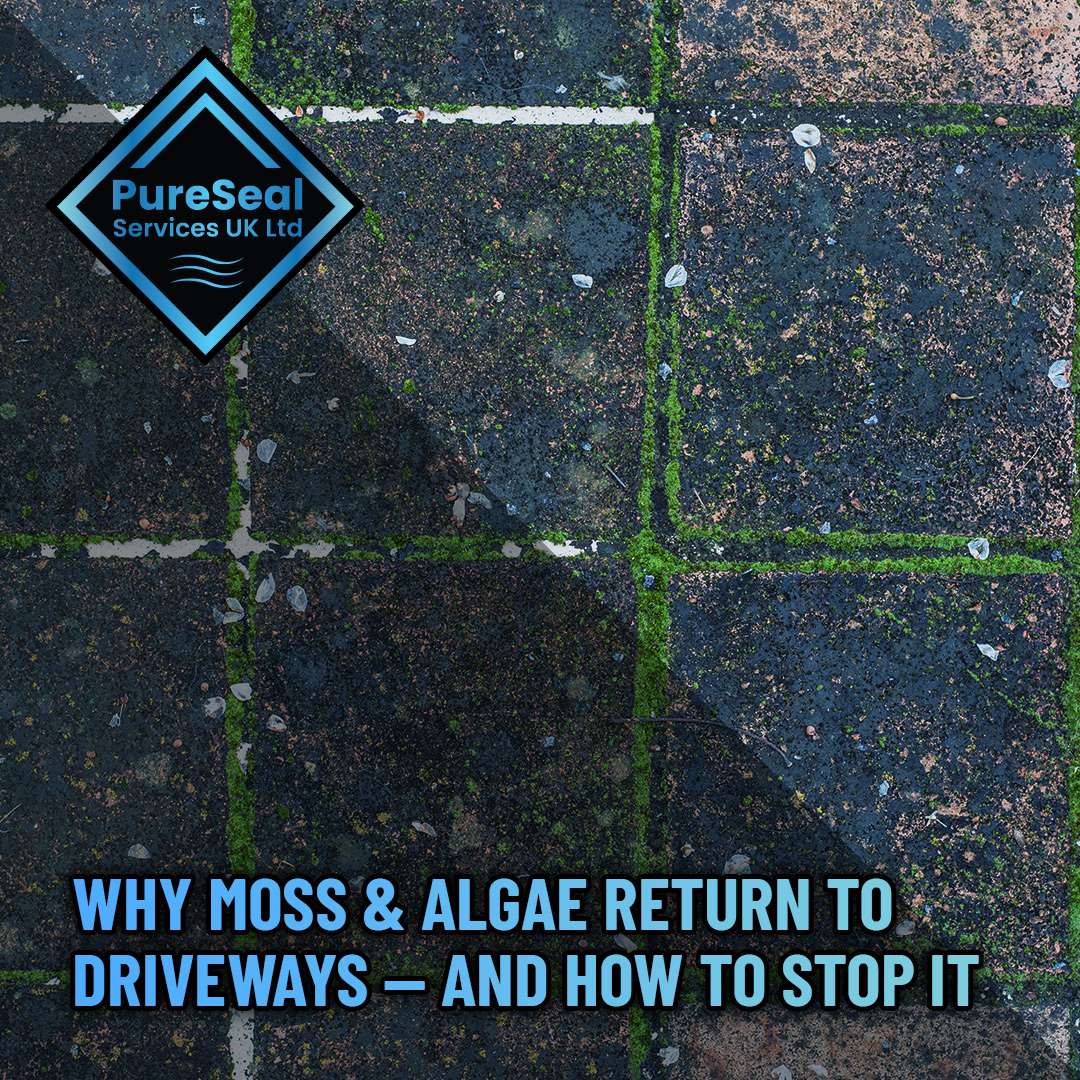
Why Moss & Algae Return to Driveways — And How to Stop It
A freshly cleaned driveway can completely transform the appearance of a property. Whether the surface is block paving, concrete, resin-bound, tarmac or natural stone, removing years of moss, algae and organic staining instantly improves kerb appeal.
However, many homeowners become frustrated when green growth starts to reappear only months after cleaning. What looked immaculate during the summer can quickly begin showing signs of moss, algae and dark staining once damp weather returns.
The reality is that moss and algae are natural organisms that thrive in the British climate. Unless the underlying causes are addressed, they will continue to return regardless of how many times a driveway is cleaned.
Understanding why moss and algae develop in the first place is the key to preventing regrowth and keeping a driveway looking cleaner for longer. Professional cleaning and treatment from Pure Seal Services can dramatically extend the life and appearance of driveway surfaces while helping to minimise future growth.
Why Moss and Algae Grow on Driveways
The UK’s climate creates ideal conditions for organic growth. Frequent rainfall, mild temperatures and shaded areas provide the moisture that moss and algae require to thrive.
Although many people use the terms interchangeably, moss and algae are different organisms.
Growth Type
Characteristics
Common Appearance
Moss
Small, dense plant-like growth
Thick green patches and clumps
Algae
Simple aquatic organism
Green film or slippery surface
Lichen
Combination of fungi and algae
Grey, white or yellow crust-like patches
All three can establish themselves on driveway surfaces when conditions are favourable.
Driveways are particularly vulnerable because they are exposed to the elements year-round. Even surfaces that appear dry during the day may retain moisture beneath the surface or between paving joints.
The Main Reasons Moss and Algae Return
Persistent Moisture
Moisture is the biggest factor in recurring moss and algae growth.
Driveways that remain damp for extended periods create the perfect environment for spores to settle and multiply. Even after professional cleaning removes visible growth, microscopic spores can quickly recolonise the surface if moisture remains present.
Common moisture sources include:
Poor drainage
Blocked gullies
Leaking gutters
Overhanging vegetation
North-facing driveways
Shaded areas receiving little sunlight
The longer water remains on the surface, the greater the likelihood of regrowth.
Shaded Conditions
Sunlight naturally helps dry surfaces and inhibit organic growth.
Areas that receive limited direct sunlight tend to stay wetter for longer after rainfall. Trees, fences, neighbouring buildings and dense shrubbery can all reduce sunlight exposure.
The table below shows how shade levels affect growth potential.
Shade Level
Drying Speed
Moss Risk
Full Sun
Fast
Low
Partial Shade
Moderate
Medium
Heavy Shade
Slow
High
Permanent Shade
Very Slow
Very High
Where heavy shade exists, preventative maintenance becomes even more important.
Organic Debris Build-Up
Leaves, soil, seeds and other organic debris create ideal conditions for moss development.
As debris accumulates, it traps moisture against the surface and provides nutrients that support growth.
Common debris sources include:
Trees
Hedges
Flower beds
Lawn edges
Wind-blown material
Regular sweeping can significantly reduce these problems.
Deteriorating Jointing Sand
Block paving is particularly susceptible to moss growth because weeds, algae and moss often establish themselves within paving joints.
Over time, weather and traffic gradually remove jointing sand. This creates small gaps where moisture and organic matter accumulate.
Once these gaps develop, moss can become established quickly.
Professional driveway cleaning often includes re-sanding block paving to restore joint stability and reduce opportunities for regrowth.
Why DIY Cleaning Often Provides Temporary Results
Many homeowners attempt to remove moss and algae using pressure washers or household cleaning products.
While these methods may improve appearance temporarily, they often fail to address the root causes.
Pressure Washing Alone
Pressure washing can remove visible growth, but it does not necessarily eliminate spores embedded within the surface.
Without additional treatment, regrowth may begin surprisingly quickly.
Potential issues include:
Issue
Result
Spores remain active
Rapid regrowth
Jointing sand removed
Increased moss growth
Surface damage
Greater moisture retention
No biocide treatment
Reduced long-term effectiveness
This explains why some driveways appear green again within a relatively short period after cleaning.
Household Chemicals
Many shop-bought products provide only short-term improvements.
Some products bleach the surface temporarily without fully killing underlying growth. Others may be diluted by rainfall before they have sufficient time to work effectively.
Professional-grade treatments are typically more effective because they are designed to eliminate spores rather than simply improve appearance.
The Hidden Problems Caused by Moss and Algae
Many homeowners view moss and algae as purely cosmetic issues. In reality, they can create several practical problems.
Slip Hazards
Algae is particularly problematic because it becomes extremely slippery when wet.
Driveways, paths and entrances affected by algae can become hazardous during rainy weather.
This can increase the risk of slips and falls for:
Homeowners
Visitors
Delivery drivers
Tradespeople
Professional treatment helps reduce these risks by removing the organic growth responsible for slippery surfaces.
Surface Deterioration
Organic growth retains moisture against driveway materials.
Over time, this can accelerate deterioration through:
Freeze-thaw damage
Surface erosion
Joint movement
Staining
Increased weed growth
Keeping surfaces clean helps protect the investment made in the driveway.
Reduced Kerb Appeal
A moss-covered driveway can make an otherwise attractive property appear neglected.
For homeowners considering selling their property, the driveway often creates one of the first impressions potential buyers receive.
Even a high-quality driveway can appear significantly older when covered in green growth.
How Professional Treatments Prevent Regrowth
The most effective approach combines cleaning with preventative treatment.
Professional driveway cleaning removes existing contamination while specialist treatments target the microscopic spores responsible for regrowth.
Biocide Treatments
A biocide is designed to eliminate organic growth at its source.
Unlike pressure washing alone, a professional biocide treatment continues working after application.
Benefits include:
Benefit
Explanation
Kills spores
Helps prevent rapid regrowth
Targets algae
Removes slippery green film
Reduces moss return
Longer-lasting results
Improves appearance
Cleaner surface for longer
Ongoing protection
Continued effectiveness after treatment
This is one of the most important differences between professional cleaning and basic washing.
Re-Sanding Block Paving
For block paving, re-sanding is often essential.
Fresh kiln-dried sand helps:
Stabilise paving blocks
Reduce water retention
Limit moss establishment
Improve driveway appearance
Without re-sanding, newly cleaned paving may become vulnerable to renewed growth.
The Role of Sealing in Moss Prevention
Driveway sealing can provide an additional layer of protection.
A quality sealant helps reduce the surface porosity of certain materials, making it more difficult for moisture and contaminants to penetrate.
Depending on the surface type, sealing may offer benefits such as:
Benefit
Impact
Reduced water absorption
Less favourable conditions for growth
Easier maintenance
Dirt removal becomes simpler
Enhanced appearance
Improved colour and finish
Stain resistance
Better protection from contaminants
Longer-lasting cleanliness
Reduced organic build-up
Not every driveway is suitable for sealing, which is why professional assessment is important before treatment.
How Often Should a Driveway Be Cleaned?
The ideal cleaning frequency varies according to environmental conditions.
Factors influencing maintenance requirements include:
Tree cover
Drainage quality
Orientation
Local climate
Surface type
Nearby vegetation
As a general guide:
Environment
Suggested Maintenance Frequency
Full sun, good drainage
Every 2–4 years
Partial shade
Every 1–3 years
Heavy shade
Every 1–2 years
High moisture areas
Annual inspection recommended
Regular inspections help identify developing problems before they become severe.
Signs That Moss and Algae Are About to Return
Homeowners can often spot early warning signs before major growth becomes visible.
Watch for:
Dark patches appearing after rain
Green film developing on the surface
Persistent damp areas
Small moss clusters between paving joints
Increased slipperiness underfoot
Early intervention is usually simpler and more cost-effective than waiting for extensive growth to develop.
Premium Driveway Cleaning vs Budget Services
When comparing driveway cleaning services, price should not be the only consideration.
Low-cost services may focus solely on rapid pressure washing, leaving spores behind and increasing the likelihood of quick regrowth.
A comprehensive service generally includes:
Service Element
Basic Cleaning
Professional Premium Service
Surface cleaning
Yes
Yes
Moss removal
Limited
Thorough
Algae treatment
Limited
Yes
Biocide application
Often no
Yes
Re-sanding
Sometimes omitted
Usually included where required
Surface assessment
Minimal
Comprehensive
Long-term protection
Limited
Enhanced
As a premium provider, Pure Seal Services focuses on achieving lasting results rather than offering the cheapest solution. Higher-quality treatments, professional equipment and comprehensive preparation help deliver cleaner surfaces and improved long-term performance.
Typical Driveway Cleaning Costs in the UK
Pricing varies depending on:
Driveway size
Surface type
Level of contamination
Access requirements
Additional treatments required
Premium driveway cleaning and treatment services generally command higher prices because they involve more than simple pressure washing.
Driveway Size
Typical Premium Cleaning Range
Small Driveway
£250–£450+
Medium Driveway
£450–£800+
Large Driveway
£800–£1,500+
Specialist Restoration Projects
£1,500+
Where sealing, extensive moss removal, re-sanding or advanced treatments are required, costs may increase further.
Homeowners should focus on value and long-term results rather than selecting the lowest quote available.
Preventative Steps Homeowners Can Take
While professional treatment provides the most effective solution, homeowners can help reduce future growth by adopting a few simple habits.
Keep Surfaces Clear
Regular sweeping removes:
Leaves
Soil
Seeds
Organic debris
Reducing debris means fewer nutrients for moss and algae.
Improve Drainage
Check regularly for:
Blocked drains
Standing water
Overflowing gutters
Poor water runoff
Addressing drainage problems can dramatically reduce moss growth potential.
Trim Vegetation
Cutting back nearby vegetation helps:
Improve airflow
Increase sunlight exposure
Reduce moisture retention
Minimise leaf accumulation
Even modest improvements can have a noticeable impact on regrowth rates.
Schedule Professional Maintenance
Routine professional cleaning and treatment can prevent minor contamination from becoming a major problem.
Many homeowners find that proactive maintenance is considerably easier than dealing with extensive moss infestations after several years of neglect.
For driveways affected by recurring moss, algae and organic staining, professional treatment from Pure Seal Services helps tackle the underlying causes while delivering longer-lasting protection against future growth.
Why Certain Driveway Materials Attract More Moss Than Others
Not all driveway surfaces experience moss and algae growth at the same rate. The material used can have a significant impact on how quickly organic contamination develops and returns.
Porous materials tend to absorb and retain more moisture, creating favourable conditions for moss spores and algae cells to establish themselves.
The table below highlights how different driveway materials compare.
Driveway Material
Moisture Retention
Moss Growth Potential
Block Paving
Medium to High
High
Concrete
Medium
Medium
Natural Stone
Medium to High
Medium to High
Tarmac
Medium
Medium
Resin Bound
Low
Lower
Block paving is particularly vulnerable because of the joints between individual blocks. These joints can collect dirt, seeds and organic debris, providing an ideal environment for moss to develop.
Natural stone driveways can also experience recurring growth due to their textured surfaces and natural porosity. While visually attractive, many stone materials require ongoing maintenance to prevent biological contamination.
Seasonal Changes and Moss Growth
Many homeowners notice that moss and algae seem to appear almost overnight during autumn and winter.
In reality, growth is often occurring throughout the year, but seasonal weather conditions accelerate the process.
Season
Growth Activity
Spring
Rapid growth begins as temperatures rise
Summer
Growth slows on sunlit areas but continues in shade
Autumn
Increased moisture encourages development
Winter
Persistent dampness supports ongoing growth
Autumn is often the most problematic period because falling leaves combine with increased rainfall. This creates a damp layer of organic material that encourages moss spores to germinate.
Winter then provides extended periods of moisture, allowing growth to spread further across the driveway surface.
This seasonal cycle explains why many driveways appear significantly greener by the end of winter than they did during the summer months.
The Importance of Early Intervention
One of the biggest mistakes homeowners make is waiting until moss growth becomes severe before taking action.
Small patches of moss may seem harmless initially, but they often indicate wider conditions that favour organic growth.
As moss expands, it can:
Retain additional moisture
Trap more debris
Encourage weed establishment
Increase surface staining
Accelerate deterioration of paving joints
Treating a driveway at the first signs of contamination is usually more effective than attempting to restore a heavily affected surface later.
Professional cleaning and preventative treatments can remove early growth before it becomes deeply established.
Why Some Areas of a Driveway Stay Cleaner Than Others
Many driveways develop moss unevenly.
You may notice that one section remains relatively clean while another becomes heavily affected.
This is usually caused by variations in environmental conditions across the driveway.
Common examples include:
Area
Typical Moss Risk
South-facing sections
Lower
Areas beneath trees
Higher
Locations near garden borders
Higher
Open, sunny sections
Lower
Areas beside walls or fences
Higher
Understanding these patterns can help homeowners identify the underlying causes of recurring growth.
Targeting problem areas with regular maintenance and professional treatment often delivers better long-term results than simply cleaning the entire driveway when contamination becomes obvious.
Where persistent moss and algae continue to return despite regular maintenance, specialist cleaning, treatment and protection from Pure Seal Services can help keep driveway surfaces cleaner, safer and more attractive throughout the year.