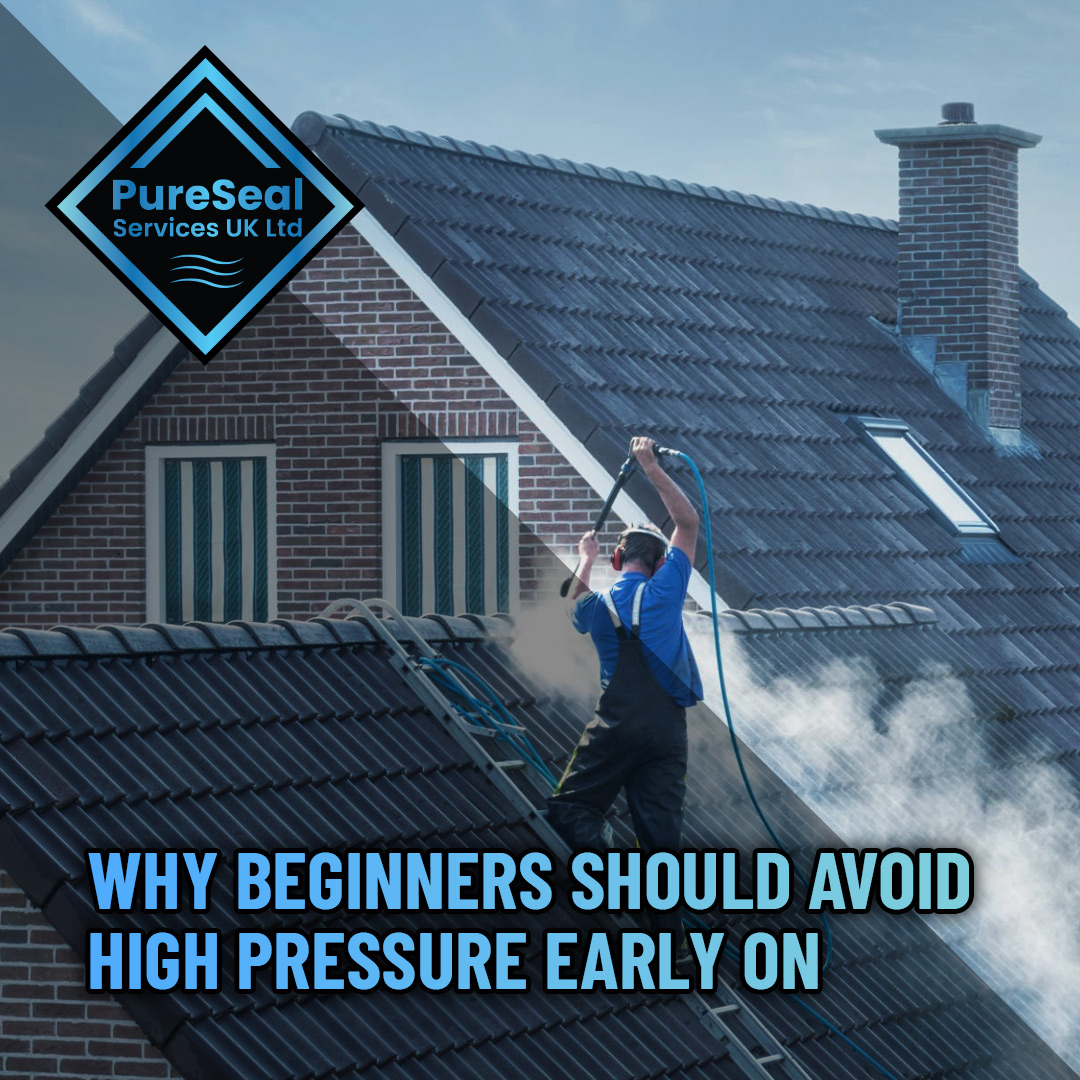
Pressure washing and exterior cleaning can be extremely rewarding. Whether you are cleaning roofs, patios, driveways, render, or UPVC, the transformation is often dramatic. However, one of the biggest mistakes beginners make is using high pressure too early in their learning journey. It may seem faster and more powerful, but in reality, high pressure can cause costly damage, safety risks, and long-term problems that outweigh any short-term gains.
Many experienced professionals will tell you that success in exterior cleaning comes from understanding surfaces, using the correct chemicals, and applying the right techniques — not simply relying on maximum pressure.
This guide explains why beginners should avoid high pressure early on, how damage happens, the financial consequences, and what safer alternatives exist.
Understanding What “High Pressure” Actually Means
Pressure washers are measured in PSI (pounds per square inch) or BAR. Beginners often assume higher numbers equal better cleaning power. This is not always true.
Pressure Level
PSI Range
Typical Use
Beginner Risk Level
Low pressure
500–1,200 PSI
Cars, delicate surfaces, softwash rinsing
Very safe
Medium pressure
1,200–2,000 PSI
Patios, decking, general cleaning
Moderate
High pressure
2,000–3,500 PSI
Concrete, industrial surfaces
High risk
Extreme pressure
3,500+ PSI
Industrial and specialist use
Very high risk ⚠️
Most exterior cleaning tasks, especially roofs and render, do not require high pressure at all.
In fact, many professional roof cleaners use low pressure combined with proper cleaning solutions.
Surface Damage Happens Faster Than Beginners Expect
High pressure can permanently damage surfaces in seconds. Once damage occurs, it cannot simply be undone.
Common types of damage include:
Etching concrete
Removing protective coatings
Cracking roof tiles
Splintering wood
Forcing water into wall cavities
Damaging pointing and mortar
Beginners often underestimate how sensitive some surfaces are.
For example, roof tiles are designed to shed water naturally. Using high pressure forces water underneath the tiles, which can lead to internal damp problems and structural issues.
Financial Consequences of Damage
Damage caused by high pressure can be expensive. Beginners may not have insurance or experience to deal with repairs properly.
Here is a realistic cost breakdown of potential damage:
Type of Damage
Repair Cost (£)
Broken roof tiles (per tile)
£15–£40
Roof leak repair
£250–£900
Damaged render repair
£300–£1,500
Replacement driveway section
£500–£2,500
Water ingress internal repair
£500–£3,000
Full roof restoration
£2,000–£6,000
One mistake can wipe out months of profit.
Beginners often assume pressure washing is low-risk, but improper use of high pressure makes it one of the riskier cleaning methods.
High Pressure Can Void Roof Lifespan
Many roofing materials include protective coatings designed to last decades. High pressure strips these coatings away.
This causes:
Faster moss regrowth
Reduced weather protection
Shortened tile lifespan
Increased maintenance costs
Instead of helping the customer, high pressure may actually accelerate deterioration.
This leads to unhappy customers and potential liability.
Water Penetration Is a Serious Risk
Water is powerful when forced at high pressure.
High pressure can push water into:
Roof spaces
Wall cavities
Loft insulation
Electrical areas
This can lead to:
Damp problems
Mould growth
Structural weakening
Electrical hazards ⚡
Water damage is often not visible immediately, which makes it even more dangerous.
The customer may discover problems weeks later.
High Pressure Is Not Necessary for Most Cleaning Tasks
One of the biggest myths beginners believe is that pressure alone does the cleaning.
In reality, cleaning effectiveness comes from:
Correct chemical selection 🧼
Proper dwell time
Correct technique
Appropriate rinsing pressure
Pressure alone is inefficient.
Professional cleaners rely heavily on specialised cleaning solutions, such as those available from:
https://puresealservices.co.uk/
These products break down organic growth safely, reducing the need for aggressive pressure.
Comparison: High Pressure vs Proper Cleaning Method
Factor
High Pressure Method
Proper Chemical Method
Cleaning speed
Fast initially
Fast overall
Surface safety
High damage risk
Very safe
Long-term results
Poor regrowth prevention
Excellent regrowth prevention
Equipment wear
High
Low
Professional quality
Poor
Excellent
Customer satisfaction
Risky
High
Chemical cleaning combined with low pressure provides superior results.
Equipment Damage and Maintenance Costs
High pressure also damages your own equipment faster.
Excessive pressure causes wear on:
Pumps
Hoses
Connectors
Spray guns
Seals
This leads to increased maintenance costs.
Equipment Component
Average Replacement Cost (£)
Pump repair
£150–£400
Hose replacement
£40–£120
Spray gun replacement
£30–£80
Seal replacement
£20–£60
Full pump replacement
£300–£900
Beginners often overlook equipment longevity.
Using moderate pressure extends equipment life significantly.
Safety Risks Increase with Higher Pressure
High pressure washers can cause serious injuries.
Water at high pressure can:
Cut skin
Inject water under skin
Cause severe bruising
Lead to infections
Injury recovery can result in lost work and medical costs.
Injury Type
Possible Cost (£)
Minor injury treatment
£50–£200
GP visits and treatment
£100–£300
Lost work days
£100–£500
Severe injury recovery
£500–£2,000
Beginners are especially vulnerable because they lack handling experience.
Surface Knowledge Comes Before Pressure Use
Professional cleaners learn to identify different surfaces first.
Each material responds differently to pressure.
Surface
Pressure Sensitivity
Roof tiles
Very sensitive
Render
Extremely sensitive
UPVC
Sensitive
Wood
Very sensitive
Concrete
Moderate tolerance
Brick
Moderate tolerance
Without proper knowledge, beginners risk serious damage.
High Pressure Often Creates Uneven Results
Beginners using high pressure often leave:
Streaks
Lines
Etch marks
Patchy areas
This happens because high pressure removes surface layers unevenly.
Chemical cleaning creates uniform results.
Consistency is a sign of professional work.
Customer Trust Is Easy to Lose
Customers expect safe, professional work.
Damage caused by high pressure can result in:
Refund demands
Complaints
Negative reviews
Loss of future work
Building trust is essential for long-term success.
Beginners should prioritise safety and quality over speed.
Insurance Risks and Liability Costs
Insurance companies take pressure washing damage seriously.
Claims can increase insurance premiums significantly.
Insurance Issue
Cost Impact (£)
Minor claim excess
£100–£500
Premium increase annually
£200–£800
Major damage claim
£1,000–£5,000
Loss of coverage
Severe financial impact
Avoiding damage protects your financial stability.
Learning Proper Technique First Is Essential
Beginners should focus on learning:
Chemical application
Dwell time management
Rinsing technique
Surface identification
Equipment control
Pressure should only be increased gradually with experience.
Professional skill comes from control, not force.
Low Pressure Cleaning Is More Professional
Softwashing and controlled rinsing provide superior results.
Advantages include:
No surface damage
Longer lasting results
Safer working conditions
Better customer satisfaction
Lower equipment costs
Many professional cleaners rarely use high pressure at all.
Long-Term Profit Is Higher with Safe Methods
Avoiding damage protects profits.
| Method | Risk Level | Profit Stability |
|—|—|
| High pressure beginner use | High risk | Unstable |
| Controlled professional method | Low risk | Stable |
| Chemical-based cleaning | Very low risk | Excellent |
Stable methods allow consistent income growth.
Psychological Mistake: Beginners Equate Power with Effectiveness
It is natural to assume stronger pressure equals better cleaning.
However, this mindset leads to poor technique.
Professional cleaning relies on:
Knowledge
Patience
Proper chemicals
Technique
Pressure is only one small part of the process.
Gradual Progression Is the Safest Approach
Beginners should follow a progression:
Stage
Focus
Stage 1
Learn equipment control
Stage 2
Learn chemical application
Stage 3
Use low pressure cleaning
Stage 4
Practice controlled rinsing
Stage 5
Increase pressure only when necessary
This progression builds skill safely.
Chemical Cleaning Reduces Physical Effort
Proper cleaning products do most of the work.
This reduces:
Physical strain 💧
Equipment stress
Risk of damage
It also produces better long-term results.
Products from https://puresealservices.co.uk/ are specifically designed for exterior cleaning and allow effective cleaning without relying on excessive pressure.
Reputation Depends on Quality and Safety
Professional cleaners build reputations based on safe, reliable work.
Damage caused by high pressure harms reputation quickly.
Customers prefer cleaners who use safe, modern methods.
Professionalism attracts better paying clients.
Beginners Benefit from Slower, Safer Learning
Taking a careful approach allows beginners to:
Build confidence
Avoid costly mistakes
Protect equipment
Maintain customer trust
Improve long-term income
Rushing into high pressure use often leads to setbacks.
Summary Table: Beginner Approach vs High Pressure Approach
Factor
Beginner Safe Approach
High Pressure Approach
Damage risk
Very low
High
Equipment lifespan
Long
Short
Profit stability
Stable
Unstable
Customer satisfaction
High
Risky
Skill development
Strong
Weak
Financial safety
Secure
Risky
High pressure may seem appealing, but it is not the foundation of professional exterior cleaning. Beginners who focus on safe techniques, proper cleaning products, and gradual skill development position themselves for long-term success. Avoiding high pressure early on protects surfaces, equipment, finances, and reputation while allowing true professional skills to develop properly.
High Pressure Can Permanently Reduce Property Value
One aspect beginners rarely consider is the effect their work can have on a property’s overall value. Exterior surfaces such as roofs, render, block paving, and stonework contribute significantly to kerb appeal and structural integrity. When high pressure is used incorrectly, the damage caused can reduce both visual quality and long-term durability.
Estate agents and surveyors pay close attention to external condition. Visible pressure damage such as etched driveways, chipped render, or stripped roof coatings can raise concerns during property inspections.
This may result in:
Reduced sale value
Delayed property sales
Survey recommendations for repairs
Reduced buyer confidence
Surface Damage Type
Potential Property Value Impact (£)
Visible roof damage
£1,000–£5,000 reduction
Etched driveway
£500–£2,000 reduction
Damaged render
£1,000–£4,000 reduction
Visible water damage
£2,000–£8,000 reduction
Beginners must understand they are working on valuable assets. Protecting the property protects both the customer and your professional reputation.
Beginners Often Misjudge Distance and Spray Angle
Two of the most important factors in pressure washing are distance and spray angle. Beginners frequently underestimate how much impact these variables have.
Standing too close increases pressure intensity dramatically. Even reducing the distance by a few centimetres can double the force applied to the surface.
Spray angle also affects pressure concentration:
Nozzle Angle
Pressure Intensity
Beginner Risk
0° (pinpoint jet)
Extremely concentrated
Very dangerous ⚠️
15°
Highly concentrated
High risk
25°
Moderate concentration
Safer
40°
Wide dispersion
Very safe
Softwash nozzle
Very low pressure
Safest
Many beginners accidentally use nozzles that concentrate pressure too much.
Learning to maintain proper distance and use appropriate nozzles is far more important than increasing pressure levels.
High Pressure Can Remove Protective Sealants
Many exterior surfaces include sealants designed to protect against moisture, UV damage, and organic growth.
Examples include:
Roof tile coatings
Driveway sealants
Render protective coatings
Stone sealers
High pressure strips these protective layers away.
Once removed, surfaces become more vulnerable to:
Water penetration
Moss and algae growth
Cracking
Discolouration
Replacing sealants can be expensive:
Sealant Replacement Type
Typical Cost (£)
Driveway resealing
£300–£1,200
Roof sealing
£1,500–£4,500
Render sealing
£500–£2,000
Patio resealing
£200–£800
Beginners using high pressure may unintentionally create additional work and expense for customers.
Using proper chemical treatments reduces the need for aggressive pressure and preserves these protective layers.
High Pressure Increases Fatigue and Reduces Work Efficiency
Many beginners believe high pressure makes cleaning easier. In reality, high pressure can make the job more physically demanding.
High pressure washers produce stronger recoil forces, which strain the:
Wrists
Arms
Shoulders
Back
This leads to faster fatigue and reduced control.
Fatigue increases the risk of mistakes, including accidental surface damage.
Lower pressure systems provide greater control and allow longer working periods without excessive strain.
Pressure Level
Physical Fatigue Level
Low pressure
Low fatigue
Medium pressure
Moderate fatigue
High pressure
High fatigue
Extreme pressure
Severe fatigue
Reduced fatigue improves work quality and safety.
Noise Levels Are Higher with High Pressure Systems
High pressure systems often produce more noise due to increased engine load and water velocity.
This can create several problems:
Neighbour complaints 🔊
Customer discomfort
Reduced working hours in residential areas
Increased operator stress
In some areas, excessive noise during early morning or evening hours may cause complaints or restrictions.
Lower pressure cleaning combined with proper chemicals reduces noise levels significantly.
This creates a more professional and customer-friendly working environment.
High Pressure Accelerates Surface Wear Over Time
Even if high pressure does not cause immediate visible damage, it can weaken surfaces gradually.
Repeated high pressure cleaning causes:
Micro-fractures
Surface erosion
Loss of structural strength
Faster ageing
Surfaces become more fragile with each aggressive cleaning.
This means future cleaning becomes riskier.
Gentle, controlled cleaning preserves structural integrity and extends surface lifespan.
Cleaning Method
Long-Term Surface Impact
High pressure frequent use
Accelerated wear
Moderate pressure controlled use
Moderate wear
Chemical cleaning with low pressure
Minimal wear
Protecting surfaces ensures customers can maintain their property safely long-term.
Beginners Often Focus on Speed Instead of Sustainability
High pressure can appear faster in the short term. However, it often creates additional problems that require correction later.
Examples include:
Repairing accidental damage
Re-cleaning uneven areas
Handling customer complaints
Equipment repairs
These problems reduce overall efficiency and profitability.
A slower, controlled approach produces better results with fewer setbacks.
| Approach | Immediate Speed | Long-Term Efficiency |
|—|—|
| High pressure beginner use | Fast initially | Poor overall efficiency |
| Controlled cleaning method | Moderate initially | Excellent efficiency |
Professional success depends on consistency, not short bursts of speed.
High Pressure Encourages Poor Cleaning Habits
Beginners who rely on pressure often fail to develop essential professional skills.
This includes:
Understanding chemical dwell time
Learning surface sensitivity
Developing controlled spray technique
Recognising when pressure is unnecessary
These skills are essential for professional growth.
Relying on pressure alone limits skill development.
Cleaners who learn proper methods early become more efficient, safer, and more profitable.
Using appropriate cleaning products and low pressure techniques encourages better habits and produces higher quality results.
Professional exterior cleaning is a skilled trade. Developing proper technique early ensures long-term success, safety, and customer satisfaction.

 Artificial and Sports Surfaces
 Awnings / Canopies / Gazebos
 Block Paving
 Brickwork
 Composite Surfaces
 Decking / Timber
 Granite
 Imprinted Concrete
 Internal Masonry
 Limestone
 Marble
 Metal Cladding
 Polished or Honed Stone
 Porcelain
 Render
 Resin Bond
 Road and Rail Signs
 Roof Tiles / Slates
 Sandstone
 Slate
Slate Solar Panels and Glass
 Stone Sills and Pier Caps
 Tarmac and Asphalt
 Gutters & UPVC
 Acid Damage
 Biofilm
 Bitumen
 Blood
Blood Carbon
 Concrete / Grout / Mortar
 Copper Oxide
 Efflorescence
 Egg
Egg Failed Sealer
 Fire Damage
 Fuel / Oil
 Graffiti
 Grease / Fat / Cooking Oil
 Lawn Fertiliser
 Lead Carbonate
 Lead Oxide
 Paint Splashes
 Rust
Rust Tar & Glue
 Tannin Removers
 Traffic Film Removers
 Trapped Moisture / Sealer Repairs
 Urine Neutralisers